


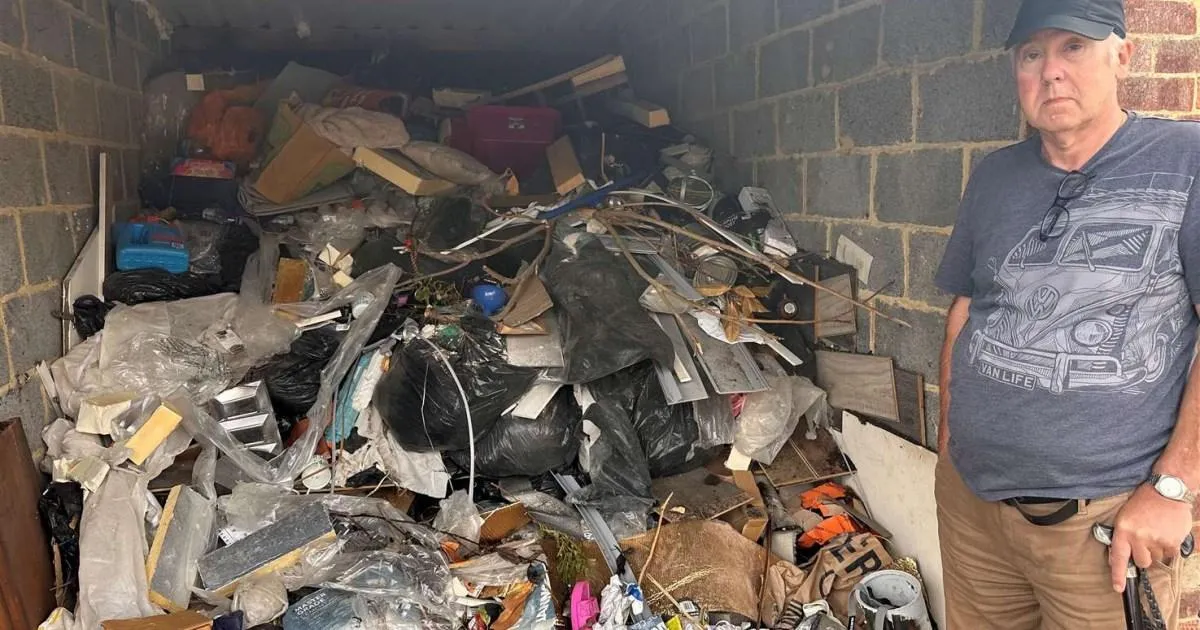
For 30 years, the lock-up garage in Larkfield, Kent, was simply part of the rhythm of Martyn de Young’s life. A retired IT consultant and grandfather of five, he paid £960 a year for the small, unremarkable space, using it to store the accumulated treasures and tools of a lifetime. It was reliable, quiet, and utterly ordinary — until one August Bank Holiday Monday when he turned the key and felt his stomach drop. Instead of his belongings, he was staring at a wall of rubbish. Three tonnes of someone else’s discarded life had been dumped inside: a sofa, torn laminate flooring, builders’ rubble, even a pair of Wellington boots. For a moment, he barely recognised the place. It was not just the shock of the mess; it was the sheer scale. The garage was nearly full, and somewhere underneath it all was his mobility scooter, the very reason he had come that day. Martyn suffers from arthritis in his hip and needed the scooter to get around. But there was no way to reach it, no path through the junk, and no easy way to make sense of how a private lock-up, protected by a door and lock, had become a fly-tipping hotspot. In his words, what followed would become a “depressing tale of woe” — a 14-month ordeal of broken promises, lost communication, and a lingering sense of being forgotten by the very organisation meant to protect his property.
The initial confusion made things even worse. When contractors were finally sent to clear the rubbish, they made an almost farcical mistake: they opened the wrong garage. They hauled out a tonne of waste from someone else’s unit before realising the error, then had to put it all back again. When the right garage was finally identified, a team removed one tonne of rubbish from Martyn’s lock-up, leaving two tonnes still inside. They promised to return to finish the job, but that second visit never happened. Martyn waited, frustrated but patient, assuming the housing association responsible for the garages — Clarion Housing — would sort things out. Then, when a second clearance date was arranged, another problem surfaced: the door and lock had been damaged, perhaps by the fly-tippers themselves or by the removal attempts, and the contractors could not get in. Clarion was supposed to schedule another date. Again, nothing. No phone call, no letter, no explanation. For months, Martyn tried to contact them for updates. He was met with silence. Then, in March, he decided to go down to the garage himself to see if anything had changed. What he found left him stunned: the garage had been completely boarded up, without any prior notice. Clarion later confirmed the boarding was meant to prevent further fly-tipping. But for Martyn, it was just another barrier keeping him away from his own property — his mobility scooter, his family heirlooms, his model railway, and pieces of his past.
The emotional toll of those 14 months cannot be overstated. Martyn is a pensioner, and every pound matters. He was paying rent for a space he could not use, and while he acknowledged that he would have been paying anyway if the garage had been available, the waste of money felt painfully pointless. To add insult to injury, Clarion sent him a notice of a rent increase during this period. That was, in fact, the only communication he received from them for over six months. “It’s just been going on and on and on for 14 months,” he said. “It has affected me; it’s been annoying and I don’t usually get annoyed.” The lack of any explanation, apology, or resolution weighed on him far more than the rubbish itself. He had hoped that by the time a year had passed, someone would have taken responsibility. Instead, he found himself writing letters, making calls, and waiting for replies that never came. He described the whole situation as “gutting and completely unnecessary,” especially because he believes it could have been sorted out right at the beginning, before it ballooned into a bureaucratic nightmare. The absence of CCTV, despite promises that cameras would be installed as a deterrent, only deepened his sense of neglect. He had done nothing wrong, yet he was the one being punished — locked out of his own space, unable to use what he paid for, and left to wonder whether anyone at Clarion was listening at all.
Beyond the practical inconvenience, there was a deeply personal loss. Martyn’s mobility scooter was trapped inside, and because he could not retrieve it, he was forced to borrow an alternative scooter for several months while he waited for a total hip replacement. It was an indignity he did not need. The garage also held irreplaceable items, including a scale model railway layout, family heirlooms, and other belongings that had accumulated over decades. Every time he passed the boarded-up door, he knew all of those things were still inside, buried under rubbish and sealed away from him. It was not just a storage problem; it was a violation of his home, his history, and his sense of security. “As a pensioner, it is quite a hit on my finances for something I am getting no benefit from,” he said. “Frankly, I am very disappointed at the lack of contact I have had from Clarion… it is over six months since I have heard anything, apart from a notice of rent increase!” The anger in his voice is understandable. He had spent 30 years trusting the garage to be safe. That trust had been broken, not just by the anonymous fly-tippers, but by the organisation that was supposed to manage and maintain the property. He wanted a refund for all the rent he had paid since the problem began, a suspension of payments until the garage was usable again, and proper repairs, including a new door and secure lock. He also wanted the remaining waste cleared, and he wanted to be present when it happened so he could identify his belongings before anything else was lost.
Martyn’s story is not just one man’s frustration; it is a reflection of a broader problem. Fly-tipping is a persistent issue in many communities, and the residents of Raven Close had seen it before. Several other garages on the site had also been fly-tipped around the same time, suggesting a pattern of abuse. No one was ever arrested or charged in connection with the dumping, and Martyn believes the rubbish was deposited sometime during the six to eight weeks he had been away from the garage, between July 1 and August 25. The fact that his garage was broken into, filled with waste, and then boarded up without his consent made him feel powerless. He was not asking for special treatment; he was asking for basic accountability. “If they expect me to pay rent, and the other people to pay rent, then they should be looking after the properties to some extent and keeping them secure,” he said. “They had said about putting up CCTV, but they haven’t done that. I’m paying rent for it, so I should be able to use it.” His demands were straightforward: clear the garage, repair the damage, refund his money, and communicate. The lack of urgency, he said, turned an avoidable incident into a months-long ordeal. What should have been a quick cleanup became a drawn-out struggle that left him questioning whether Clarion cared at all about the tenants and residents who depended on them.
Finally, after 14 months of silence, there was a glimmer of resolution. In late October, Clarion Housing reached out to Martyn, and while they still did not explain why it had taken so long, they acknowledged the problem. A spokesperson said the organisation was “sorry for the inconvenience” and confirmed they were working with him to resolve the outstanding issues. They promised to reimburse the rent he had paid for the period the garage had been unusable, arrange for the remaining waste to be cleared with Martyn present so he could identify his belongings, and explore additional security measures for the site, including a controlled-access barrier. The spokesperson also noted that the other affected garages at Raven Close had been cleared and secured to prevent further fly-tipping. For Martyn, the news was welcome, but it came with a lingering bitterness. A year and a half of stress, disappointment, and wasted money could not be undone by a single apology. Still, he hoped that the promised actions would finally happen. He wanted to walk into his garage again, see his scooter and his model railway, and feel that the space was his once more. He wanted the rent refund so he could breathe a little easier as a pensioner on a fixed income. And he wanted Clarion to treat its tenants with the respect they deserved. His story is a reminder that behind every housing complaint, there is a person whose daily life is affected by the silence of those in power. For Martyn, the nightmare may finally be ending, but the memory of being ignored, locked out, and left to wait will not disappear as easily as the rubbish. What he truly wants is simple: a safe, usable garage, a fair refund, and the reassurance that his belongings — and his dignity — have not been permanently buried.