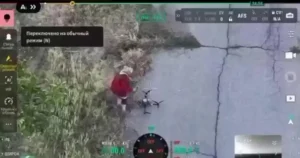


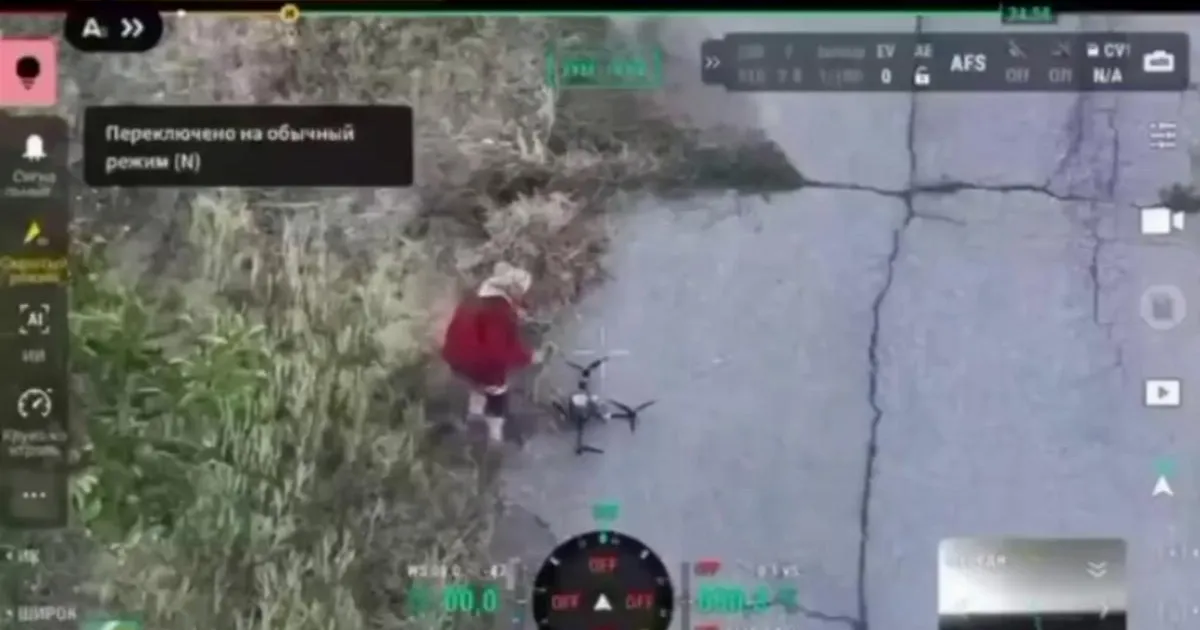
A video circulating online shows an elderly Ukrainian woman in a red coat doing something almost casually heroic. The footage, which has been shared widely, captures her leaning over a downed Russian drone lying on the ground, opening a small compartment, and pulling out a fibre-optic spool. Once that spool is removed, the drone becomes nothing more than dead weight. The operator on the other end loses all control. With the same unhurried calm of someone collecting firewood, she lifts the useless drone and walks away without a second glance. No panic, no celebration, no grand speech. Just a grandmother, a coat, and a small act of defiance that has since been seen by millions. The clip struck a nerve far beyond the battlefield. People called her amazing. One Ukrainian commentator simply wrote, “God bless her.” Another added, with a knowing laugh, “Moral of the story: don’t f**k with Ukrainian grandmas.” It is the kind of moment that has become part of the quiet folklore of this war, a reminder that sometimes the most devastating blows are landed not with missiles, but with bare hands and stubborn nerve.
To understand why the video resonated so deeply, it helps to understand what that woman actually did. Russian drones of this type rely on fibre-optic cables rather than radio signals to be controlled in real time. The cable is stored on a spool inside the drone and unspools as it flies, creating a physical tether between the operator and the weapon. That tether is what makes the drone so difficult to jam, since no radio signal is involved to intercept or disrupt. But it is also the weapon’s greatest vulnerability. Sever the cable, or remove the spool, and the operator suddenly loses video feed, control, and situational awareness. The drone becomes a helpless piece of machinery, unable to guide itself or complete its mission. In a way, the grandmother found the perfect kill switch. She probably didn’t need anyone to explain the technology to her. She may not have known the term “fibre-optic” until later. But her instinct was unmistakeable. She saw a machine with a weak point and she went straight for it. There is something deeply poetic about that, a woman whose life has been shaped by the hardships of the twentieth century dismantling one of the most advanced weapons of the twenty-first with nothing more than her hands. She didn’t attack it with force. She simply understood where the enemy was most fragile.
And she is not alone in this strange, almost folkloric tradition. In 2022, at the very beginning of the war, a story emerged from Kyiv of a grandmother who managed to disable a Russian drone by throwing a jar of pickled tomatoes at it. Her granddaughter, a woman named Elena, confirmed the story at the time, explaining that her grandmother had been smoking on the balcony when she heard the weapon buzzing nearby. Without hesitating, she grabbed the nearest heavy object she could find, a jar of pickled tomatoes and plums, and hurled it at the drone. The improvised projectile struck the drone, took it out of the air, and the grandmother then disposed of the wreckage. In a war full of terrible statistics and sophisticated military equipment, those moments of absurd, unexpected courage stand out. They have turned the Ukrainian grandmother into a symbol of unbreakable resistance. She is the person who has lived through too much to be afraid. She has seen empires rise and fall, endured famines and upheavals, and watched her country go through war after war. She does not scream when she hears an incoming drone. She looks at it with the same expression she might give a stray animal bothering her chickens. And then she does what needs to be done. These stories are not just charming anecdotés. They are a source of morale, a darkly humorous reminder that the enemy can be beaten by ordinary people who refuse to give up.
The timing of the latest story is significant because it comes as concerns grow about a new wave of Russian drone warfare. Reports have revealed that Vladimir Putin has been stockpiling what some military analysts call “unkillable” fibre-optic drones, apparently diverting large numbers of next-generation FPV drones away from the front lines in Ukraine and storing them in rear depots. Western intelligence sources have suggested that the Kremlin may already have amassed up to 130,000 of these weapons, a number that could rise to as many as 200,000 by the end of the summer. These are not ordinary drones. Because they are controlled through physical fibre-optic threads rather than radio signals, they are almost impossible to jam through electronic warfare. A radio-driven drone can be blinded, confused, or disabled by the right frequency; a fibre-optic drone carries its signal with it, safe from interference. That makes them extraordinarily dangerous, particularly for countries that have spent years relying on jamming equipment as a first line of defence. But the grandmother’s viral act is a powerful reminder that no weapon is truly unkillable. Every system has a vulnerability. Every machine has a thread that can be pulled. For all their terrifying sophistication, these weapons still depend on something external, something physical, something that can be cut, removed, or ripped away. The woman in the red coat found that weak point in seconds.
The strategic implications go far beyond one lucky grandmother. Russian military insiders have reportedly suggested that such a massive stockpile of fibre-optic drones could be used in a potential assault against Nato nations, with the Baltic states of Estonia, Latvia, and Lithuania seen as especially vulnerable. The thinking appears to be that a sudden, overwhelming wave of un-jammable drones could paralyse these countries, potentially shocking Europe into submission before Nato has time to mount a full response. The Baltic states possess advanced electronic warfare capabilities, but they do not have Ukraine’s brutal, hard-won experience with mass drone combat. They have not been forced to adapt their tactics overnight under fire. They have not lived through years of constant attacks. According to Russian planners, that difference could be decisive. But what the grandmother’s story shows is that this calculation leaves out something fundamental: people. Wars are not won by weapons alone. They are won by the willingness of ordinary men and women to resist, to improvise, and to laugh in the face of terror. The Baltic grandmothers may not have combat training, but they have something just as valuable. They have memory. They have lived under occupation before. They know what is at stake. And, as their Ukrainian counterparts have shown time and again, they are not going to be the ones who stand by passively while their homes are invaded.
In the end, the image of that woman walking away with a useless drone under her arm is both hilarious and profound. It captures the heart of Ukraine’s resistance in a single frame: a person of quiet strength, armed not with a high-tech weapon but with a sharp mind and a refusal to be scared. The comments, the memes, the laughter, the applause, all of it carries a deep sense of relief and pride. Against all odds, the spirit of resistance is alive and well. This is not just a story about a grandmother and a drone. It is a story about how technology, no matter how advanced, is still vulnerable to the simplest acts of human courage. It is also a reminder that in any war, the most unpredictable element is always the human one. You can build drones with fibre-optic cables, swarm tactics, and artificial intelligence, but you cannot programme for the unpredictable grandmother who decides she’s had enough. She did not ask for permission. She did not wait for instructions. She simply removed the spool, lifted the drone, and walked away, leaving the whole world to wonder exactly who is really in control. So let the Russian army stockpile its unkillable weapons. Let the strategists plan their surprise offensives. Because somewhere in a small Ukrainian yard, or a high-rise balcony, another grandmother is watching. Her hands are on her hips. There is a jar of pickled tomatoes within reach. And she is not afraid. God bless her. Indeed.