

It was the kind of early hour that should have belonged to quiet motorways and sleeping towns, when the world feels suspended and the ordinary rhythms of life pause for a few hours. Just after 1 a.m., along a stretch of Hungary’s M3 motorway near the small settlement of Mezőkeresztes, something went horribly wrong. A bus carrying dozens of Polish holidaymakers was on its way to Nyíregyháza, a city in northeastern Hungary, when disaster struck. The vehicle left the road, tipped over, and slammed into a ditch. In minutes, a trip that had been filled with holiday anticipation became a nightmare of emergency lights, shattered glass, and urgent rescue efforts. By the first official counts, at least twelve people had lost their lives and ten others were being treated in hospitals. The bus was carrying 57 passengers and a driver, all of whom had been heading to their destination full of plans and expectations. When the crash happened, the normal rules of travel were rewritten in a moment of terrible abruptness, leaving a scene anywhere along the European highway route that no one could have prepared for.
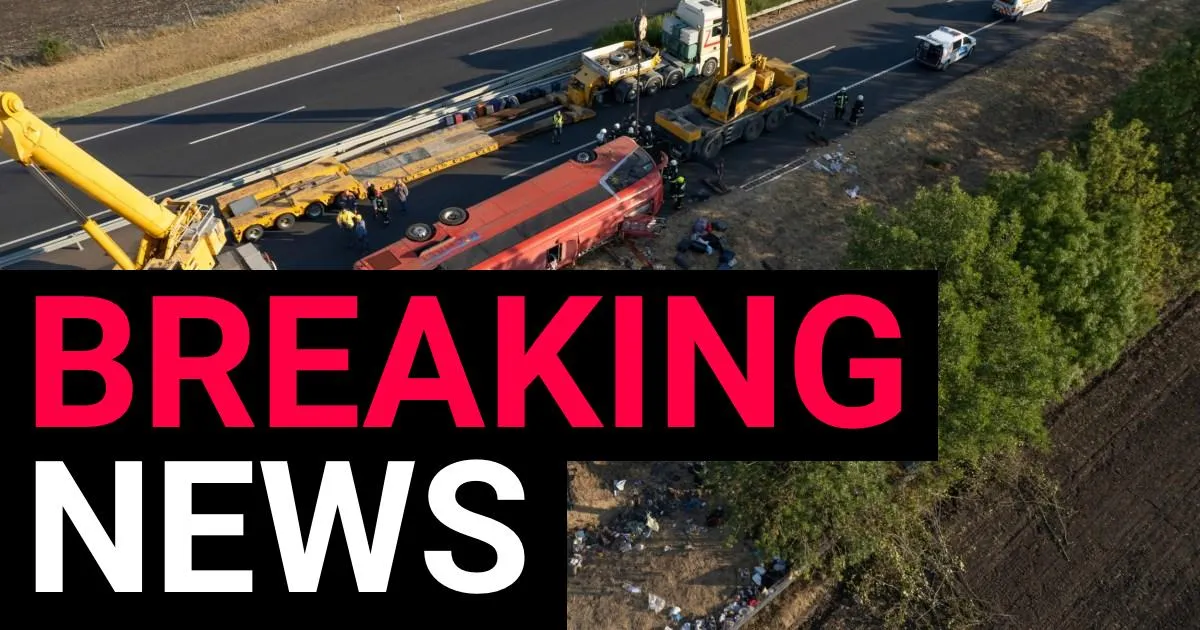
When the grey morning light arrived, the roadside view was almost unbearably surreal. Photographs from the scene showed the mangled shell of the coach lying in a muddy ditch, its body twisted, its windows shattered, and its roof buckled. Personal belongings had spilled out across the grass: suitcases, bags, shoes, the kind of familiar objects that travelers pack with such care and routine, scattered under open sky as evidence of the force of the impact. Emergency teams worked cautiously around the wreckage, and one image showed the bus being lifted from the ditch in an effort to free anyone still trapped or to allow investigators to begin piecing together what had happened. The M3 motorway runs eastward across Hungary, connecting Budapest toward the country’s northeastern regions, and this part of the journey had already been completed by the time the bus approached Mezőkeresesztes. Yet, for reasons that were still being scrutinized, the coach veered off course and crashed into the terrain just beside the asphalt, a quiet stretch of road transformed into a place of mourning. According to a statement from police, the initial suspicion was that the driver may have fallen asleep. That possibility made the tragedy feel all the more delicate, because everyone knows the weight of exhaustion, how fatigue can steal awareness in the very moments when there’s no second chance.
The death of a driver’s alertness, if that is indeed what the investigation ultimately proves, would summarize one of the most haunting fears of the road. The bus was not just carrying anonymous passengers; it was carrying a group of travelers, probably people who knew each other, who had perhaps laughed together, shared snacks, listened to music, slept with their heads resting against windows, and dreamed about what was waiting at the end of the route. Police suspected the driver had lost control because he had fallen asleep, a possibility that has no romance or consolation, only the sobering reminder that every motorway during every long journey is driven on trust. For roughly two hours before the crash, the bus had been part of the quiet flow of night travel. Then the difference between one second of attention and a long descent into a ditch became absolute. The fact that no one could yet answer definitively why the accident occurred made the shock even heavier. Investigators would need to study marks on the road, the state of the coach, the driver’s condition, and the timeline of recent hours. Slovak. But nothing they found would bring back the twelve people, or make the moment less violent for survivors and witnesses riding inside the metal shell when everything slid sideways.
As the magnitude of the destruction became undeniable, officials from both Poland and Hungary moved into crisis mode. In Poland, the accident immediately took on a national dimension, because these were Polish citizens, or residents, traveling on a European route. Polish President Karol Nawrocki released a message on social media, saying that he received the tragic news with deep sorrow, expressing grief for so many Polish compatriots who died on that Hungarian highway. There was a rare carefulness in his words, because leaders often struggle to speak in the presence of such numbers: twelve, ten, fifty-seven, all painfully concrete arithmetic for a disaster. Poland’s Minister of Foreign Affairs, Radosław Sikorski, also stated publicly that a tragic bus accident involving Polish tourists in Hungary had been confirmed, and he promised that consular services were acting. The Polish embassy in Budapest, along with consulates in the region, quickly began coordinating with Hungarian authorities, and a dedicated hotline was set up for families who were terrified to see their names on the news, hoping that their loved ones were not among the victims. In the world, no news is more frightening than a phone call that never comes, and no parent, spouse, child, or friend could digest the reports without thinking of their own intimate person on a bus. The diplomats worked behind the scenes, but the presence of their offers represented the larger love that political institutions could offer in such sorrow.
At the same time, the earth knew the crash site had become a place of national and symbolic importance. The tiny town of Mezőkeresztes, normally anonymous, was suddenly a geographical point of mourning. Rescue workers from several emergency units arrived to the edge of the ditch, police officers helped secure the area, and medics treated the living, while others did what little could be done for the dead. The survivors, wounds in their minds and bodies, were taken to local hospitals, where they would eventually try to contact their families with trembling voices, and, undoubtedly, many of them will struggle to understand an act of such sudden violence. The wreckage remained in view of photographers, and every image broadcast reminded the watchers that what happened was not a script or an abstract headline. There were pieces of wood, plastic, metal, clothing, and an entire universe of memories scattered alongside the asphalt. In the Czech Republic, in Italy, in France, perhaps in every country where people travel by bus from one country to another, the details made people pause and think of the fragile line between a simple trip and a tragic end. The ordeal also visited Hungary, the country that suddenly had to host a tragedy involving guests, and there was no distinction between theirs or ours in grief.
In the aftermath, there is no neat conclusion, no reassuring lesson, as if a nightmare can be safely filed next to statistics. The crash on the M3 motorway will be remembered as a terrible reminder that life is no more than a moving vehicle, and in an instant can be changed. At the scene, all that was left was the hollow shell of a bus, the patient emergency teams, the scattered suitcases, and the memory of at least twelve people who once had names, dreams, destinations, and people waiting for them. The survivors will have to find a way to live with complicated images, the families will enter a different time, the people who lost loved ones will confront long periods of grief, and the governments will investigate, issue statements, and help bury the dead. But in the quiet of the morning after, the greatest meaning of this tragedy is difficult to put into words. Perhaps the best honoring of the wasted lives is to remember that the bus was ordinary things at an ordinary hour, and that it carried ordinary lives, same as all of us, no one prepared to be forever transformed by a ditch at the side of a motorway. While the work continues, the buses will continue to roll and the road will reopen, but the memory of this night and the lives it broke will shape many families forever.