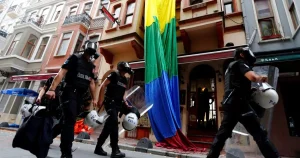


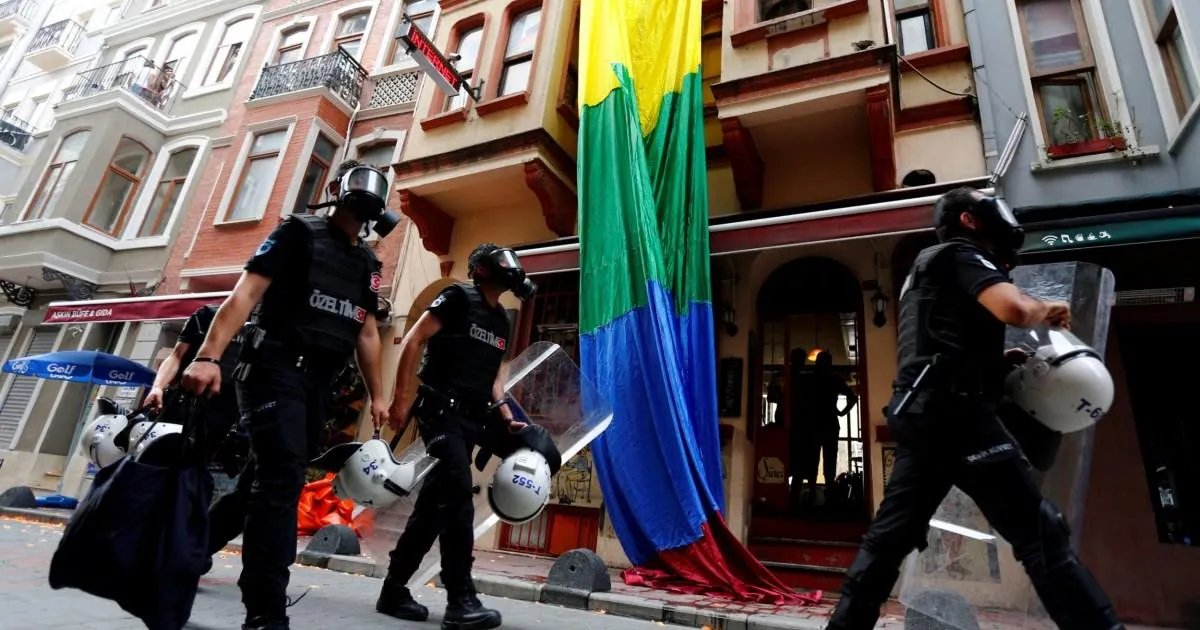
Imagine waking before sunrise to the sound of heavy fists against your door. You have not received any warning, any explanation. You are still half asleep, heart pounding, when the door swings open and police officers flood into your home. In cities across Turkey over the weekend, this became a terrifying reality for dozens of people. Turkish police launched coordinated dawn raids in 12 provinces, sweeping through popular LGBTQ+ hangout spots, bars, cafés, and private homes. The stated goal was a government campaign called “My Family is Safe,” but the targets were not people who had committed any clear crime. They were members of a community. Authorities arrested 162 people in total, including current and former members of prominent LGBTI+ rights organizations. They also blocked websites and social media accounts linked to activists, cutting off the digital spaces where many people find connection and support. For the people caught in these raids, the operation was not abstract. It was a group of strangers going through their phones, their computers, their private messages, looking for something that could be used against them. It was being handcuffed and taken away in front of their neighbors. Some were pulled from their beds, others from the streets outside familiar meeting places, and in the chaos, friends and family members did not know where they were being taken or when they would see them again. It was the sudden realization that the government has decided that your identity, your relationships, and your community are a threat to society. This is what state power looks like when it is turned against a vulnerable group: it does not need to prove guilt; it only needs to create fear.
The official announcements came rapidly, and they were designed to portray the operation as a legitimate legal sweep. Turkey’s Justice Minister Akin Gurlek said that proceedings had begun against 162 suspects, as well as nine associations and 13 businesses. The charges were broad and, for many observers, suspiciously vague: pornography, producing obscene content, and a variety of other accusations including forming a criminal organization, drug use, prostitution, and obscenity. These are heavy charges with serious consequences, yet they have so far been presented without any clear evidence connecting them to the alleged actions of the detainees. In Istanbul, the chief prosecutor’s office said police detained 26 people and seized drugs, digital equipment, smuggled alcohol, and a firearm. In Ankara, prosecutors said 21 additional people were arrested as part of an investigation into Kaos GL, one of the oldest and largest LGBTI+ rights organizations in Turkey. The raids were conducted simultaneously, a sign of careful coordination, and they appeared designed not just to make arrests but to make a point. Kaos GL itself reported that at least 50 activists had been detained in total, with 10 of them taken into custody during raids on their homes. The organization said authorities had blocked access to dozens of websites and social media accounts linked to LGBTI+ organizations and activists. This digital censorship is not a minor detail. For many LGBTI+ people in Turkey, especially those living outside big cities, the internet is the only safe place to learn about their identity, meet others, and find support. By severing those connections, the state is attempting to isolate people and make them afraid to reach out. The use of unrelated charges such as drugs and firearms is especially alarming. Such accusations are difficult to defend against and can keep people in pre-trial detention for months, even if they are ultimately found innocent. Human rights groups see this as a familiar pattern in Turkey: political opponents are not charged for their activism, but for crimes they almost certainly did not commit, twisting the law to serve a political agenda.
To understand this crackdown, it is necessary to understand the political climate in which it happened. President Recep Tayyip Erdogan has made no secret of his determination to increase Turkey’s birth rate, which has been falling for years. He has launched what he calls a “Decade of Family and Population,” and the “My Family is Safe” campaign is part of that broader effort. In speeches, he has repeatedly emphasized the importance of the traditional family, portraying it as the foundation of the nation and warning that Turkey must have more children to remain strong. His government has introduced pro-natalist policies, marriage incentives, and public campaigns designed to encourage childbearing, all built on the belief that the only proper household is a heterosexual one. In this worldview, LGBTI+ people are not just different; they are a threat to national survival. Erdogan has publicly referred to LGBTQ people as “perverts” and has blamed them for the country’s declining birth rates. This is not just rhetoric. It creates the moral framework for actions like the weekend raids. The government tells the public that it is protecting children and families from a dangerous influence. Prosecutors have claimed there is evidence that children were being inappropriately influenced on issues related to sexual orientation and gender identity. But no such evidence has been made public, and rights groups have dismissed the claims as a moral panic. It is worth remembering that same-sex relationships are not illegal in Turkey. Yet homophobia is widespread. LGBTI+ people face discrimination in employment and housing, harassment in public, violence on the streets, and hostile coverage in state-aligned media. The government’s campaign makes this climate worse. When the president calls a community “perverts” and then sends police to raid their homes and organizations, he is sending a clear message to every ordinary citizen: these people are enemies, and you are free to treat them as such. The raids are therefore not an isolated event. They are the latest expression of a deliberate strategy to erase LGBTI+ people from public life and force everyone into a single, narrow model of family.
Turkey’s Human Rights Association responded with strong language. In a statement, it said: “This is not a judicial investigation; it is a political operation aimed at forcing society into a monolithic family model and purging LGBTI+ and independent civil society under the guise of protecting the family and children.” The association also warned that including unrelated charges such as “forming a criminal organization,” “drugs,” “prostitution,” and “obscenity” served not to reveal the truth but to incriminate an entire community. On social media, it added: “The real name of this operation is not ‘My Family is Safe’; it is state-led discrimination, politics of fear and the dismantling of civil society.” These are strong words, but they reflect the reality of what is happening. The raids were not aimed at solving crimes. They were aimed at dismantling organizations that have spent years supporting LGBTI+ people, documenting human rights violations, and demanding equal treatment. By charging these organizations with crimes like “pornography” or “obscenity,” the government is trying to criminalize their very existence. There were also reports that some of those detained were initially denied access to lawyers, leaving their families in excruciating uncertainty. The accusation about children being influenced is perhaps the most damaging. In a conservative society, this kind of claim can ruin a person’s reputation before a trial even begins. It paints LGBTI+ people as predators and turns the public against them. It also makes parents fear their own children’s questions, and it tells young people questioning their identity that they are abnormal and dangerous. The people detained in these raids are not criminals. They are activists, artists, students, healthcare workers, and neighbors. They are people who built community in a country that increasingly treats their existence as a problem. Arresting them under the banner of protecting families does not make families safer. It makes families with LGBTI+ members more afraid, and it sends a message to every young person in Turkey that there is no place for them if they refuse to hide.
The international community reacted with alarm. Nacho Sanchez Amor, the European Parliament’s Turkey rapporteur, called the crackdown a “shocking escalation” of repression. He said: “This imposition of a moral agenda is a blatant violation of fundamental rights and Turkey’s international commitments taking the country down a dark path.” Those words carry weight because Turkey is a candidate for European Union membership and is party to international agreements that protect freedom of assembly, expression, and association. The weekend raids are a direct challenge to those commitments. But the danger is not limited to the LGBTI+ community. If the Turkish government can raid the offices and homes of activists because it disagrees with their ideas, then every independent organization is at risk. Women’s rights groups, environmental movements, journalists, and human rights defenders should all be paying attention. The “My Family is Safe” campaign may sound like a peaceful slogan, but it is being used as a weapon against civil society. In a country where independent institutions are already under intense pressure, these arrests signal that organizing for any cause the government dislikes will come with consequences. The European Parliament’s response, while welcome, will not immediately release the detainees or restore the blocked websites. But it matters for another reason. It tells the people whose lives were turned upside down this weekend that they are not alone. It reminds them that the world is watching, and that the struggle they are fighting is not only about LGBTI+ rights. It is about the right to exist openly, to speak freely, and to gather peacefully, rights that should belong to everyone. International attention cannot replace safety, but it can provide some hope in a moment when hope feels scarce.
Despite the brutality of the crackdown, the LGBTI+ community in Turkey has shown remarkable resilience. In past years, Pride marches and transgender rights demonstrations have drawn large crowds to the streets of Istanbul, even after they were banned. The government has tried to silence those movements, but they have not disappeared. They have adapted, supporting each other through underground networks, online platforms, and the courage of individual activists. This latest operation is a harsh reminder of how powerful the state can be when it decides to target a group. But it is also a sign of weakness. A government that is truly confident in its ideas does not need to raid homes at dawn and block websites. It does not need to invent criminal conspiracies around organizations that provide legal advice, healthcare referrals, and cultural events. The human need behind this struggle is simple. People want to love who they love. They want to be recognized for who they are. They want to live without constantly looking over their shoulders. No police raid can destroy that need. But the raids do make life harder. They push people into hiding. They drain resources that could be used for support and advocacy. They create an atmosphere of fear in which even going to a café with friends can feel dangerous. Community organizers say they will continue their work anyway, because the alternative is to accept invisibility, and that is something they have refused for years. The international community must do more than issue statements. It should provide emergency funding for legal defense, offer safe migration pathways for those at immediate risk, and keep pressuring the Turkish government to release the detainees and drop the charges. Until that happens, the people arrested this weekend remain in custody, their futures uncertain, their names now part of a political battle they did not choose. But they are not enemies. They are human beings who dared to believe that another way of living is possible. That belief is not a crime, and no amount of state violence can make it true.