

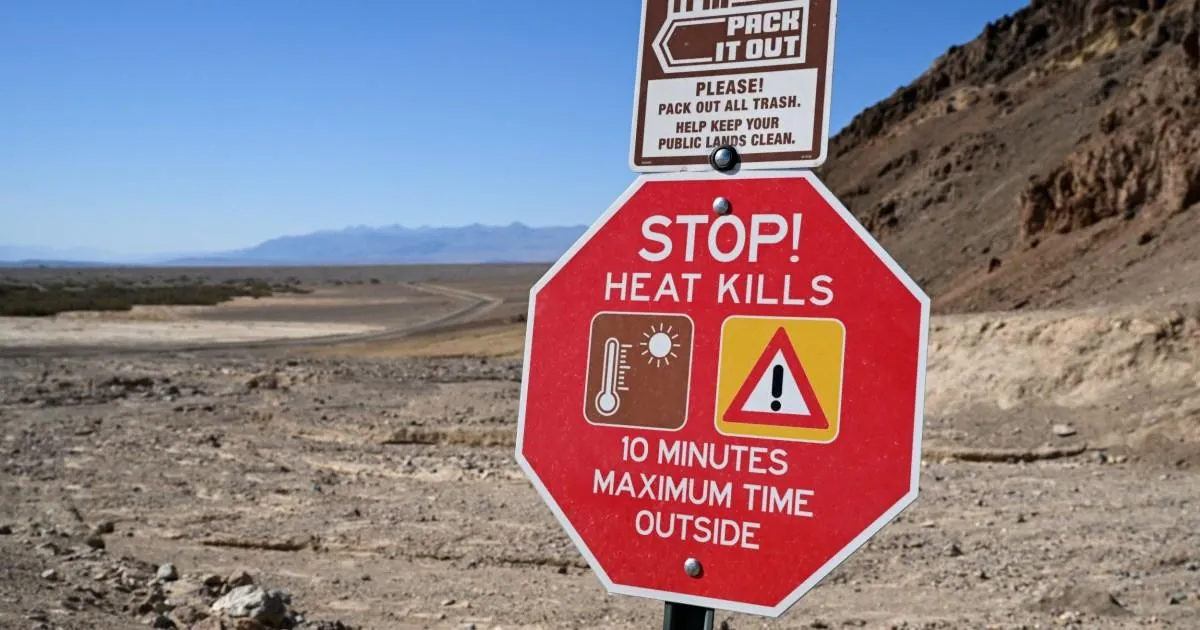
Death Valley is one of those names that sounds like a warning before you ever arrive. It is a vast, beautiful, savage landscape where temperatures climb to levels that seem impossible for life. On Monday, that warning became reality for Pierre Michel Formosa, a 68-year-old French tourist whose visit to the California park ended in tragedy. Formosa was traveling with a companion when their vehicle became stuck in mud in the middle of the desert, not far from one of the park’s main routes but still dangerously far from safety. The temperature had reached 47°C, and the sun poured down on a landscape with almost no shade, no water, and no mercy. At that moment, the only thing they could do was try to reach help on foot. In ordinary circumstances, a broken-down vehicle is an inconvenience. In Death Valley, it can be the beginning of a nightmare. They left the car and began walking toward Badwater Road, which connects the park’s most famous salt flats to the outside world. They did not know, as so many visitors before them have not known, just how quickly the desert can strip away a person’s strength. The heat does not announce itself; it just presses down until the body begins to fail. It starts with dizziness, then confusion, then the muscles give up. Formosa managed to cover about 1.3 miles before his body stopped cooperating. His companion faced the cruelest choice: stay with a friend who could no longer walk, or keep going and hope to save them both. That choice, made in the middle of a furnace, would shape the rest of another person’s life forever.
At around 2pm, the companion reached Badwater Road. Somehow, step after step, that person had made it. The companion flagged down a passing driver, and the alarm was raised. But for Formosa, rescue arrived too late. The distance he had covered was not great by any normal measure—1.3 miles is a walk many people do casually in a park. In 47°C heat, with no shade and no water, it becomes an expedition with almost no margin for error. The companion had pushed on all the way to the road. Survival may have depended on luck, on physical condition, on the almost inhuman determination that takes over when a life is at stake. The image of that walk is hard to shake: two people, perhaps friends, perhaps family, leaving behind their stranded vehicle because they had no other choice. They must have been hopeful at first. The road was not that far. Someone would come. But as the heat wrapped around them and the sun beat down, hope began to shrink. Formosa stopped. The companion must have known that staying meant dying together. That person left a friend behind and kept moving, one foot in front of the other, carrying the weight of that decision. When the companion finally reached the road and saw a vehicle approach, relief and horror must have collided. They had made it. Now they had to send rescuers back for someone left behind. That is not a story anyone expects to carry with them from a holiday.
Search teams were quick to respond. Park rangers were joined by a California Highway Patrol helicopter, and they began scanning the vast, unforgiving terrain. But the desert is enormous, and a person lying still in it is almost impossible to see. The sun moved across the sky, the heat continued to shimmer off the ground, and every minute mattered. Later that afternoon, they found Formosa’s body about 1.5 miles from Badwater Road. He was gone. The National Park Service released the news with the kind of measured language that officials use when they hope to prevent another tragedy. Death Valley National Park Superintendent Mike Reynolds expressed his condolences to Formosa’s family and said, “This is a heartbreaking reminder of how quickly conditions here can turn dangerous.” Those words are true, but they cannot begin to cover the grief. Somewhere in France, a family learned they would never see Pierre again. A friend who walked out of the desert alive will spend the rest of their life replaying the moment they decided to keep going. A rescue team, used to the worst the park can offer, once again felt the weight of a life that could not be saved. There is no warning that feels adequate when it comes too late. The park had issued no casual shrug; the National Weather Service had already warned of extreme heat, and temperatures were forecast to reach 48°C the following day. But warnings are easy to overlook when a place is so beautiful and so remote. Death Valley does not look like a killer. It looks like a postcard.
Death Valley’s record of danger is not a secret. Between 2007 and 2023, the park recorded 62 deaths. Some are vehicle accidents, some are medical emergencies, but many are heat-related—people who underestimate what the conditions can do to the human body. At 47°C, the ground radiates heat upward, so a person standing in the sun is effectively being cooked from both sides. Sweating stops being enough. The body’s core temperature climbs, the heart pounds, the mind clouds. Walking 1.3 miles under those conditions is not a stroll; it can be a death sentence. This is why park officials repeat the same advice over and over: stay on paved roads when temperatures are extreme, carry plenty of water, bring satellite phones and emergency beacons. They know that tourists come from all over the world to see a place unlike any other, and they also know that many are not prepared for what that place can do. Mike Reynolds put it as plainly as possible: “Death Valley is an extraordinary place, but its heat, distances, and remoteness can be dangerous, regardless of experience.” Even the most seasoned hikers can be caught out. Even people who have visited before can make a single mistake. A car stuck in the mud is not supposed to be deadly. A breakdown is supposed to be an inconvenience. But in Death Valley, ordinary problems turn into emergencies with terrible speed. The difference between a safe trip and a deadly one can be a few litres of water, a charged phone, or the decision to turn back before it is too late.
Pierre Michel Formosa’s death is not just a statistic. It is a reminder that adventure has a boundary, and nature never signs a contract with visitors. Maybe he and his companion set out believing that help was close. Maybe they thought they could walk to the road in twenty minutes. In many parts of the world, they would have been right. But Death Valley is not many parts of the world. The park service’s guidance is designed for moments exactly like this: if your car breaks down, stay with it. A vehicle is a shelter; it is easier for rescuers to spot than a human body, and it offers some shade and a base. Wandering away on foot, especially in extreme heat, is almost always the wrong choice. Yet it is also the most human choice. The instinct to seek help, to do something, to move toward safety, can overpower reason. The companion who survived had no way of knowing what would happen. That person made the same decision that anyone might make, and it saved their life. It also cost more than anyone should have to pay. The thought of Formosa’s last moments is unbearable: alone on the desert floor, perhaps under a blazing sun, waiting for a rescue that never came. Help had been so close, in miles. It was, in every other way, too far. The heat, the silence, the emptiness of the landscape around him—none of it would have shown any mercy. He was a tourist, a visitor, someone who probably came to see one of the most extraordinary places on Earth. His name now belongs to a story that is told with caution, but for his loved ones it is not a lesson or a warning. It is a loss.
Death Valley has always been a land of extremes. In 2022, the desert flipped from one kind of danger to another when a near-record downpour caused flash flooding across the area. Nearly 1,000 people were stranded as water rushed through canyons and across roads, forcing a temporary closure of the park. It was a violent reminder that even the driest place on Earth can unleash deadly weather. Rain that would be a nuisance in most places becomes a catastrophe when the ground cannot absorb it. Mud, ironically, was what trapped Formosa’s car. Mud was the small, almost mundane event that set in motion a deadly chain. It did not look like a threat. It simply held the vehicle fast, and then the desert did the rest. People often imagine Death Valley as a static world of sand and rock, but it is never still. Its beauty is tied to its danger, and its danger does not follow a schedule. A tourist can arrive on a day of impossible heat and leave three days later after a flood. Or they can drive off a paved road and into a patch of mud and never make it home. This is the lesson that officials, rescuers, and survivors try to pass on, and it is a cruel one. The desert does not hate anyone; it simply does not care. For a French family, the name Pierre Michel Formosa is not a case study or a headline. It is a husband, a father, a brother, a friend. It is a trip that should have been a story of adventure and ended as a story of loss. The rest of Death Valley will continue to dazzle visitors with its colors, its silence, and its impossible scale. But behind every beautiful view is a warning written in heat, distance, and time. The best way to honor the man who died on that desolate stretch of desert is to remember that the desert is not a place to conquer. It is a place to survive, and only with humility.