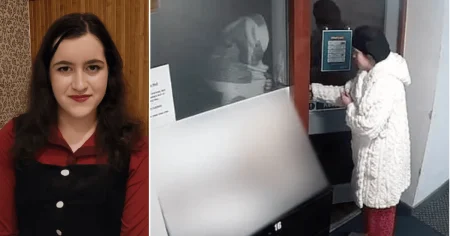


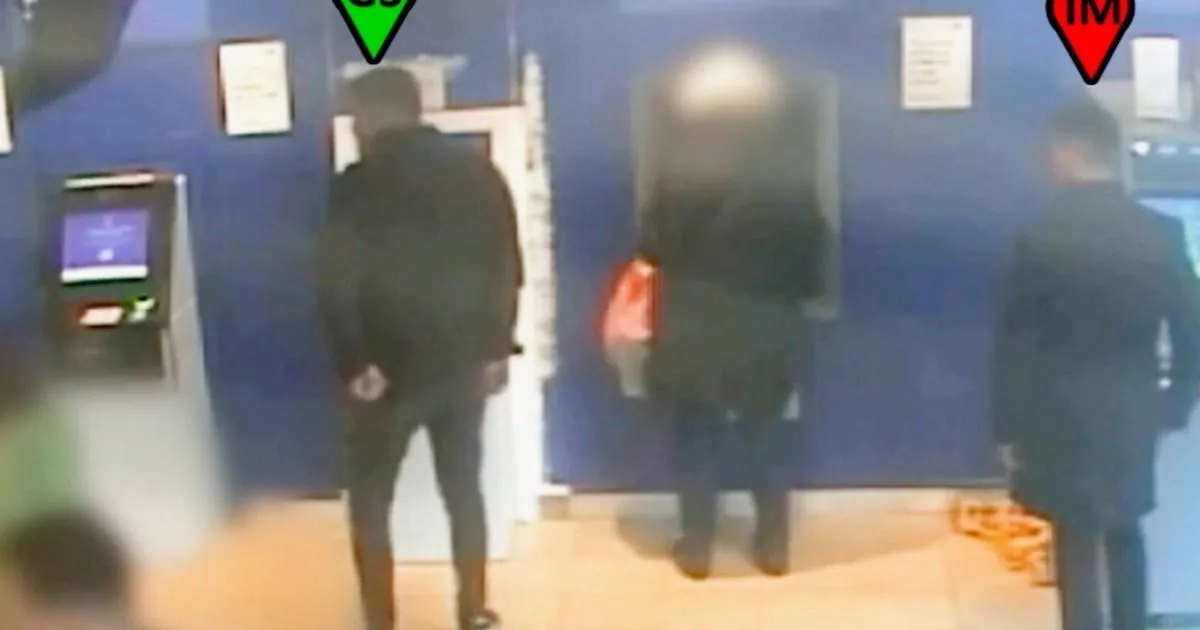
Imagine walking into your local bank branch on an ordinary weekday, perhaps to collect a little cash for the week ahead. You are older, perhaps a little unsteady on your feet, and the cash machine is familiar—a routine errand you have completed a hundred times before. Then you feel a light tap on your shoulder. A stranger smiles and points to a banknote on the floor. “Is this yours?” he asks, his voice kind and concerned. In that brief moment of confusion and gratitude, your world is quietly taken apart. This was the cruel and calculated trick used by three Romanian men to steal more than £40,000 from pensioners and other vulnerable bank customers across England. CCTV footage captured the moment Ionut Matei, 40, Vasile Ciubotaru, 45, and Ramonel Mandache, 51, worked as a team inside Halifax and Lloyds Bank branches. The first man would drop a banknote behind an unsuspecting victim, then tap them on the shoulder and ask if they had dropped the money. While the victim’s attention was on the floor and their hands were busy fumbling for their own wallet or purse, a second thief—who had quietly memorised the victim’s card number—would step forward and brazenly swap the real bank card for a similar-looking one. The victim would retrieve what they thought was their own card and leave, unaware that they had just handed their financial life to a gang of professional fraudsters. Police said the victims did not realise they had been targeted until long after they had walked away from the machine, and sometimes not until days or weeks later, when they checked their bank statements and found their accounts drained.
The gang’s method was simple, but devastatingly effective, and it relied on the oldest human instinct of all: helping someone who appears to be in need. The men deliberately operated inside bank branches, not on the street, because they knew that people feel safer in those spaces. They targeted the elderly and the vulnerable, people who might be slower to react, less likely to notice a swapped card, and more likely to trust a polite stranger. The offences took place between October 2024 and August 2026, and the gang travelled across the country to carry out their scam, striking in Cheshire, Staffordshire, Nottinghamshire, Greater Manchester, South Yorkshire and Kent. Their victims were ordinary people, many of them pensioners, who had gone to a bank to withdraw money for groceries, bills, or perhaps to treat a grandchild. The gang watched them carefully, observing as they typed in their PINs, waiting for the perfect moment to strike. One of the men would drop a banknote on the floor behind the chosen victim, then tap them on the shoulder to ask if they had dropped it. It was a tiny act of theatre, but it worked again and again. While the victim was distracted, another member of the gang would swap their card with a similar-looking one. The offenders then used the stolen card and PIN to make cash withdrawals and purchases, sometimes in excess of thousands of pounds, leaving their victims devastated and struggling to understand how they had been so easily deceived. For the most affected victim, the loss was a staggering £11,100, which disappeared over a period of almost two weeks before they finally discovered they had become the target of fraud. By then, the gang had moved on, ready to find their next victim in another town, another bank, another innocent moment of kindness.
The victims of this scam were not just robbed of money; they were robbed of their confidence, their sense of safety, and in many cases, their independence. For an elderly person, a bank card is not just a piece of plastic—it is the key to their pension, their savings, their ability to pay for care, to buy food, to live with dignity. To have that taken away by strangers who smiled at them and pretended to help is a betrayal that leaves deep psychological scars. Detective Sergeant Stephanie Bland, the Senior Investigating Officer for Operation Rages, said that alongside the significant financial losses, the gang’s actions had a “lasting impact” on the victims. That phrase, “lasting impact,” is important. It speaks to the sleepless nights, the anxiety every time the phone rings or the post arrives, the embarrassment of having to tell family members that they were tricked, and the fear of going out alone. Many victims likely replayed the moment over and over in their minds, wondering how they could have been so easily fooled, even though the fault lay entirely with the criminals who exploited their goodwill. The gang did not use violence or threats; they used charm and deceit, which can be even more damaging. They chose their victims carefully, targeting those who might not shout for help, who might not know how to report a crime online, who might simply be too ashamed to tell anyone what had happened. In doing so, they betrayed not only the individuals they stole from, but the very trust that holds communities together.
Operation Rages was a nationwide theft and fraud investigation led by Cheshire Police, and it involved offences that took place in Warrington and Widnes as well as many other areas across the country. The investigation was complex, spanning multiple police force areas and requiring detectives to piece together CCTV footage, bank records, and witness statements from dozens of victims. Detective Sergeant Bland described the operation as a “complex investigation spanning multiple force areas,” but she also made clear that the police were determined to pursue the gang no matter where their crimes had taken them. “In policing there are no borders,” she said. “And even though a majority of these offences occurred outside of Cheshire, our officers were determined to identify those responsible for these crimes, bring them before the courts, and provide reassurance to victims and the wider public.” That determination paid off. On Monday, at Liverpool Crown Court, the three men were sentenced after pleading guilty to conspiracy to steal and conspiracy to commit fraud by false representation. Their combined sentences totalled more than 13 years in prison. Matei, who had no fixed abode, was jailed for five years and six months, and was also sentenced for knowingly entering the United Kingdom in breach of a deportation order. Ciubotaru, of Balfour Road, Ilford, was sentenced to four years and eight months. Mandache, of Henniker Gardens, East Ham, London, received three years. For the victims, the sentences offered some measure of justice, though no amount of prison time could fully undo the damage caused.
The court hearing marked the end of a long and painstaking investigation, but it also served as a stark reminder of how vulnerable people can be to crimes that exploit their trust. The gang were not sophisticated hackers breaking into computer systems from a dark room; they were face-to-face con artists who used human weakness as their weapon. They understood that most people, especially older people, are polite and helpful, and they used that against them. They chose bank branches because they knew their victims would be holding cash and cards, and they knew that the moment of distraction would be enough. The fact that they were able to steal more than £40,000 from victims across six different regions of England shows how brazen they were, and how often their trick worked. It also highlights the importance of raising awareness about such scams, so that potential victims can recognise the signs and protect themselves. Police have urged people, particularly those with elderly relatives or neighbours, to talk about these crimes and to remind one another that no stranger in a bank needs help checking a banknote on the floor. It is a sad reality that kindness can be weaponised, but by talking about it, communities can take away some of the power that con artists rely on.
In the end, this is a story about more than just stolen money. It is about the quiet resilience of people who have worked hard all their lives, only to be targeted in their later years by those who saw them as nothing more than an opportunity. It is about the detectives who refused to give up, who followed the trail across county lines and brought a gang of fraudsters to justice. And it is about the uncomfortable truth that, in a world where we are taught to be helpful and polite, there are those who will use our own goodness against us. The victims of this scam will carry the memory of that moment in the bank with them for a long time, but they are not to blame. The blame rests entirely with the three men who now face years behind bars. As they begin their sentences, perhaps they will have time to think about the pensioners they deceived, the trust they betrayed, and the lives they damaged. The money they stole may never be recovered, but the sentences handed down at Liverpool Crown Court send a clear message: this kind of cruelty will not be tolerated. For the rest of us, the lesson is to look out for one another, to share these stories, and to remember that a little caution is not the same as unkindness. The banknote on the floor may be real, but the helpful stranger may not be.