

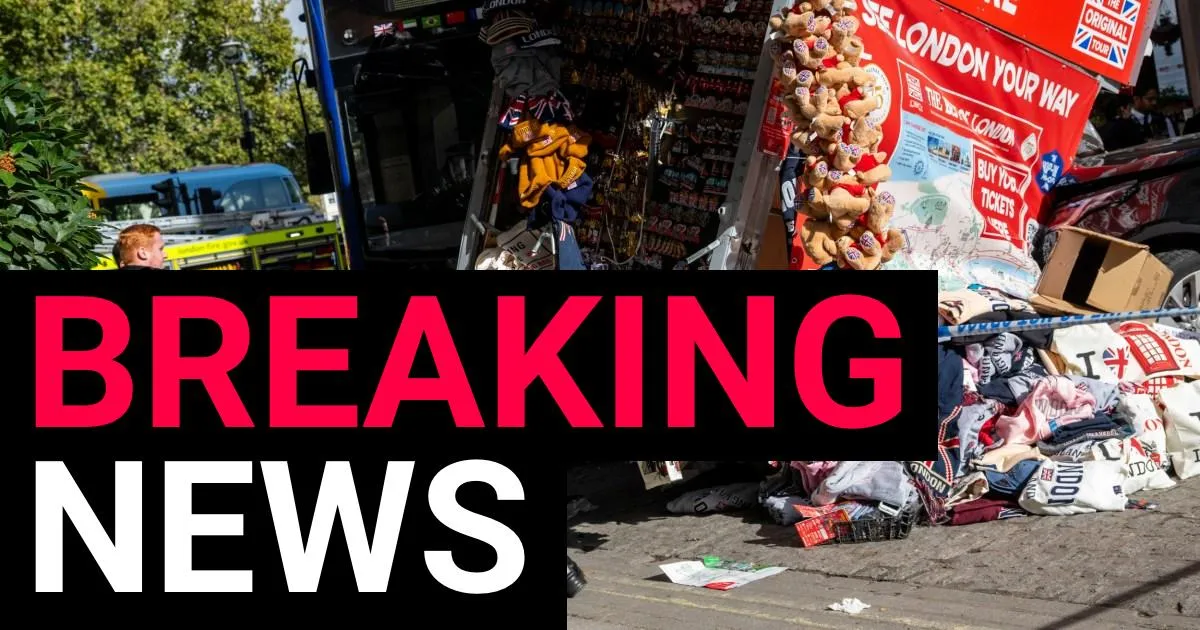
On a bright Thursday afternoon, one of London’s most famous sightseeing spots became the scene of an unexpected and alarming accident. At around 12:30pm, an open-top tour bus operated by Golden Tours ploughed into a souvenir stand on the corner of Spring Gardens and Trafalgar Square, a location that is normally packed with visitors snapping photos, checking maps, and soaking in the historic atmosphere. The bus, which had been carrying tourists on a leisurely open-air journey through the capital, first struck a set of traffic lights before continuing into the small kiosk that sold London-themed keepsakes. In a matter of seconds, the street was strewn with key rings, tote bags, and other souvenirs, scattering colourful reminders of the city across the pavement. A black 4×4 was also reportedly involved in the collision, adding another layer of confusion and concern to an already chaotic scene. Yet despite the violence of the impact and the wreckage left behind, there were no reports of any injuries. For everyone present, the moment must have felt surreal—one instant the tourists were enjoying the sights, the next they were witnessing a bus tangled in the remnants of a street vendor’s livelihood. The incident served as a sharp reminder that even the most familiar corners of a bustling city can be transformed into a scene of drama in an instant.
Eyewitnesses described a sequence of events that unfolded quickly and without warning. According to those who were near the corner of Spring Gardens and Trafalgar Square, the tour bus crashed into the traffic lights first, then ploughed into the souvenir stall, which also sold tickets for other sightseeing operators. The stand, a modest but important fixture for tourists looking to plan their next excursion, was left severely damaged, its displays and stock scattered across the road. A black 4×4 also hit the stand, suggesting that the incident involved a complicated chain of collisions rather than a single isolated mistake. People in the area rushed to see if anyone needed help, while others stood back in disbelief, watching as firefighters and police arrived on the scene. The emergency response was swift: fire engines, a fire rescue unit, and police officers were soon stationed around Trafalgar Square, managing traffic and cordoning off the affected area. The immediate priority was to ensure that everyone was safe and that no one was trapped or injured. Photographs taken at the scene showed the aftermath in vivid detail—the damaged bus, the collapsed stand, and the litter of tourist merchandise lying on the ground. It was a scene that could have been much worse, and the fact that no injuries were reported was met with relief by onlookers and authorities alike.
Golden Tours, the company behind the open-top bus, responded quickly with a public statement acknowledging the incident. A spokesperson said that the company was aware of the accident near Trafalgar Square and was investigating the circumstances surrounding it. The statement emphasised that the wellbeing and safety of passengers, staff, and members of the public were always the company’s highest priority. The spokesperson also noted that incidents of this nature were extremely rare, and that Golden Tours took all matters relating to safety very seriously. For a company whose business depends on carrying thousands of visitors through London’s busy streets each year, such an event is both a logistical challenge and a reputational concern. The immediate concern, however, was not about image but about the people involved. Passengers on the bus must have been shaken by the sudden impact, as their pleasant journey through the city turned into an unexpected stop. The stand’s operator, too, faced the sight of their goods and equipment damaged or destroyed in a matter of moments. Golden Tours expressed no immediate conclusions about what had caused the collision, indicating that a full investigation would be needed to understand exactly what went wrong. Their careful, measured language reflected a company wanting to reassure the public that safety was paramount, while also avoiding speculation before all the facts were known.
The London Fire Brigade also provided details of their response to the incident. A spokesperson confirmed that firefighters were in attendance at a road traffic collision on Spring Gardens in Charing Cross, the area adjacent to Trafalgar Square. The Brigade reported that one tourist bus had been in collision with street furniture, a technical description that captured the damage done to the traffic lights and the souvenir stand. Firefighters were called at 12:32pm, just minutes after the crash occurred, and two fire engines plus a Fire Rescue Unit were dispatched from fire stations in Euston, Paddington, and Chelsea. The presence of a specialist rescue unit underscored the seriousness with which the emergency services treated the situation, even though it ultimately became clear that no one had been seriously hurt. The firefighters’ role was likely focused on making the scene safe, checking the buses for any fuel leaks or structural hazards, and ensuring that there was no risk of fire. They worked alongside police officers who managed the flow of traffic and began the task of investigating how the collision had happened. For the emergency crews, this was another routine but serious callout, one of many that occur across London every day. But for those directly affected, it was anything but routine. The intersection of Spring Gardens and Trafalgar Square, usually a place of gentle tourism and busy pedestrian flow, had become a work site, with flashing lights, tape, and the careful coordination of crews in uniform.
The wider significance of the incident lies in its location. Trafalgar Square is not just a crossroads in central London; it is one of the most visited and recognisable public spaces in the world, drawing crowds of tourists, school groups, street performers, and office workers throughout the day. The souvenir stand that was struck was not merely a business; it was part of the texture of the area, a small outpost of tourism where visitors could pick up a memento of their trip to the capital. Its damage represents a disruption to the everyday rhythm of the city. Incidents like this also raise questions about the safety of street furniture and temporary structures in areas where heavy vehicles and pedestrians mix. London’s roads are notoriously busy, and tour buses, with their size and limited visibility, require particular care when navigating narrow streets and tight corners. While the exact cause of this crash had yet to be determined, the event served as a reminder of how quickly things can go wrong, even in familiar surroundings. For the vendors who operate in such locations, there is an inherent vulnerability; their stands are exposed to the elements and to the movements of traffic, and they rely on the assumption that drivers will remain in control. The fact that a 4×4 was also involved suggests that the chain of events was more complex than a simple single-vehicle accident, and investigators would have had to piece together exactly how the vehicles and the stand came to be damaged.
In the aftermath of the crash, the most remarkable fact remains that nobody was injured. In a scenario that could easily have involved pedestrians, passengers, or the vendor being struck, the outcome was mercifully free of casualties. The scattered souvenirs, the damaged bus, and the dented stand will, in time, be repaired or replaced, and the street will return to its usual bustle. But for the people who witnessed the event, the memory of the bus ploughing into the stand is likely to linger. It is the kind of incident that makes people pause and think about the fragility of ordinary moments. A tourist’s holiday snap, a quick cup of coffee, a few minutes spent browsing a souvenir stand—all of these can be interrupted in an instant by an unexpected turn. Golden Tours’ promise to investigate and to prioritise safety will be tested in the days and weeks ahead, as will the broader commitment of the city to protecting pedestrians and street traders. There will be questions about road design, driver training, vehicle maintenance, and the placement of temporary structures. These are not glamorous topics, but they matter deeply in a city where millions of people move through the streets every day. For now, the relief that no one was hurt is the dominant emotion, and the resilient spirit of Londoners and visitors alike will ensure that the corner near Trafalgar Square soon returns to normal. The incident will be recorded as a curious headline, a moment of drama in a city that has seen far worse, and a reminder that safety in public spaces is a shared and ongoing responsibility. In the end, the story is less about the crash itself and more about the community of people who came together in its wake—emergency workers, bystanders, and the businesses affected—all finding a way to move forward.