



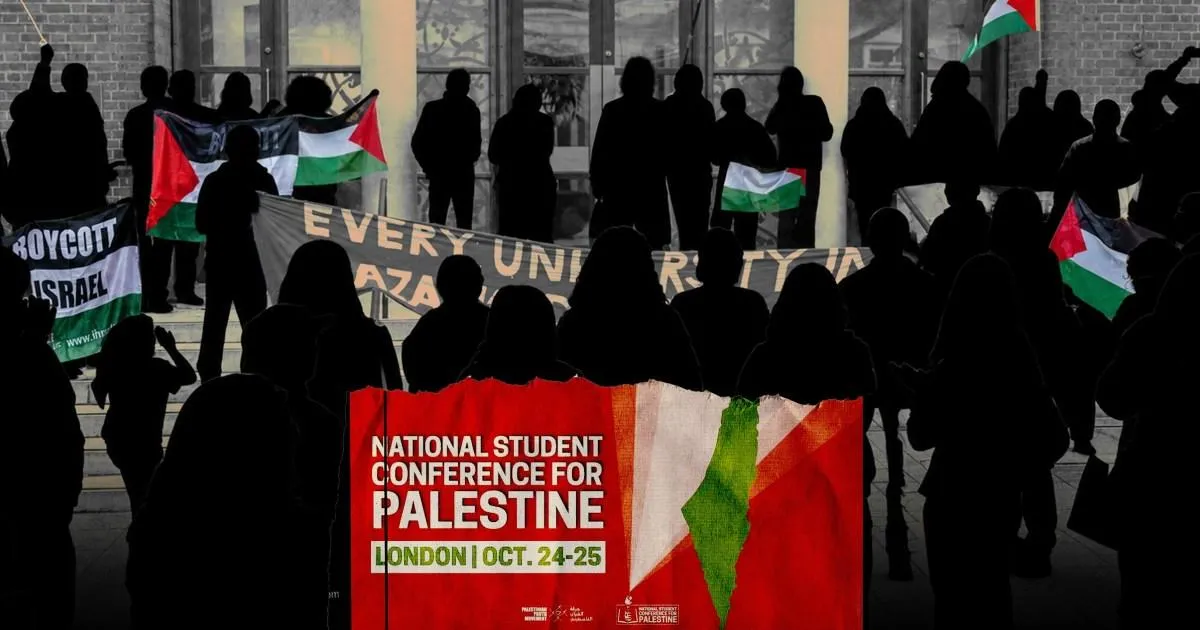
On a grey, uncertain London weekend, students from some of the country’s most celebrated universities are gathering for what might look, on the surface, like just another activist conference. But the National Student Conference for Palestine, organised by the Palestinian Youth Movement (PYM) and promoted by pro-Palestine student societies from King’s College London, the London School of Economics, City St George’s, the University of Manchester and SOAS, has become far more than a calendar event. It is now at the centre of a fierce national debate about extremism, free speech, campus politics and the safety of Jewish students. The conference’s own promotional material describes it as a “space to strategise, organise, and build the collective power needed to confront Zionism,” with plans to help activists “fortify our tactics… and forge the unity necessary to end universities’ complicity.” Tickets were being sold in the days before the event, and for the students planning to attend, this is clearly a moment of deep conviction and solidarity with the Palestinian cause. For others, however, the gathering represents a dangerous legitimisation of violence, and the people behind it, they say, should be investigated for ties to terrorism. The controversy could not have erupted at a more sensitive time, with campuses across Britain already struggling to balance passionate political expression with the duty to protect students from harassment and hate.
The organisation at the heart of the storm, the Palestinian Youth Movement, describes itself as an independent, grassroots movement of young Palestinians and their allies. Yet a trail of allegations, reports and legal filings has followed the group for years. The most serious accusation is that PYM has close ties to the Popular Front for the Liberation of Palestine, the PFLP, a militant organisation designated as a terrorist group by the European Union, the United States and Canada, and sanctioned in the UK. The PFLP has a long history of violence, including bombings and plane hijackings aimed at Israel. In 2019, a French appeal court cited a 2015 report from France’s domestic intelligence agency, the DGSI, which reportedly described PYM as “affiliated with the PFLP.” A report published in July 2024 by Israel’s Ministry for Diaspora Affairs and Combating Antisemitism similarly alleged that PYM enjoys “close ties to the PFLP and its affiliates.” Much of the evidence cited in these reports comes from public events. In May 2024, for instance, PYM helped organise a pro-Palestine conference in Detroit that reportedly broadcast video endorsements from Salah Salah, a founding member of the PFLP, and Wisam Rafeedie, another PFLP figure. PYM has also shared platforms with Samidoun, a group later sanctioned by Canada as a terrorist entity and designated by the United States as a “sham charity” allegedly acting as a fundraising front for the PFLP; Samidoun denied that designation at the time. At a 2022 rally with Samidoun outside the Israeli Consulate in Manhattan, protesters spoke of liberating Palestine “by any means necessary.” PYM has also campaigned for the release of imprisoned PFLP militants, including Walid Daqqa and Khalida Jarrar, and in Britain this year it held a four-day “summer school” in the Peak District during which, according to The Telegraph, young people chanted that they would achieve “victory over Zionism.” The group also reportedly produced a “Siege on Labour” toolkit, offering tactics for targeting the offices of local MPs and regional Labour Party headquarters, including sit-ins, pickets and rallies. Perhaps most inflammatory of all, Jeanine Hourani, a spokesperson for PYM’s British branch, has reportedly described the taking of hostages by Hamas on 7 October as “legitimate” and “effective,” saying the moment had “reaffirmed the use of prisoner exchanges as a legitimate and effective tactic within national liberation and anti-colonial struggles.” For its part, PYM maintains that it is a completely independent organisation with no affiliation to any proscribed group or political faction, and insists that the allegations of terrorist links are based on innuendo and false assumptions.
Against that backdrop, the calls for official intervention have been loud and urgent. Former Home Secretary Priti Patel, a Conservative MP, did not mince her words. She said the British public and members of the Jewish community would be “alarmed” by the conference, which she described as an opportunity “for people to spread hatred and antisemitism and promote terrorist views.” She added that many people would feel unsafe simply knowing the event was taking place. Labour MP Luke Akehurst, a prominent voice on national security issues, also urged the Government to take the alleged links between terror groups and student activists seriously. “Too often,” he told Metro, “our campuses have become breeding grounds for extremism, undermining our national security. I urge the Government to investigate these links and take appropriate action to prevent young people from being recruited into movements which support political extremism and violence.” These are not abstract concerns. They speak to a broader anxiety that what begins as campus activism can tip into something more dangerous, especially when young people are exposed to powerful rhetoric and global narratives of victimhood and resistance. The politicians’ remarks reflect a growing unease across the political spectrum about the role of universities in incubating ideologies that, at their extremes, can justify terror. For many Jewish students, the conference is not merely a political inconvenience but an existential worry, a sign that they may no longer feel safe or welcome in spaces where such ideas are celebrated. The fact that student groups from elite institutions, often seen as engines of social progress and critical thinking, are promoting the event has only intensified the sense of shock and betrayal.
Jewish organisations have amplified these concerns, framing the conference not as an exercise in free expression but as something far more sinister. The Jewish Leadership Council warned that the gathering “risks legitimising violence against Jews” and argued that, at a time of grave violence and threats against Jewish communities, student groups should not be aligning themselves with PYM. The Council also called on universities and student unions to take action against any affiliated groups that attend the conference. The Campaign Against Antisemitism urged universities to do more to stop their students from “flirting with extremism.” Meanwhile, UK Lawyers for Israel (UKLFI) has been especially active. The legal organisation says it has documented extensive evidence of PYM’s links with organisations associated with terrorism, including the PFLP, and has sent its report to universities whose student groups appear to be attending. UKLFI warned that, given PYM’s track record, there were “serious grounds for concern that this conference will expose students to extremist propaganda.” The language is strong, but so is the underlying fear. These groups see the conference as a moment of accountability, a test of whether universities are willing to confront extremism on their own campuses or will hide behind legalisms while dangerous ideas take root. They point to the alleged connections between PYM and groups that have celebrated violence, and they ask a simple question: if a student society were promoting a conference run by any other designated terrorist organisation, would the response be so muted? For them, the stakes are not just reputational but deeply human—about the safety and dignity of Jewish students who might see the event as an endorsement of those who wish them harm.
The universities themselves have responded with careful, legalistic statements that reveal the immense pressure they are under. The London School of Economics defended its position by noting that universities are required by law to protect free speech and that the Palestinian Youth Movement is not a proscribed group, meaning promoting or attending its event is not unlawful or a breach of LSE rules. King’s College London Students’ Union said it was not involved in organising, funding or endorsing the conference, and that the group promoting it, KCL Stands for Justice, was not a KCLSU student group. Where concerns are raised, the union said, it deals with them under its policies and the law, while respecting students’ lawful freedom of expression. The University of Manchester Students’ Union went further, saying its Board of Trustees had reviewed the dossier from UKLFI but concluded that much of the detail concerned activities of other organisations and individuals, or activity by the Palestinian Youth Movement outside the United Kingdom. The union condemned terrorism without reservation and insisted that antisemitism had no place in its community, adding that the safety and wellbeing of Jewish students mattered as much as those of any other student. It also noted that PYM is not proscribed under the Terrorism Act 2000 and is not on the UK Sanctions List, so it remains a lawful organisation. Attending a conference organised by a lawful organisation, the union argued, is lawful activity. SOAS said it had received the UKLFI report and was considering its findings in accordance with its legal and regulatory obligations. A government spokesperson, meanwhile, struck a delicate balance: the right to express and discuss lawful political views is a cornerstone of democracy, but there is no place for unlawful extremist hatred and abuse. Universities, the spokesperson added, should take their Prevent duties seriously and ensure robust steps are in place to stop unlawful extremist activity and keep students safe. These statements, while carefully worded, do little to resolve the underlying tension. They reflect the impossible position many institutions now find themselves in: accused both of stifling legitimate political speech and of turning a blind eye to extremism, with the law offering only a murky guide through the fog.
In the end, the National Student Conference for Palestine is more than just a single event on a London weekend. It is a mirror held up to British society and its unresolved arguments about free speech, security, solidarity and faith. The students who will gather are, for the most part, young people who genuinely believe they are standing against injustice, and they see no contradiction between their cause and the presence of PYM, which they view as a legitimate movement. But for the Jewish students who share those campuses, the conference and the rhetoric surrounding it evoke a darker history, one in which demonisation of a people was allowed to fester in polite institutions before exploding into violence. The fact that a university group has already confirmed it is not attending, and that others are distancing themselves, suggests the pressure is being felt. But the deeper questions remain. How do universities protect free expression while also protecting their students from harm? How do campaign groups distinguish between legitimate Palestinian solidarity and antisemitic incitement? And how far should the state go in investigating organisations that have not been proscribed but which some believe are linked, however indirectly, to terror? There are no easy answers. What is certain is that the conference, whatever it achieves or fails to achieve, has already succeeded in forcing a national conversation. That conversation—about belonging, fear, identity and the limits of political activism—will continue long after the last workshop ends and the students have returned to their lecture halls. For now, the only real hope is that the dialogue remains honest, that the safety of all students is taken seriously, and that the search for justice for Palestinians is never allowed to turn into a justification for hatred against Jews. That is a line worth defending, not just in London, but everywhere.