


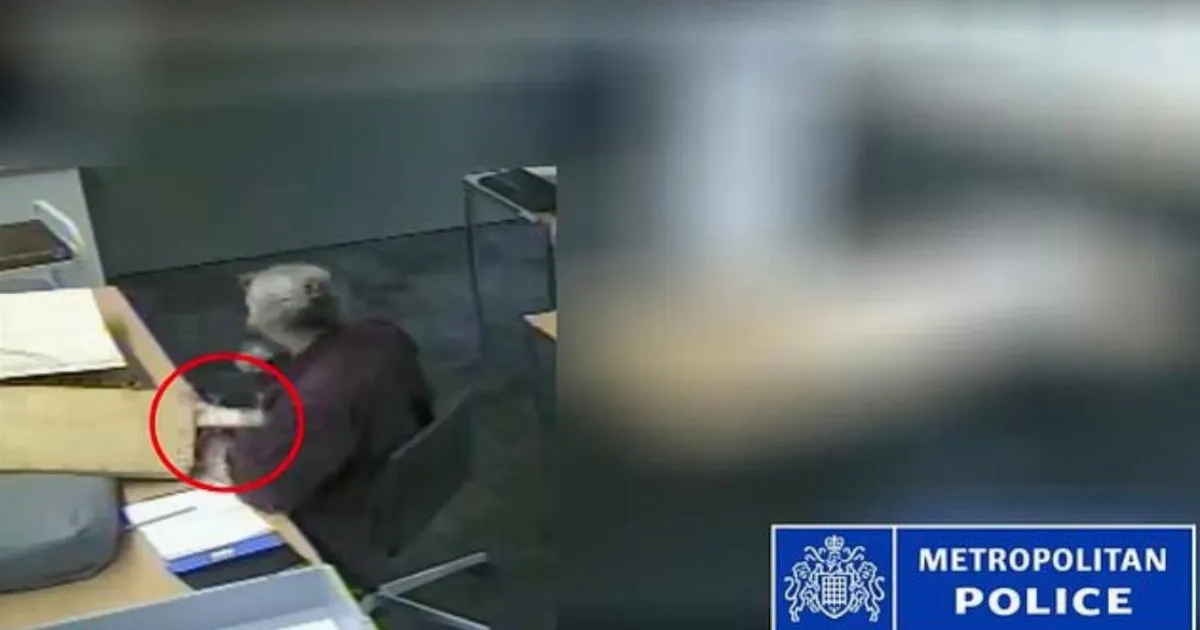
At first glance, it might have looked like an ordinary research visit to one of London’s most respected cultural institutions. A man in his seventies, calm and composed, asked to see an antique atlas at the National Maritime Museum in Greenwich, claiming the scholarly interest of a serious reader. But the quiet atmosphere of the Caird Library was shattered when staff discovered something deeply unsettling: a knife left on the floor near the chair where the visitor had been studying. Moments later, they realized that one of the most valuable pages from a 350-year-old book was gone. Melvin West, now 73, had not been there to study history—he had come to tear a piece of it away. On 26 February last year, West used the blade to slice a rare map out of the atlas, carefully concealed it, and walked out of the museum as if nothing had happened. The missing page was not just any old illustration. It was a celebrated double-hemisphere world map, a masterpiece of seventeenth-century cartography that had survived centuries of wars, weather, and changing tastes, only to be stolen in a few moments of calculated betrayal. The room where he sat was no ordinary reading area; it was part of the internationally renowned Caird Library, a resource used by scholars from all over the world. The discovery of the knife, abandoned in his wake, felt almost like an insult—a crude signature left behind by someone who had treated a treasure of human knowledge as a casual target for profit.
The stolen map is known as Nova Orbis Tabula, printed in 1684 by the Dutch cartographer Frederick de Wit. It is regarded as one of the most beautiful examples of the Dutch Golden Age, a time when geography, art, astronomy, and mythology were woven together in a single breathtaking image. The map is famous not only for its geographical details but for its elaborate decoration: zodiac signs circle the globe, cherubs float among clouds, and intricate ornamentation frames the two hemispheres. It also reflects the limits of European knowledge at the time, portraying California as an island—a mistaken belief that explorers and mapmakers clung to for many years. To historians, the map is a window into how people once imagined the world, combining careful observation with beautiful fantasy and spiritual symbolism. To artists, it is a masterpiece of engraving and design, a work that rewards close attention with endless small wonders. To librarians and curators, it is an irreplaceable part of a shared cultural inheritance, something that belongs in a public collection where anyone can see it. But because of West’s actions, that map is now hidden somewhere, locked away from scholars, students, and the public. The theft did not just remove a piece of paper from a book; it tore a hole in the record of human curiosity and craft. The atlas originally contained twelve historic maps, each one precious in its own right, but the Nova Orbis Tabula was special even among such distinguished company. Its disappearance has left a gap that cannot be filled by any photograph or digital scan, because there is no substitute for the original object—the very paper, ink, and artistry that connect us directly to the hands that made it more than three centuries ago.
Police soon began piecing together what had happened, and the investigation revealed a careful, practiced thief rather than a desperate opportunist. Detectives examining CCTV footage discovered that West had visited the library on three separate occasions before carrying out the theft, apparently casing the building and studying its security measures. He had even registered for a library reader’s card, using the name Melville West to gain legitimate access to the collections. That level of planning suggested experience, and indeed West was no stranger to this kind of crime. He had multiple convictions across Europe for stealing pages from valuable antique books, making him a known and prolific art thief. When officers identified him, they obtained a search warrant and arrested him at an address in Chingford, where he was then living, on 4 March. During questioning, West answered no comment to questions about the map’s current location or whether he had already sold it. Despite the evidence against him, he offered no explanation and no cooperation. As a result, the Nova Orbis Tabula remains missing to this day. For those who care about cultural heritage, this is the most painful part of the story. A man has been brought to justice, but the object at the heart of the crime is still out there somewhere, perhaps hidden in a private collection, perhaps already sold to a buyer who knows it was stolen, perhaps sitting in a storage box waiting to be rediscovered. The silence that followed West’s arrest left investigators with an incomplete victory and left the public without the chance to see one of the most beautiful maps ever made.
Detective Constable Sophie Hayes, who works with the Metropolitan Police’s Art and Antiques Unit, spoke publicly about the case in terms that cut straight to the deeper loss. She appealed to anyone with knowledge of the map’s whereabouts to do the right thing and contact the police so that it could be returned to the library. Hayes stressed that the Caird Library is an internationally important resource, used by scholars from around the world, and that thefts like this one mean the only people who profit from beautiful artefacts are the thieves themselves. Her words carried a clear message: this was not a victimless crime, even though no one was physically hurt. The victims are the researchers who can no longer consult the original, the museum staff who trusted a visitor and were betrayed, and the wider public who have been denied access to a piece of their own history. A spokesperson for Royal Museums Greenwich also expressed satisfaction that the criminal case had been brought to a close, noting that the institution had cooperated closely with the Art and Antiques Unit throughout the investigation. But behind the carefully measured official statements, it is easy to imagine the dismay felt by librarians and curators who spend their lives protecting such treasures. They had done everything right, maintaining security and welcoming researchers in good faith, yet one determined thief had found a way to slip through. The emotional impact of such a betrayal goes beyond the material loss. It creates a sense of distrust and caution, forcing institutions to reconsider how they balance openness with security, and reminding everyone that the cultural world is not immune to the greed of a few.
The legal process eventually delivered a measure of justice. West was charged with theft, criminal damage, and possession of a bladed article, and after pleading guilty at Bromley Magistrates’ Court, he was sentenced at Woolwich Crown Court on Thursday, 22 October. The judge handed down a sentence of three years’ imprisonment, a clear acknowledgment of the seriousness of the crime. Perhaps even more importantly, the court also imposed a ten-year Criminal Behaviour Order that prevents West from being alone in any reading room of a museum or library in England and Wales. That order is a direct response to the pattern of his offending: for years he had used the quiet, trusting environment of research libraries as a hunting ground, and the court wanted to make sure he could not do so again. It is a rare and significant restriction, one that reflects the determination of the authorities to protect cultural collections from repeated predators. Still, the sentence does not bring back the map. It does not tell investigators where the stolen page has gone, and it does not repair the damage done to a book that had survived for centuries with its treasures intact. For all the satisfaction that comes with seeing a repeat offender held accountable, there is a lingering sense of unfinished business. West is behind bars, and for the next decade he will not be allowed near the kind of materials he once stole, but the Nova Orbis Tabula is still missing. The map may be somewhere in Britain, or it may have left the country long ago. It might one day surface in a museum’s storage room, a dealer’s catalogue, or a police raid, but until then, everyone with an interest in history must live with the uncertainty.
In the end, this is a story about the strange relationship between beauty and greed, and about how even the most careful cultural protections can be undone by a single determined individual. The map that Frederick de Wit created in 1684 was never meant to be hidden. It was made to be seen, to be studied, to inspire wonder and curiosity about the world. It has survived centuries of change, outlasting the empires and ideas that existed when it was printed, only to fall victim to a thief in a quiet library in Greenwich. That contrast—between the grandeur of the object and the smallness of the crime—is what makes this case so striking. A man with a knife entered a place built on trust and knowledge, and he walked out with something priceless rolled up in his pocket. The harm he caused cannot be measured simply by the financial value of the map, because the true loss is cultural and emotional. Fortunately, the authorities have not given up. The appeal for information remains open, and the police are asking anyone who knows where the map is to do the right thing. There is still a chance that this extraordinary piece of Dutch Golden Age artistry will be found and returned to its rightful home. If that happens, the story will end not with a thief in prison, but with a beautiful work of human imagination finally coming back to the light. Until then, the Nova Orbis Tabula remains a ghost in the collection—remembered, admired, and deeply missed, waiting for someone to reveal where it has gone.