

-
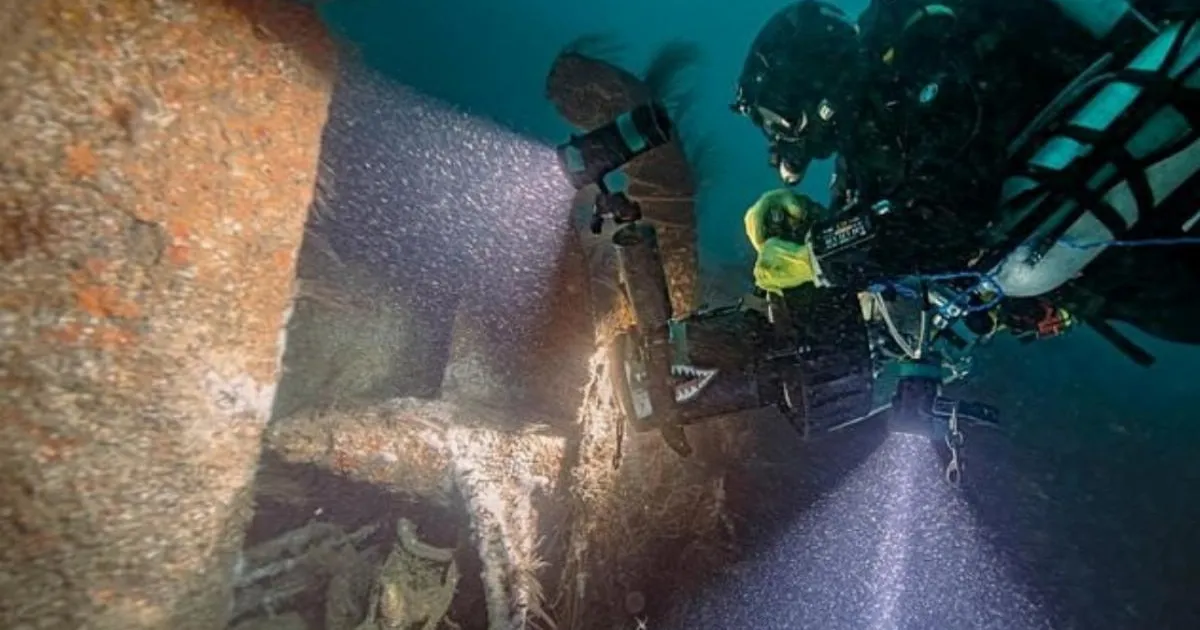
Some discoveries are made with maps and instruments; others are made with a held breath, a beam of light cutting through cold green water, and the unmistakable shape of history emerging from the gloom. For Dominic Robinson, a diver with the Plymouth-based Gasperados team, that moment arrived roughly twenty miles off the coast of Salcombe, Devon, where the seabed lies about 230 feet beneath the surface. He and his team had been hunting for a German U-boat that had vanished from official records, not because it had slipped into myth, but because a careless clerical mistake had placed it somewhere else entirely. For decades, the submarine had rested in silence, undisturbed by currents or curiosity, a steel tomb and time capsule all at once. And then, on a dive that must have felt like stepping into a forgotten photograph, Robinson began to recognize the details that textbooks and archives had only described in words. He saw the snorkel, a piece of engineering that allowed the boat to breathe while submerged. He saw the conning tower, rise from the sand like the spine of some great iron beast. “I started seeing the individual features,” Robinson later recalled, his voice carrying the quiet thrill of a man who knew he was looking at something important. “I saw the snorkel, I saw the conning tower, all those kind of things – I knew that we were going to get the video needed to identify it, so I was really pleased about that.” In that instant, the wreck stopped being an anonymous silhouette and became U-672, a German submarine with a long-dead crew, a curious emblem of a pig painted on its tower, and a story that had waited more than eight decades to be told properly.
-
The story of U-672 is not one of glorious victory or dramatic last stand, but of survival measured in minutes, choices made under immense pressure, and a captain who refused to let his men die for a lost cause. By 1944, the Battle of the Atlantic had turned decisively against Germany. The U-boats that had once terrorized Allied shipping were now the hunted, their technology outdated, their crews young and exhausted. U-672 was part of this desperate tide. On 18 July 1944, it was operating in the English Channel, a narrow stretch of water that had become a graveyard for submarines on both sides. The British frigate HMS Balfour detected the boat and, with a persistence that must have felt like the drumbeat of doom, dropped depth charges that exploded around the hull. The damage was severe. Water began to leak into the compartments, systems failed, and the submarine started to sink beyond the point of no return. The captain, whose name would later be spoken with respect by the very people who had once considered him the enemy, faced an impossible arithmetic: he could order a final dive and take his fifty-two men to the bottom with him, or he could surface and surrender. He chose to wait until the last possible moment. Why? Perhaps because he wanted to give his crew every chance, perhaps because he hoped the damage might somehow stabilize, or perhaps because he understood that surfacing a damaged U-boat in the middle of enemy waters was an act of surrender, and he wanted to delay that as long as he could. But in the end, he gave the order. The submarine rose to the surface, listing and broken. The captain then deliberately scuttled his vessel, opening the hatches so that U-672 would sink beneath the waves on its own terms, carrying no one with it. The entire crew survived. They bobbed in lifeboats, surrounded by the wreckage of their own ship, until they were captured and, after the war, returned to Germany.
-
Survival, however, does not always mean the end of the story. For the crew of U-672, the war ended in captivity; for their submarine, the war never ended at all. It sank slowly into the icy darkness of the Channel, coming to rest on the seabed at a depth where light rarely reaches. There it remained, hidden not by intention but by error. The coordinates recorded for its sinking were wrong, a clerical mistake that would confuse historians and salvage teams for generations. The submarine lay about 46 miles away from the location written in official documents, a discrepancy that might have been corrected if anyone had thought to question it. But the war moved on, the crew went home or moved on themselves, and the U-boat became a footnote in naval archives. Only the divers who eventually found it could piece together the truth. For them, the identification was not simply a matter of confirming a hull shape. They matched the snorkel system, a distinctive feature that allowed the boat to run its diesel engines while submerged, and the radar-decoy equipment, a primitive form of electronic warfare designed to confuse enemy detection. But the most human clue was the emblem. U-672 was known to have a pig painted on its conning tower, a darkly humorous mascot that perhaps reflected the crew’s grim fatalism or their desperate hope for luck. When the divers saw that symbol, faded but still recognizable, they knew they had found the right boat. It was a strange moment, standing at the intersection of steel and memory. This was not just a wreck; it was the last physical trace of fifty-two men who had once laughed, feared, dreamed, and prayed inside its cramped compartments.
-
The discovery also mattered deeply to the living. Dominic Robinson, the diver who first recognized the features, had made contact with the family of the U-boat’s captain. What he learned transformed the wreck from an archaeological curiosity into a personal reunion. The captain, he said, had lived a “long and happy life” after the war. That simple phrase carries enormous weight. Imagine the man who had ordered his own submarine to be scuttled, who had watched his command disappear beneath the waves, who had spent years as a prisoner of war, and who then returned to a Germany that was itself in ruins. To live a long and happy life after all that suggests a kind of resilience that is difficult to comprehend. The captain’s family, when they heard that his submarine had finally been found, did not speak of anger or bitterness. Instead, they said “how proud he would have been and how pleased he would have been to know that it had been found at last.” That is the strange mercy of time. The enemy of 1944 becomes, in 2026, a man whose descendants can feel pride in the fact that his ship has been honored and remembered. The discovery gives the family a tangible connection to a man they loved, a proof that his story was not forgotten. For Robinson, hearing those words must have been as satisfying as the dive itself. A wreck can tell you facts; a family tells you meaning. And in that exchange, the U-boat ceased to be a symbol of war and became a chapter in a human biography, a chapter that ended not with an explosion, but with an old man who knew that his final act of command had allowed fifty-two men to live.
-
There is a bitter irony in the fact that U-672 remained hidden for so long because of a simple mistake. Dr Axel Niestle, a historian who specializes in U-boats, confirmed that “due to a clerical error” the position of the submarine was recorded as being some 46 miles away from its actual resting place. For decades, anyone who wanted to find the wreck would have been searching in entirely the wrong patch of water. Perhaps some did. Perhaps there were divers who had looked at sonar scans and wondered about the shape beneath the swell, only to give up because it did not match the coordinates on file. The sea is vast and unforgiving; without the right information, finding a single submarine is like finding a needle in a field of dark, moving haystacks. But the error also protected the wreck. Because no one knew where it truly lay, U-672 was spared the fate of many other war wrecks, which were salvaged for metal, stripped by looters, or disturbed by inexperienced divers. Instead, it sat untouched, held in a state of preservation that allowed the Gasperados team to identify it with confidence. The very mistake that kept it hidden also kept it safe. This is the kind of detail that makes history feel almost alive, as if the submarine itself had chosen to wait for the right moment to be found. The snorkel, the radar decoy, the painted pig, all remained intact enough to tell their story. And when the correct coordinates were finally discovered and the divers made their descent, they were not just following a map; they were following the trail of a clerical error that had somehow become a guardian.
-
What does it mean to find a lost submarine more than eighty years after its crew was forced to abandon it? On one level, it is a triumph of detective work and diving skill, a satisfying answer to a historical riddle. On another, it is a meditation on the nature of memory and the strange relationships that war creates between enemies. The men of HMS Balfour who dropped those depth charges were trying to kill the men of U-672. They succeeded in destroying the submarine, but they failed to destroy the crew. The captain who scuttled his own boat gave his men a future, and one of them, or perhaps many of them, went on to live lives that would not have been possible if he had chosen differently. The captain himself lived long enough to see nations that had once been at war become allies, to see the waters of the English Channel become a highway for trade and tourism rather than a battlefield, to see his own U-boat forgotten by almost everyone. Until now. The discovery of U-672 does not change the outcome of the war, nor does it heal the wounds of the conflict. But it does remind us that every shipwreck is also a human story. The men who served on that submarine were not abstractions. They were soldiers, sailors, husbands, fathers, sons. They had a pig on their tower, which suggests a certain irreverent humor. They trusted their captain enough to follow his order to surface, and they survived because of it. Now, decades later, their submarine has been found, identified, and remembered. Divers have seen the place where they lived, and their descendants have been told that the wreck is no longer lost. That is perhaps the most human thing of all: the need to know that those who came before us have not been erased, that their names and their ships and their stories can still surface, even from the deepest water. U-672 lies on the seabed off Devon, silent and broken, but it is no longer alone in the darkness. The world knows where it is. And that, in its own way, is a kind of victory.