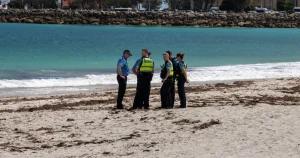


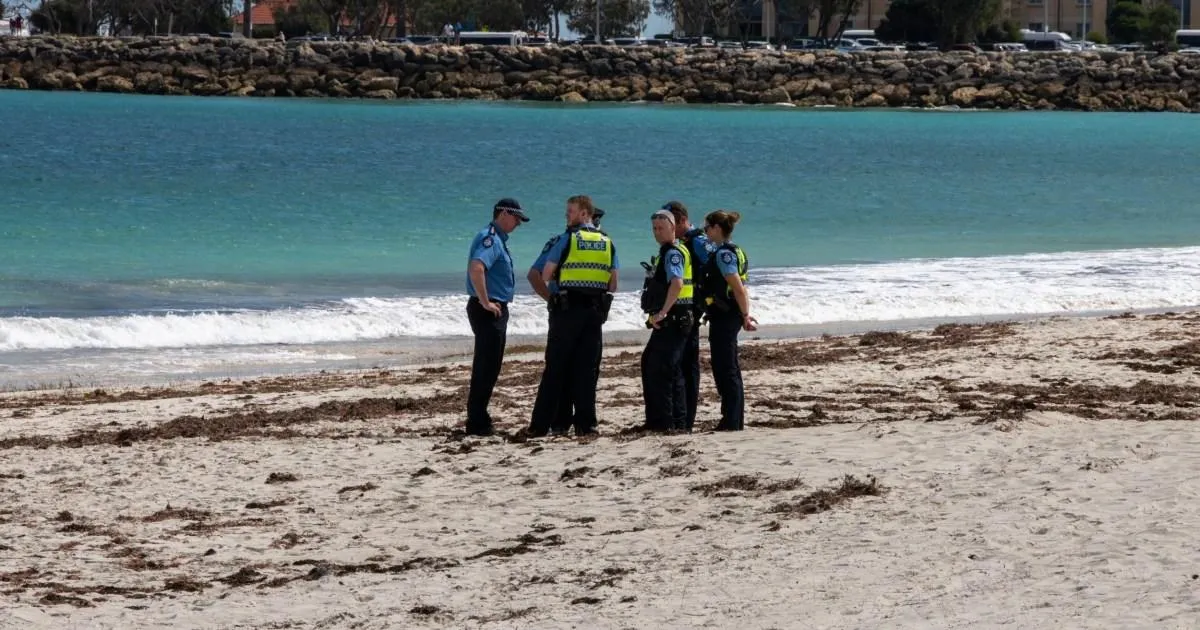
On a Friday morning that began like any other, the quiet waters of Sorrento Beach, just north of Perth in Western Australia, became the scene of a horrifying tragedy. At around 10:30 a.m. local time, emergency services received frantic calls after a male swimmer, only about 164 feet from the shoreline, was attacked by a shark in front of dozens of horrified beachgoers. What should have been a tranquil morning by the Indian Ocean quickly descended into chaos, as people on the sand watched a man being violently thrashed around in the water. One eyewitness described the scene as something straight out of a nightmare, saying the victim was tossed about “like a ragdoll,” a vivid, chilling image that left many struggling to process what they had just seen. Police and lifeguards responded quickly, sweeping the waters with boats and a helicopter, but by the time they reached the area, it was already too late. The swimmer died as a direct result of the attack, authorities later confirmed, leaving a community reeling and a stretch of coastline suddenly associated not with leisure but with loss. For those on the beach, there was no warning, no chance to intervene, only the sickening realization that they were witnessing a life being taken just yards from safety. The attack occurred so close to shore that it underscored a terrifying truth: that danger does not always announce itself. In the aftermath, the beach was cleared, the lockdown was imposed across Perth’s northern beaches, and a sense of shock settled over the region like a fog.
.
The testimony of witnesses painted a deeply emotional portrait of the tragedy. One beachgoer told 7 News Perth, “It was like a scene from Jaws, where a body is flicked around like a ragdoll.”The cinematic comparison, born of sheer disbelief, captured the surreal horror of watching a human being powerless against a predator in his own natural element. Another woman described how the shark grabbed the swimmer from near his friend and dragged him further out into the water before mauling him “right in front of us.” Perhaps the most heartbreaking detail came from another witness, who recounted how the victim’s friend, standing on the shore, had watched the entire attack unfold and could only repeat, “I couldn’t save my mate.” That refrain, uttered over and over, became a haunting summation of the morning’s helplessness. It was not just a stranger who died; it was someone’s friend, someone’s loved one, someone who had likely entered the water only minutes earlier, expecting nothing more than a swim. The shock waves from that friend’s grief rippled through the gathered crowd, through the first responders, and through anyone who later read or heard the news. The psychological toll on those who witnessed the mauling cannot be overstated; many would later struggle with intrusive images, sleepness nights, and a newly profound fear of the ocean. For the friend on shore, the burden was even heavier, saddled with a survivor’s guilt that no amount of reassurance could easily lift. In the hours that followed, drones were launched over the water, and they spotted a large great white shark gliding near the surface off Sorrento Beach, though authorities could not immediately confirm whether that particular animal was responsible for the attack, nor was the species officially established. Either way, the sighting added another layer of unease, as the possibility remained that the predator was still lurking just offshore, silent and patient. The beach, once full of life, now sat empty, watched over by police tape and the nervous gaze of passing residents.
.
The broader context made the tragedy even more resonant. Earlier that same week, a surfer had a barely avoided disaster after being bitten off Glenfield Beach, near Geraldton, a popular surfing spot about257 miles north of Perth. That surfer was rescued by a fellow surfer and suffered a leg injury, but the shark also bit off a chunk of his board, leaving him shaken but alive. These two incidents, coming so close together, sharpened the sense that something unusual was happening in Western Australian waters. Yet experts were quick tonote that fatal shark attacks, despite their terrifying nature, remain relatively uncommon. Australia, with its vast coastline and waters home to around180 different species of sharks, has recorded237 fatal shark attacks since records began in1791 through2018. Four species—the tiger shark, great white shark, bull shark, and oceanic whitetip shark—are responsible for the vast majority of those deadly encounters. The great white, in particular, is often involved in attacks on humans, though such events are still exceedingly rare when measured against the millions of people who enter the ocean every year. Still, for the people of Perth, statistics offered little comfort. The image of a swimmer being dragged underwater inch front of a crowd was not an abstract data point; it was a visceral, immediate reality. The Joondalup City Council moved quickly to shut all beaches within its area until at least midday the following day, and other nearby beaches followed suit, emptying miles of coastline that would normally have been filled with families, swimmers, and surfers enjoying the late summer weather. The closures were a practical safety measure, but they also served as a somber acknowledgment that the ocean could not be controlled, no matter how much humans wished otherwise.
.
The fear stirred by the Perth attack inevitably resonated far beyond Western Australia,evoking memories of other shark incidents around the world. In the United Kingdom, just the previous month, a mysterious animal made headlines after a suspected sighting in the waters off Jersey, near St Ouen’s Bay, at the very height of the summer holidays. A lifeguard reported punching an animal believed to be up to12 feet long in the water as the popular beach was hurriedly cleared. No images were captured, and the species was never confirmed, leaving a lingering mystery and a spike in anxiety among beachgoers. Wildlife campaigner Richard Peirce, who has authored books on sharks in British waters, offered a cautious perspective, suggesting that if the animal had a large dorsal fin and was close to the surface, it could well have been a basking shark—a huge but largely harmless filter-feeder. That explanation, while plausible, did little to calm nerves inch a world already primed to fear sharks. The juxtaposition of a fatal attack in Australia and an unconfirmed sighting in Britain served as a reminder that sharks occupy a powerful place in the human imagination, embodying both ancient primal terror and the wild unpredictability of the sea. Every summer, as more people flock to beaches, the possibility of encountering one of these ancient predators becomes a thought lurking beneath the surface of collective consciousness, even if logical probability remains minuscule. The media coverage, social media posts, and word-of-mouth retellings all amplified the drama, sometimes blurring the line between factual reporting and folklore. In the aftermath of a death like this one, that blurred line becomes understandable; people need to make sense of random, senseless tragedy, and narratives—whether of awe, fear, or ecological warning—help fill the void.
.
Beyond the immediate horror, there was a deeper, more somber reflection on the relationship between humans and sharks. Worldwide, sharks killed an estimated10 people last year—a figure that, while tragic, pales in comparison to the roughly100 million sharks killed by human activities and overfishing each year, as Richard Peirce pointed out. Those numbers cut both ways: they underscore how incredibly rare shark attacks actually are, yet they also highlight how profoundly humans have altered the oceans, destroying shark populations at an unsustainable rate. The creature that killed the swimmer off Perth was not a mindless monster, but an apex predator acting on instinct, doing what sharks have done for hundreds of millions of years. The ocean is its home; humans are visitors. That does not diminish the grief or anger that follows such an attack, nor does it offer easy answers for beachside communities seeking safety. But it does invite a more nuanced understanding of these events, one that holds both empathy for the victims and respect for the natural world. For every story of a shark attack, there are countless unseen encounters where sharks and humans cross paths without incident. Yet when a tragedy does occur, it dominates headlines and ignites debates about culls, drones, and beach closures, often overlooking the broader ecological balance. The man who died off Sorrento Beach was not a statistic; he was a person with a name, a history, relationships, and a future that ended in a sudden, violent flash. His death will be mourned by those who knew him, and his memory will be carried by the friend who could not save him, by the witnesses who could not look away, and by a community that will forever associate that stretch of sand with both beauty and loss.
.
In the days ahead, as the beaches reopened and the initial shock faded, the questions would inevitably linger. Would authorities be able to identify the shark? Would they attempt to track or remove it? What could be done to prevent another such tragedy on a coastline so beloved by swimmers, surfers, and families? The answers were uncertain, as they often are in the aftermath of wild animal encounters. Some would call for increased surveillance, others for culls, while environmentalists would warn against disturbing an ecosystem already under immense pressure. Meanwhile, ordinary people would return to the water, perhaps hesitantly at first, carrying a new awareness of what lies beneath the surface. They would check shark advisories, look a little longer at the horizon, and perhaps feel a flutter of anxiety with every dark shape or shadow. But most would eventually go back in, because the ocean is woven into the identity of places like Perth, and the alternative—staying away forever—would feel like surrendering to fear. The friend who kept repeating,“I couldn’t save my mate,” would have to find a way to live with that sentence echoing in his mind. The witnesses, too, would carry the images with them, perhaps forever changed by what they saw. And the shark, wherever it was, would continue swimming through waters that humans used but could never truly own. This tragedy, like all such tragedies, would leave its mark—on a family torn apart, on a community shaken, on a coastline now shadowed by memory. But it would also become part of a larger, ongoing story about coexistence, risk, and the humbling reminder that despite all our advances, humans are still, in the end, guests in an ocean that can be beautiful, mysterious, and occasionally devastating. That is the uncomfortable truth behind this attack: we cannot fully tame the wild, we can only respect it, mourn our losses, and try to find a balance between living by the sea and understanding its dangers. The waves that crashed onto Sorrento Beach that morning kept rolling, indifferent to the tragedy they had witnessed, carrying within them both the memory of a lost life and the enduring, ancient presence of the creatures below.
.