

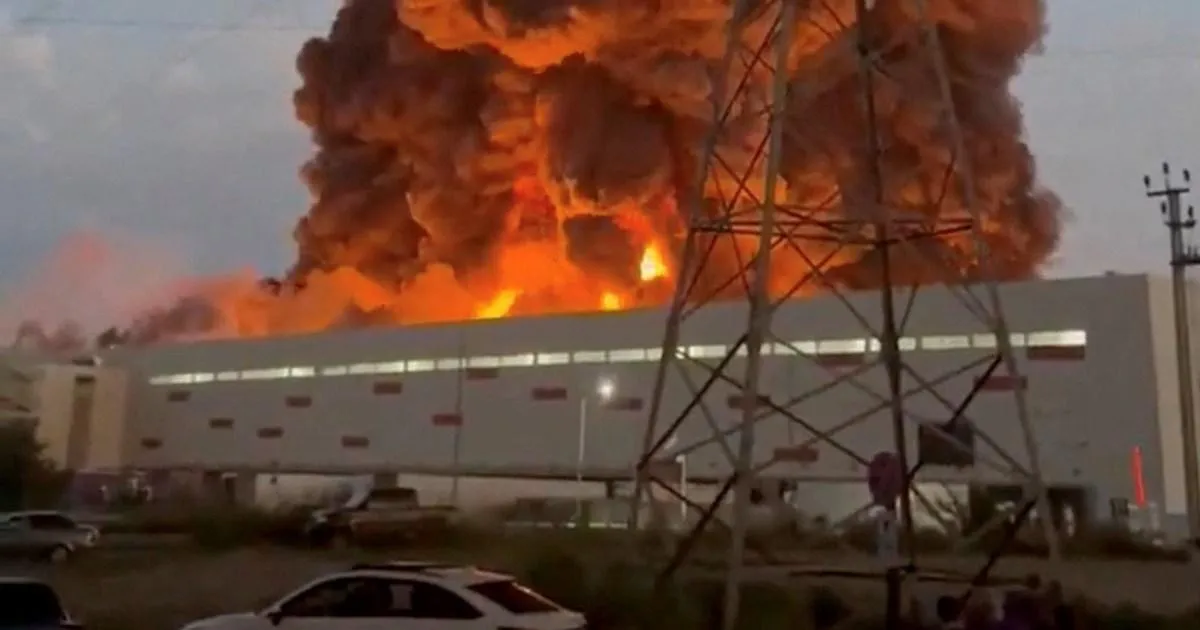
The escalating conflict between Russia and Ukraine has taken an increasingly personal toll on the Russian civilian population, marked by a series of devastating drone strikes targeting the infrastructure of Wildberries, the country’s equivalent to Amazon. These attacks, which shattered the relative domestic calm often portrayed by state officials, serve as a stark reminder of the reach of modern aerial warfare. By targeting the logistics hubs that power Russia’s retail economy, these drone strikes have transcended military objectives, bringing the chaos of the front lines directly into the warehouses where hundreds of ordinary Russians clock in for their daily shifts. The loss of life and the visible destruction in places like Krasnodar, Nevinnomyssk, and Armavir reflect a shifting reality where safety is no longer guaranteed behind state borders.
The emotional weight of these incidents was captured poignantly by Tatyana Kim, the head of Wildberries, who expressed profound grief over the loss of her staff. Her public remarks highlighted the disconnect between the cold statistics of a war report and the human catastrophe of losing colleagues who were simply performing their jobs. With several people sustaining injuries and at least one life lost in the most recent bombardment—compounded by the tragic death of eight workers in a separate strike just days prior—the human cost has become inescapable. Seeing images of smoke billowing over urban centers and hearing of debris striking high-rise apartment buildings has forced a realization among citizens that the economic heart of their nation is now vulnerable to high-tech, persistent strikes.
These strikes are not merely humanitarian nightmares but represent a calculated economic pressure point for the Kremlin. When Deputy Prime Minister Alexander Novak noted that digital platforms like Wildberries contribute nearly 9% of Russia’s GDP, the significance of targeting these warehouses becomes clear: the objective is to disrupt the internal logistics that sustain the Russian consumer market. When online commerce is crippled and widespread blackouts occur—such as those reported in occupied Crimea following strikes on electric substations—the stability of the Russian home front begins to fracture. The integration of technology in modern retail means that an attack on a warehouse is not just an attack on a building, but a systematic disruption of the convenience and economic normalcy that a government relies on to maintain domestic support.
While Russia navigates the fallout from these attacks, Ukraine is simultaneously grappling with significant internal turbulence. The sudden firing of key military leaders, including the defense minister responsible for modernizing the army, has sparked widespread public demonstrations across Ukraine. President Volodymyr Zelensky’s decision to overhaul the upper echelons of his command structure has left a country already exhausted by war feeling anxious about the continuity of its defenses. By appointing Major General Ihor Skybiuk as the new Chief of the General Staff, Zelensky is attempting to project an image of stability and experienced leadership, emphasizing the need for absolute coordination during a perilous time. However, the optics of replacing top brass amid active, high-stakes combat have clearly unsettled a population yearning for consistency.
The turbulence within the Ukrainian government reflects the impossible pressures of a nation defending its sovereignty while facing internal dissent and the strain of prolonged mobilization. Zelensky’s effort to frame the new appointments as a “shoulder-to-shoulder” transition suggests an urgent desire for cohesion, yet, the disconnect between government decisions and public sentiment remains palpable. As both nations continue to trade blows—Russia through aggressive expansion and Ukraine through tactical, long-distance strikes—the common thread is the displacement of peace. Ordinary people on both sides are finding themselves caught in the machinery of a war that is increasingly defined not by traditional battlefields, but by the destruction of the civilian spaces where life typically unfolds.
Ultimately, this cycle of violence serves to erode the boundaries between military strategy and civilian existence. With reports of dangerous munitions being found in harmless items like power banks and the systematic targeting of infrastructure that keeps power and commerce running, the war has effectively metastasized into every corner of daily life. As the leadership in both Moscow and Kyiv face scrutiny—one for the vulnerability of its domestic economy and the other for the volatility of its military hierarchy—it is the workers, the residents, and the families who bear the brunt of the instability. As the dust settles from these recent drone strikes, the long-term impact on regional stability remains grim, suggesting that as long as the conflict continues, no warehouse or city block can be considered entirely out of harm’s way.