


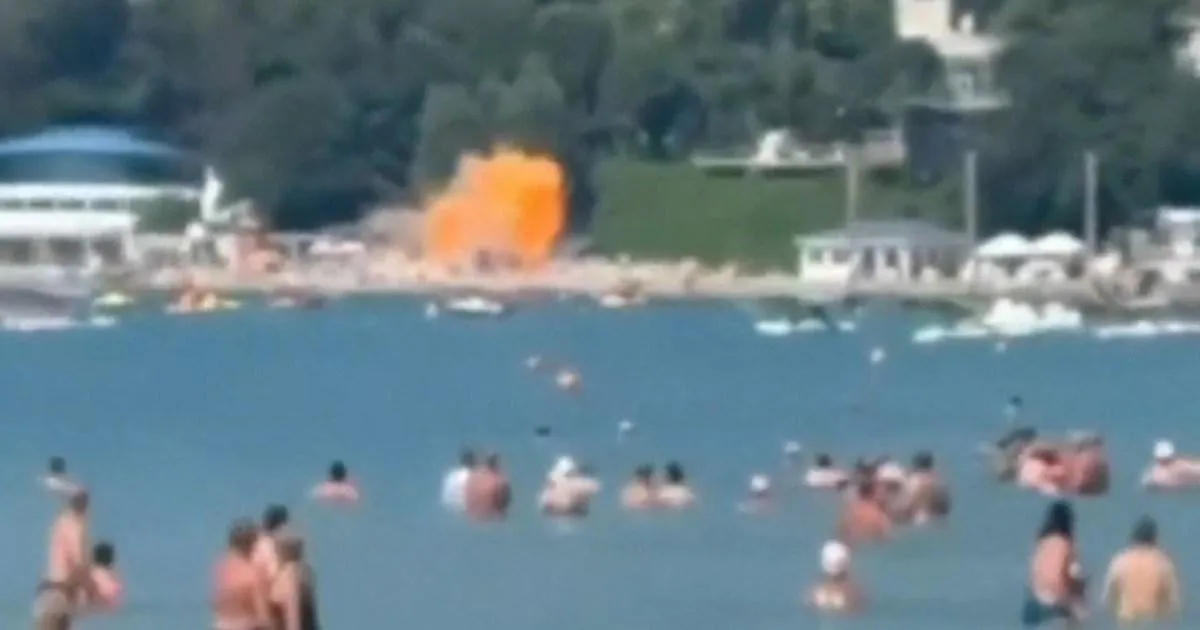
The tranquility of a summer day in the Russian resort town of Arkhipo-Osipovka was shattered in a heartbeat when a Ukrainian drone plummeted into a crowded beach. What should have been a peaceful afternoon of sunbathing and swimming—with temperatures hovering at a sweltering 29C—instead became a scene of absolute terror. As the unmanned aircraft veered off course and smashed into the nearby cliffs, the resulting explosion sent a massive fireball into the sky, followed by a thunderous boom that shook the coastline. Tragically, the chaos claimed four lives, including a young child, and left over a dozen others injured, turning a popular holiday destination into a landscape of grief and confusion.
The harrowing experience of the bystanders highlights the utter lack of preparation for such an event. Despite reports that a drone threat had been issued by the local mayor earlier that morning, it was rescinded within ten minutes, leaving the public with a false sense of security. When the drone actually appeared, there were no sirens to warn swimmers to seek cover. Witnesses recounted a desperate scramble for safety; some individuals tried to shield themselves behind stone ledges or crouched beneath sun loungers as the sound of air defense machine guns echoed in the distance. The scenes were visceral and raw, with reports of bloodied bystanders fleeing the scene as the realization of the explosion’s impact set in.
Governor Veniamin Kondratyev later stated that the devastation was likely caused by falling debris after the drone was intercepted by Russian air defenses. While the official explanation focuses on the mechanics of the interception, it does little to comfort the families of those lost or the residents who now view their seaside retreats with deep apprehension. As the dust settled, the reality of the regional conflict—often kept at a distance for those in vacation spots—had violently intersected with civilian life. The contrast between the carefree atmosphere of the beach and the sudden violence of war serves as a grim reminder of the unpredictability of the ongoing hostilities between Russia and Ukraine.
Adding a layer of geopolitical tension to the tragedy is the proximity of the crash site to one of the most enigmatic locations in Russia: the so-called “Putin’s Palace.” Located just 17 miles away in Gelendzhi, this massive, billion-pound complex has long been a subject of intense speculation and controversy. The facility is famously opulent, featuring everything from a private amphitheater and an ice palace to a pole-dancing boudoir and a 16-storey underground bunker capable of surviving a nuclear strike. Because the area has been a recurring target for drone strikes, the crash has fueled rumors about whether the palace, or the nearby private resort serving the Russian aerospace bureau, was the actual intended target.
The history of this site is as complicated as the politics surrounding it. Ever since whistleblower Sergei Kolesnikov first brought the palace to public attention in 2010, the estate has been a lightning rod for criticism regarding state corruption and excess. While loyalists have occasionally attempted to rebrand the site as a mere commercial aparthotel, the sheer scale and fortification of the complex continue to draw intense scrutiny. Whether or not the drone was truly aiming for a military-linked facility or the residence of the Russian leadership, the tragic irony remains that the collateral damage fell squarely upon innocent families enjoying a day by the Black Sea.
Ultimately, this incident underscores the frightening reality of a conflict that no longer stays contained to the front lines. As the war stretches on, the boundaries between military infrastructure and civilian spaces continue to blur, placing ordinary people in the direct line of fire. Behind the technical reports and the tactical debates about drone trajectories, there is the human cost: a shattered community and the heartbreaking loss of a young child. As the authorities in Krasnodar grapple with the aftermath, the people of Arkhipo-Osipovka are left to process a day that began with the sun and ended in a nightmare that has fundamentally changed their perception of home and safety.