
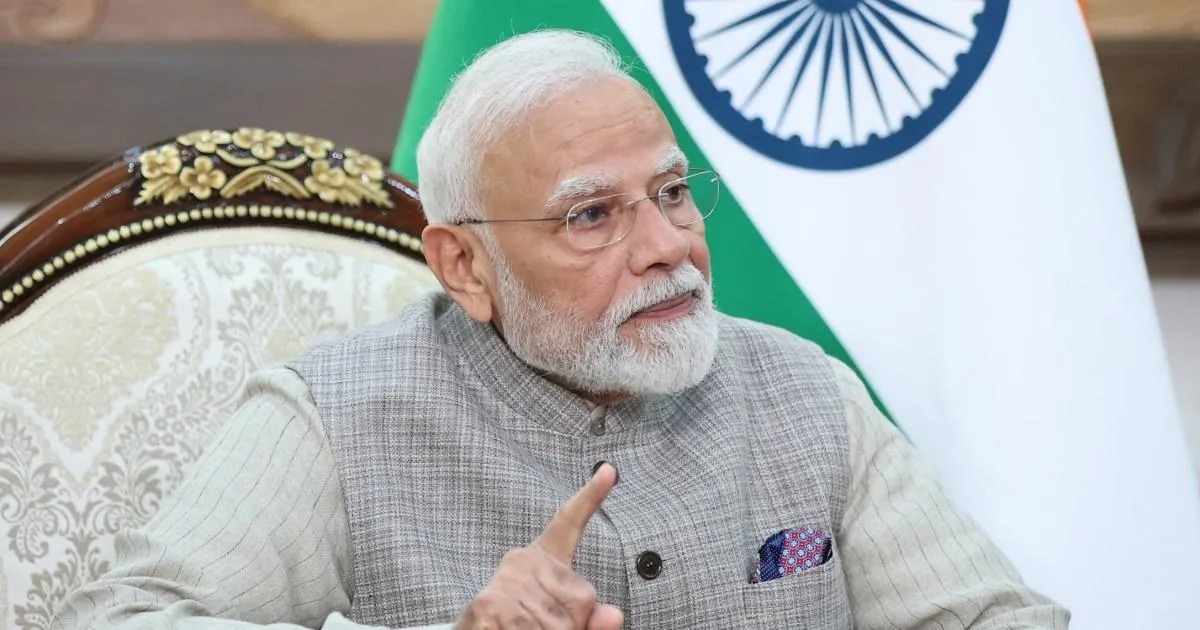
At a summit meant to project unity among nations pushing back against the West, the most striking image was not a handshake or a shared declaration. It was the sight of Russian President Vladimir Putin shifting uneasily in his seat as India’s Prime Minister Narendra Modi delivered a message that was as simple as it was devastating: the war in Ukraine must end. The two leaders were meeting on the sidelines of the Shanghai Cooperation Organisation summit in the Kyrgyz capital, Bishkek, a gathering of Russia, China, Iran, India, Pakistan and Belarus. The summit was celebrating its twenty-fifth anniversary, and its purpose was to present itself as a credible counterbalance to the West. But the opening moments of the Putin-Modi talks turned into an unexpectedly tense diplomatic moment. In video footage, Modi is seen speaking directly, his tone calm but firm, telling Putin that the ongoing war was setting humanity back. He said that every day the conflict continues, humanity loses ground, and every step toward peace offers genuine hope to the world. The directness of the remark was striking, especially from a leader who has carefully maintained close ties with Moscow. Yet there was no mistaking the weight of the words. Putin, who had been listening through a translator, appeared visibly uncomfortable. He put down his earpiece on the table, his face stern, as if the physical act of removing the translation device was a way of distancing himself from the message. It was a small gesture, but one that spoke volumes about the tension in the room.
Modi did not stop at a general appeal. He went further, saying that the world needed to move from endless war to an end to the war, to a cessation of hostilities. He framed the need for peace as the call of humanity, not just the position of India. “The land of Gandhi and Buddha shares a single message: the path of peace,” he told Putin. These words carried a moral weight that was hard for even the most hardened leader to dismiss. India, a country with deep historical roots in non-violence and spiritual diplomacy, was using its own cultural inheritance to make a point that transcended geopolitics. Modi also made clear that India would continue to support all peace efforts and would keep doing so in the future. According to a Kremlin transcript, he expressed support for any initiative that could bring the war to an end. For a leader who has often been criticized for remaining neutral on the invasion, this was an unusually direct and public statement. It was not a demand, not a threat, but it was a plea, and one that came from a man who has consistently refused to condemn Russia outright. That refusal has frustrated Western leaders, who have tried to pull India closer to the US-led alliance. Yet here, in front of cameras, Modi chose to use his influence not to isolate Putin, but to appeal to whatever common humanity remained. The juxtaposition was powerful: he called Putin “my friend” even as he urged him to stop the killing.
Putin’s response was brief, restrained, and perhaps deliberately vague. He looked at Modi and said, “Thank you very much, Prime Minister. We are moving forward along this path.” But his body language told a different story. The moment he placed his earpiece down on the table, it seemed as though he was closing a door, not opening one. He did not engage with the substance of Modi’s remarks, did not offer any commitment to peace talks, and did not acknowledge the human cost of the war. Instead, he retreated into diplomatic language, the kind that has become all too familiar since the invasion of Ukraine began in February 2022. Putin has repeatedly insisted that Russia will only end the war on its own terms. In a speech to the United Russia party on August 22, he dismissed any suggestion that the conflict was winding down. “The special military operation continues,” he said. “We will move only forward.” That phrase, “only forward,” stands in stark contrast to the path of peace that Modi urged. It reveals a leader who sees the war not as a tragedy to be ended, but as a mission to be completed. For Putin, withdrawing from Ukraine would mean admitting defeat, and that is something he seems unwilling to do, regardless of the international pressure. The discomfort visible in the video clip may not have been about the message itself, but about the source. Being challenged by a Western leader is one thing; being urged toward peace by a friend in the Global South is quite another.
The setting of the meeting added another layer of meaning. The Shanghai Cooperation Organisation was never meant to be a forum for public criticism. It is a grouping of powerful, often authoritarian, states that share a common interest in challenging the dominance of the West. Russia, China, Iran, India, Pakistan and Belarus came together in Bishkek to mark a quarter-century of that project. For years, the SCO has been a symbol of an alternative world order, one in which Western values and institutions hold no special authority. But Modi’s intervention showed that the bloc is not a monolith. India has walked a careful line since the start of the war. It has refused to join Western sanctions against Russia, and it has continued to buy Russian oil in enormous quantities. In fact, India and China have become the biggest buyers of Russian crude, providing Moscow with a lifeline of revenue even as the West tries to strangle its economy. Modi praised the growing economic ties between the two countries, and his personal relationship with Putin remains warm. But he also used the SCO stage to remind everyone, including the Russian president, that economic partnership does not mean moral endorsement. India’s position is deeply pragmatic. It needs Russian energy, Russian weapons, and Russian support on issues like Kashmir and China. Yet it also wants to be seen as a responsible global power, a voice for the developing world, a nation that can speak truth to power. This balancing act is not easy, and it was on full display in Bishkek.
Behind the diplomatic maneuvering, the human cost of the war continues to mount. The same week that Modi and Putin met, reports emerged that millions of Ukrainian books had been destroyed in what publishers described as deliberate Russian attacks. These were not accidental casualties of war. They were targeted efforts to erase Ukrainian culture, to silence voices, to destroy the very idea of a nation. Several publishers reported that recent attacks had severely hampered their ability to get new Ukrainian literature to readers. Books, after all, are dangerous things to an authoritarian regime. They carry ideas, memories, and dreams that no bomb can completely destroy. The destruction of libraries and printing houses is a reminder that this war is not just about territory. It is about people, about identity, about the right to exist. Modi’s words at the summit took on an even deeper resonance when set against this backdrop. When he spoke of humanity being set back a step every day the war continues, he was not speaking in abstractions. He was speaking about real lives, real families, real books being burned. The appeal for peace is easy to dismiss as rhetoric, but in the face of such destruction, it becomes an urgent moral demand. And yet, the world watches as the leaders of the SCO, nations that claim to represent the future of global order, struggle to find even a few words of common humanity.
In the end, the image of Vladimir Putin setting down his earpiece may become one of the defining moments of the summit. It was not a dramatic confrontation or a fiery speech. It was a quiet, almost awkward gesture that revealed the growing isolation of a man who has chosen war over peace, and pride over compassion. Modi’s message was not a threat. It was an invitation, an appeal from a leader who still believes that dialogue can triumph over destruction. But whether Putin heard it is another question. His response, “We are moving forward along this path,” was carefully chosen to mean nothing while appearing to mean something. It allowed him to acknowledge Modi’s words without accepting their message. The earpiece on the table, however, said what words could not. It said that he had heard enough, that he did not want to listen, that he was done with the conversation. The war continues. The books burn. The children cry. And the leaders of the world’s most powerful nations sit across from each other, speaking past one another, while humanity waits for a step toward peace that may never come. But perhaps the moment planted a seed. In the land of Gandhi and Buddha, the path of peace has never been easy. It is walked slowly, often in silence, through hardship and resistance. Modi may not have changed Putin’s mind in Bishkek. But he showed the world that even within the halls of power, someone is willing to say what so many people feel. And sometimes, that is where the journey begins.