
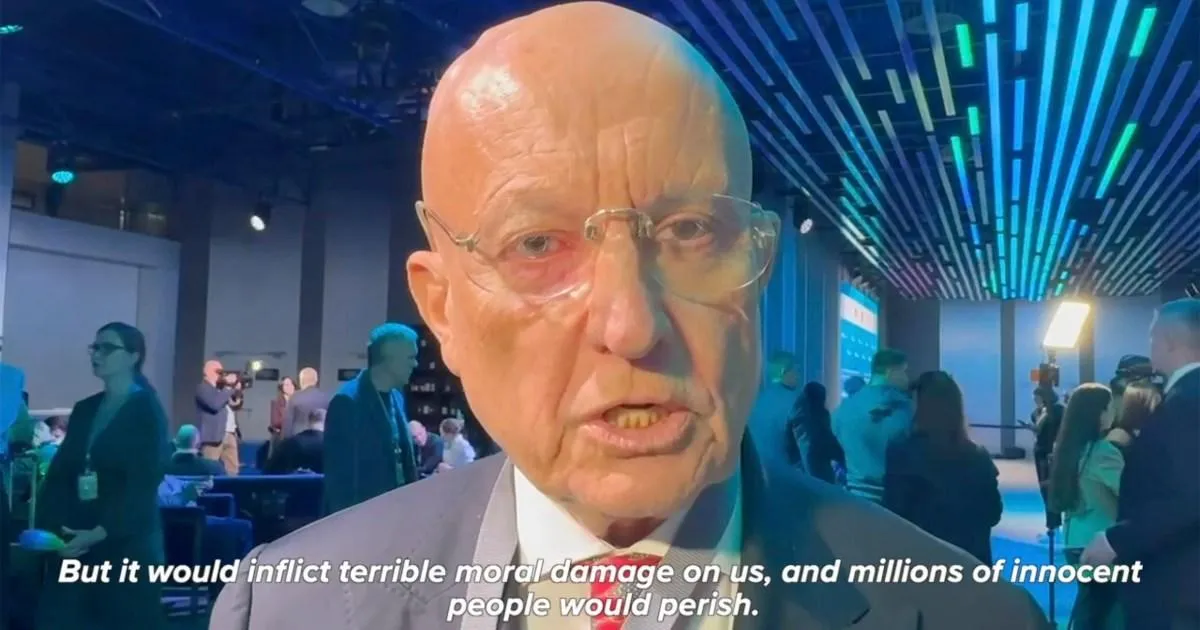
It begins with a voice that sounds like it belongs to a nightmare, yet it comes from a real person sitting in a place of immense power. Sergei Karaganov, a 74-year-old Russian foreign policy veteran who is so closely linked to the Kremlin that he has been dubbed “Professor Doomsday,” has issued a chilling warning that has sent ripples of fear across the world. Karaganov, who serves as Honorary Chairman of the Praesidium of Russia’s Council on Foreign and Defence Policy, is not a fringe figure or an armchair commentator. He is one of the most senior advisors to President Vladimir Putin, a man whose words carry weight in the corridors of the Kremlin. In a recent interview, he said that if Vladimir Putin presses the nuclear button, millions of innocent people will die. This is not a hypothetical threat or a piece of dramatic fiction. It is a real, terrifying possibility that has been placed on the table by someone who has direct access to the Russian leadership. The warning comes after weeks of rising tensions between Russia and the West, with both sides engaging in increasingly aggressive rhetoric and military posturing. For ordinary people living in NATO countries, in Ukraine, and even in Russia itself, his words are a reminder that the security of our world is far more fragile than many of us care to admit.
Karaganov did not hide his intentions or soften his message. He said that Russia would be forced to launch a nuclear strike if NATO countries deployed troops to Ukrainian territory, or if there were a direct threat to Russian territory. He specifically mentioned Kaliningrad, Russia’s Baltic Sea outpost, which is wedged between Poland and Lithuania and holds significant strategic value for Moscow. In his view, any NATO movement toward that region would be seen as a crossing of a red line, a provocation that would justify the use of the most devastating weapons ever created by humanity. The most disturbing part of his warning is not just the threat itself, but the calm, almost casual way in which he delivered it. He smiled at one point during the interview, as if discussing something as routine as weather patterns rather than the potential annihilation of entire cities. He said that he does not want a nuclear war and that he is actively working to prevent such a scenario, but his words betray a dangerous acceptance of nuclear conflict as a possible, even likely, outcome. When the interviewer reminded him that he had previously suggested a preemptive nuclear strike, Karaganov responded with two terrifying words: “It’s not too late.” This is the language of someone who believes that Russia should be willing to use its nuclear arsenal first, rather than wait to be attacked.
What makes Karaganov’s comments even more alarming is his apparent confidence in Russia’s ability to win a nuclear war in Europe. He claimed that such a war would be “easily won” by Russia, though he acknowledged that it would inflict “terrible moral damage” on his own country. He also said that millions of innocent people would perish, a phrase that feels almost absurdly inadequate when describing the actual consequences of a nuclear exchange. The reality is that even a so-called “limited” nuclear war would cause catastrophic loss of life, not just in the countries directly involved but across the entire planet. Scientists have long warned that nuclear detonations would send massive amounts of soot and debris into the stratosphere, blocking out sunlight, causing global temperatures to plummet, and triggering widespread crop failures and famine. In other words, Karaganov is talking about the possible end of civilisation as if it were a chess move. He also expressed satisfaction that both President Putin and Foreign Minister Sergei Lavrov have begun saying that if a war were to break out, it would be “very short.” This is a deeply worrying statement because it suggests that the Russian leadership is preparing the public for the idea that a nuclear war could be brief and survivable, a dangerous falsehood that has been repeated by nuclear strategists for decades.
The international response to Karaganov’s remarks has been swift and firm, at least from NATO. In a written response, NATO strongly denounced the threat of force and called out Russia’s rhetoric as irresponsible. The alliance reminded everyone that NATO is a defensive organisation and that none of its activities or exercises pose any risk to any part of Russia. This is an important point, but it is unlikely to reassure a world that has grown accustomed to Russian nuclear threats. Russia has repeatedly warned that it would use nuclear weapons if NATO and other European countries continue to “threaten” its territory. These warnings have become so frequent that they risk being normalised, but each one is a reminder of the extraordinary danger we face. The situation is further inflamed by concrete actions. Russia has announced a 27 percent increase in military spending, bringing its defence budget to a record £150 billion next year. This is not the budget of a nation preparing for peace. It is the budget of a nation preparing for a prolonged and potentially catastrophic confrontation with the West. While the specific news cycle may move on, the underlying tensions remain, and the possibility of a miscalculation or misunderstanding that spirals out of control remains horrifyingly real.
Behind the political rhetoric and strategic posturing, it is essential to remember what is truly at stake. Karaganov speaks of millions of innocent people dying, but those are not just numbers. They are mothers and fathers, children and grandparents, friends and lovers. They are people who wake up every morning with hopes and dreams, people who worry about their jobs and their families, people who laugh, cry, and love in the same way that people in Moscow, London, Washington, and Kyiv do. A nuclear war would not be fought between abstract entities called “Russia” and “the West.” It would be fought between real human beings, and the consequences would be suffered by real human beings, many of whom have no power over the decisions that lead to war. The bombs would not discriminate between soldiers and civilians, between the powerful and the powerless, between those who supported the conflict and those who simply wanted to live their lives in peace. They would incinerate cities, poison the land and water for generations, and leave survivors in a world of unimaginable suffering. And as the scientists remind us, the effects would not stop at the borders of the warring nations. The entire world would feel the consequences, including countries that had nothing to do with the conflict. This is the reality that Karaganov is speaking about with such detachment, and it is a reality that should terrify every single person on this planet.
In the end, the most important thing we can do is refuse to accept this as inevitable. Karaganov may believe that a nuclear war in Europe can be easily won, but history and science tell us otherwise. The only winning move in a nuclear war is to prevent it from happening at all. This requires leadership, diplomacy, and a genuine commitment to dialogue on all sides. It requires pushing back against the dangerous idea that nuclear weapons are just another tool in a military arsenal. It requires remembering our shared humanity, even when the rhetoric is filled with threats and ultimatums. The words of “Professor Doomsday” should be a wake-up call, not a reason for despair. They should remind us that peace is not something we can take for granted, and that it must be actively built and protected every single day. We cannot let ourselves become numb to the horrifying possibility of nuclear war. We must listen to the warnings, take them seriously, and demand that our leaders find a better way. The stakes could not be higher. Millions of innocent lives hang in the balance, and the decisions being made right now, in the halls of power, will determine the future of humanity itself. We may not have control over those decisions, but we have the power to raise our voices, to demand peace, and to remind the world that behind every political calculation lies the precious, irreplaceable value of human life.