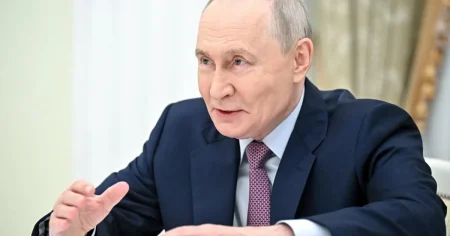


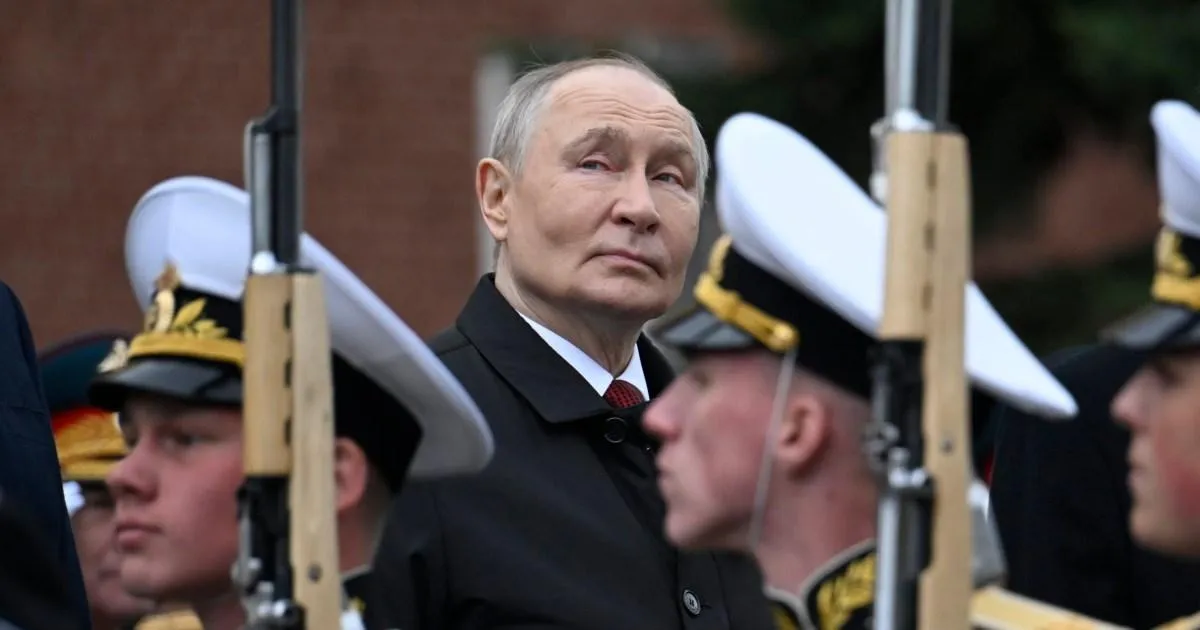
In the cold, unblinking language of government spreadsheets, 17.1 trillion roubles is just a figure. But numbers like that have a way of becoming flesh and bone, steel and smoke. According to documents seen by Reuters, Vladimir Putin is proposing to spend 17.1 trillion roubles — roughly £154 billion — on defence in 2027. That is more than a quarter higher than the 13.5 trillion roubles originally planned for that year. Across the next three years, the Kremlin’s military budget would total a staggering 50 trillion roubles, or about £450 billion. This is not a rounding error. It is a statement of intent. It tells the world that Russia’s ruler has chosen the path of war, and he intends to walk down it for years to come. The proposed increase is not merely an adjustment; it is an escalation. It comes at a time when many European countries are struggling with the cost of living, with healthcare, with housing. Yet in Moscow, the priority is clear: guns before butter, missiles before medicine. For ordinary Russians, this means more of their national wealth being poured into the machinery of conflict while their own futures are mortgaged to the Kremlin’s ambitions. For the rest of Europe, it means a neighbour that is arming itself at a pace not seen since the darkest days of the Cold War. The word “defence” in the budget is a euphemism. Much of this money will go toward the war in Ukraine, toward replenishing ammunition stocks, toward developing and producing the weapons that have already reduced entire cities to rubble. It is also a signal to NATO: Russia is prepared to endure economic pain, isolation and sanctions in order to maintain its military machine. The question that hangs over every diplomatic meeting, every summit, every late-night phone call between leaders is whether this relentless spending will ever translate into a broader conflict. The Kremlin would say it is merely protecting itself. Its neighbours hear something far more menacing.
Those fears are not confined to Eastern Europe. In London, the UK’s Defence Secretary Wes Streeting has used language that would have seemed unthinkable a few years ago. Russia, he said, is the biggest threat to Britain’s security. “We’ve got war in our continent. We’ve got a Russian president who has imperialist ambitions, who is constantly testing Britain’s defences, Nato defences and testing the strength of our alliances,” he told the public last weekend. Then came the sentence that should make every European pause: “the sobering reality is that we face a greater risk of war than we’ve done at any point in my lifetime.” Streeting is not a firebrand. He is a government minister responsible for the country’s security, and his words were carefully chosen. They reflect a consensus among Western intelligence agencies that Russia is not simply a distant problem in Ukraine, but an active, aggressive force that is probing the vulnerabilities of the entire Euro-Atlantic community. The phrase “imperialist ambitions” is important. It suggests that Putin’s goals are not limited to the Donbas or Crimea. It suggests a worldview in which Russia has a right to a sphere of influence, and in which the sovereignty of smaller nations is negotiable. For Britain, this means more than just watching events in Kyiv with concern. It means defending undersea cables, monitoring spy ships, countering cyber-attacks, and preparing for the possibility that a Russian aircraft might one day cross into NATO airspace with hostile intent. It means asking hard questions about whether the country’s own armed forces are ready, whether its defences are strong enough, whether its alliances are truly solid. Streeting’s warning was not alarmism. It was an honest assessment from someone who has access to intelligence that the rest of us will never see. And it was delivered in the plainest possible language: the risk of war is greater now than at any point in his lifetime. For a generation that grew up after the Berlin Wall fell, that is a terrifying thought. The Cold War was something from history books. Now it feels like a dress rehearsal for the present.
NATO’s Secretary-General, Mark Rutte, has been equally blunt. Speaking today, he said Russia is “testing us across Europe”. He listed the ways: airspace violations, arson, sabotage, and the Russian hybrid attack at Leipzig airport in August. These are not acts of conventional war, at least not yet. They are the grey-zone tactics of a power that wants to destabilise without triggering a full-scale response. Hybrid attacks are deliberately ambiguous. A fire at a warehouse, a GPS signal jammed over the Baltic, a suspicious drone near a military base — each incident can be dismissed as an accident or the work of criminals. But taken together, they form a pattern of intimidation. The goal is to sap the will of democratic societies, to make citizens feel unsafe, to force governments to spend time and money on threats that are hard to prove and harder to counter. Rutte acknowledged that NATO does not see an imminent military attack against the alliance. But he warned that Russia’s campaign of hostile actions against allies will continue. “We must all remain vigilant,” he said. It is a message that carries particular weight in the Baltic states, in Poland, in Finland — countries that share a border with Russia or lie within easy reach of its missiles. But it is also a message for Western Europe, where many people have grown accustomed to peace and prosperity and find it hard to imagine tanks rolling across the continent again. The Leipzig airport incident Rutte mentioned is a case in point. In August, reports emerged of a Russian-linked hybrid attack at the German airport, part of a broader pattern of interference that has included everything from cyber-attacks on government websites to attempts to recruit asylum seekers for sabotage. These are not the actions of a country that wants peaceful coexistence. They are the actions of a country that is waging a slow, calculated campaign against the West, probing for weaknesses, testing the limits of solidarity. The challenge for NATO is to respond firmly without escalating. Every exercise, every patrol, every statement is a balancing act. Too little and Russia will see weakness. Too much and it could provoke the very conflict everyone wants to avoid.
The most alarming development, however, is the Kremlin’s renewed nuclear rhetoric. In a diplomatic note seen by Reuters, Russia warned NATO that it would be ready to use the “entire arsenal of forces and capabilities at its disposal, including nuclear weapons” to defend its territory if the alliance attempted to isolate the Kaliningrad region from the rest of the country. Kaliningrad is a heavily militarised Russian exclave wedged between Poland and Lithuania, both NATO members. It is slightly bigger than Connecticut, but its strategic importance is enormous. It hosts Russia’s main Baltic navy base, along with a range of military assets, including nuclear-capable Iskander missiles. For NATO planners, Kaliningrad is both a threat and a target. Western military officers have said that key installations there would be among the first struck if Russia ever launched an attack on an ally. The Russian note accused NATO of a “dangerous and reckless course” that entailed “high risks of the outbreak of a direct armed conflict”. It even raised the possibility of Russian strikes against decision-making centres in NATO member states “right from the outset”. That is not diplomatic language. It is a threat to bomb capitals. It is hard to overstate how chilling this is. Nuclear weapons have not been used in war since 1945, and the idea that a major power would openly threaten them in a written communication to a military alliance is something out of the most frightening Cold War scenarios. Russian Foreign Ministry spokeswoman Maria Zakharova added her own ominous commentary. Citing statements by NATO dignitaries that she claimed demonstrated “Russophobia” and a readiness to wage war, she said these figures “need to be brought back down to earth”. Then came the line that will haunt anyone who reads it: “If Europe attacks Russia, it will be a completely different sort of war — a very short war.” The implication is clear. A war between Russia and NATO would not be a long, grinding conflict like the one in Ukraine. It would be nuclear, and it would be over quickly — because the world as we know it would be over too. Whether Zakharova’s words are bluff or genuine intent is impossible to know. But in the fog of nuclear threats, no one can afford to assume they are empty.
NATO’s response has been firm, but carefully measured. Spokesperson Allison Hart confirmed on Wednesday that Russia had sent a written message to the alliance. “We strongly denounce the threat of force, including any irresponsible nuclear rhetoric,” she said. She insisted that NATO is not targeting Kaliningrad and had sent a reply “noting that Nato is a defensive alliance and none of our activities or exercises pose a risk to any part of Russia”. That is the official line, and it is true in the narrow sense that NATO has no plans to invade Kaliningrad. But the alliance has been conducting a series of military exercises in the Baltic Sea region, with more planned in October. Last year, it launched Operation Baltic Sentry to protect communication cables and pipelines from sabotage. These are defensive measures, but they are also shows of force. The tension is obvious. Russia sees NATO’s presence in the Baltic as a threat to its exclave. NATO sees Russia’s missiles in Kaliningrad as a threat to its members. Each side believes it is acting defensively, and each side interprets the other’s actions as preparation for aggression. This is the classic security dilemma, and it is playing out in real time on Europe’s eastern flank. The danger is that a single miscalculation — a drone, a stray missile, a misunderstood signal — could trigger a chain reaction. Military exercises are supposed to reduce that risk by demonstrating readiness and deterring attack. But they can also be misread as preparation for an offensive. The fact that Kaliningrad is surrounded by NATO territory makes it uniquely vulnerable and uniquely dangerous. Russia has always treated it as a fortress, a place where its Baltic fleet can shelter and from which it can project power. The idea that NATO might try to cut it off from the rest of Russia is, from Moscow’s perspective, an existential threat. From NATO’s perspective, the idea is absurd; the alliance has no interest in seizing Russian territory. But in a crisis, perceptions matter more than reality. The exchange of notes between Russia and NATO is a sign that communication channels are still open, which is good. But the content of those notes is a reminder of how close to the edge we are. Every word of nuclear rhetoric, every exercise, every intercepted aircraft brings the world a little closer to a confrontation that no one can control.
What does all this mean for the people who are not in government bunkers, not in military command centres, not in the rooms where these decisions are made? It means waking up to news alerts about nuclear threats. It means watching the price of energy and food rise because a war on the other side of Europe is disrupting supply chains. It means reading about Russian hybrid attacks and wondering whether the suspicious van parked down the street is just a delivery vehicle or something more sinister. It means, for Ukrainians, living with the daily reality of bombs and drones and blackouts and funerals. The numbers in Russia’s defence budget are not abstract. They are the price of the missiles that have already killed thousands of people. They are the cost of the drones that buzz over Kyiv at night. They are the wages of the soldiers who are sent to the front with inadequate training and equipment. Behind every trillion roubles is a destroyed home, a shattered family, a city reduced to rubble. And behind the warnings from British and NATO officials is a genuine fear that this could spread. The human impulse is to look away, to hope that the leaders will sort it out, to believe that war is something that happens to other people in other times. But the people who are paid to think about these things are telling us that this time is different. They are telling us that the risk of a wider war is real, that the threat of nuclear weapons is not just a rhetorical flourish, and that the institutions we have relied on for seventy years are being tested as never before. It would be easy to give in to despair. But despair is exactly what the Kremlin wants. The purpose of nuclear threats and hybrid attacks is to make us feel helpless, to divide us, to convince us that resistance is futile. The only way to counter that is to remain clear-eyed and steady. That means supporting Ukraine, strengthening NATO, investing in defence, but also keeping the door open to diplomacy. It means understanding that deterrence is not the same as provocation, and that strength is not the same as aggression. The next few years will be dangerous. The budgets are being set, the missiles are being deployed, the warnings are being issued. But history is not written in advance. The choices that leaders make — and the pressure that ordinary citizens put on them — can still shape the outcome. We are not bystanders. We are part of this story, and the story is not over yet.