


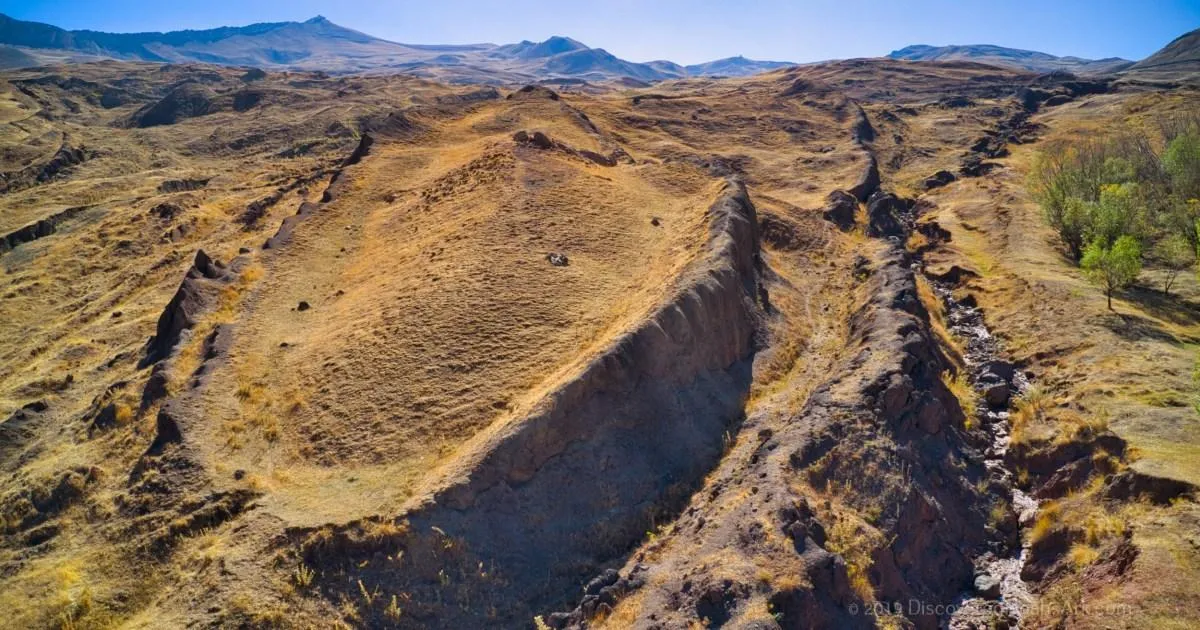
For centuries, the story of Noah’s Ark has captivated the human imagination, a tale of divine judgment, immense faith, and the preservation of life itself. Now, a team of researchers believes they are closer than ever to proving that the legendary vessel is not just a myth, but a tangible artifact buried deep within the mountains of eastern Turkey. The site of this potential paradigm-shifting discovery is the Durupinar Formation, a remarkable, boat-shaped geological feature nestled near the peak of Mount Ararat, a location long associated with the Ark’s final resting place. For decades, this formation has been a focal point for creationists, archaeologists, and adventurers alike, its silhouette offering a tantalizing glimpse of a possible answer to one of history’s greatest mysteries. Recent technological advancements, however, have moved the conversation from speculation and faith-based inference to the realm of data-driven scientific inquiry, providing compelling evidence that might just rewrite history as we know it.
The new wave of evidence comes from a private research group called Noah’s Ark Scans, which has employed cutting-edge ground-penetrating radar (GPR) technology to peer beneath the surface of the Durupinar Formation. Their preliminary findings, which have sent ripples through the archaeological and theological communities, point to a complex, man-made structure hidden beneath the earth. The lead researcher, Dr. Khosrow Bakhtar, an engineer with decades of experience working for US defense agencies, developed a proprietary radar system to conduct the scans. What he and his team found was unexpected and nothing short of extraordinary. Instead of the homogenous, natural rock formations one would expect from a geological feature, the radar revealed a tightly organized network of internal spaces—corridors, hallways, and chambers—that are distinctly non-random in their arrangement. This internal architecture is the key piece of evidence, as it strongly suggests that the structure was designed and built by intelligent beings, rather than sculpted by natural erosion and tectonic activity.
Dr. Bakhtar’s expert analysis of the radar data is the cornerstone of the new claims. He has stated with conviction that the signature returned by the radar is unlike anything he has encountered in his forty-year career. A natural geological mass, he argues, would not produce such a structured, organized signal. The placement of the voids and the linear patterns of the internal “walls” indicate a deliberate blueprint, echoing the Biblical description of an Ark built with specific dimensions and internal compartments. The scale is also a significant factor, as the formation itself measures an astonishing 515 feet in length, which aligns remarkably well with the Biblical measurement of 300 cubits. While skeptics have long dismissed the formation as a curious quirk of nature, the new radar data presents a formidable challenge to that narrative, making a compelling case that humanity might be standing above the physical remnants of the greatest vessel ever constructed.
The mystery deepens with the results of soil and material analysis conducted at the site. In 2024, researchers collected samples from the surrounding area and discovered abnormally high levels of potassium, as well as evidence of decomposed lumber. These findings transform the story from one of simply visible stone and earth to one that involves biological and man-made materials. The presence of wood, broken down over millennia, is exactly what one would expect to find at an archaeological site, and its proximity to the boat-shaped formation lends credence to the theory that it is not just a rock formation, but a shipwreck of monumental proportions. Furthermore, the research team, including independent researcher Andrew Jones and his colleague William Crabtree, has mapped out a series of tunnels that traverse the formation. These aren’t just random fissures in the rock; they follow a deliberate pattern, with some tunnels leading to what appears to be a large, hollow central chamber. This layout beautifully mirrors the narrative of the Ark, which housed a central living space for Noah, his family, and the animals during the flood.
The human element of this discovery is what truly brings the story to life. The researchers are not detached scientists in sterile labs; they are explorers driven by a sense of wonder and purpose. Dr. Bakhtar describes the find with an almost poetic reverence, musing over the possibility that the object beneath the surface “could be a ship. It could be a spaceship.” This sense of awe is shared by his colleagues. William Crabtree paints a vivid picture of the site, describing a tunnel leading from the top of the formation down towards its middle, a passage large enough for a person to walk through. Their ultimate ambition is as thrilling as it is logical: to get inside. They want to move beyond radar scans and surface samples and achieve direct access to the structure’s core. The plan involves core drilling to retrieve samples from deep within the identified chambers and, most excitingly, lowering a camera into the voids to visually confirm the existence of the internal architecture and its contents. This could potentially reveal evidence of animal DNA, which would be the smoking gun, proving that the vessel once carried living creatures.
Of course, the archaeological and scientific worlds remain deeply divided on the validity of these claims, and rigorous skepticism is a healthy part of the process. Critics have long pointed to the Durupinar Formation as a textbook example of a “pareidolia” event—a psychological phenomenon where the human brain perceives a familiar pattern, like a boat, in a random stimulus. The shape of the mound, while boat-like, has been previously studied and dismissed by many geologists as a natural up-thrust of rock and mud, perhaps a solidified mudflow. They argue that erosion can create remarkably regular shapes and that the “corridors and chambers” seen in radar scans could be misinterpretations of layered geological strata, faults, or pockets of different soil types. The burden of proof for such an extraordinary claim as confirming the physical existence of Noah’s Ark is immense. A radar scan, while powerful, is still an indirect method of exploration. The ultimate validation rests on a physical excavation, which is a complex and politically delicate endeavor given the site’s location and significant religious importance. Until the team can successfully drill or dig into the structure and reveal a physical, indisputable human artifact—like a wooden plank, a metal fitting, or an artifact of the cargo—the scientific community is right to demand more evidence.
Regardless of what the ultimate outcome is, the research at the Durupinar Formation serves as a powerful reminder of the profound connection between faith, history, and science. For believers, this investigation validates the Bible’s account, offering physical proof of a story that has shaped the spiritual landscape for thousands of years. For the scientific community, it represents a fascinating geological and archaeological puzzle, challenging them to remain open to new possibilities and to use advanced technology to test age-old hypotheses. The scans have not solved the mystery, but they have dramatically reopened the case, injecting new life into a debate that most assumed was closed. The prospect of a full publication of the radar data in November, followed by potentially groundbreaking core sampling, has the world waiting with bated breath. The ancient mariners who built a vessel to survive the apocalypse may have left behind more than just a story; they may have left behind a tangible message from the past, waiting for the right moment to reveal itself. Whether it is a divinely ordained ship or a remarkable natural phenomenon, the Durupinar Formation has once again captured our collective imagination, standing as a silent sentinel to one of the greatest questions ever posed: Did the great flood truly happen, and will the legend of Noah’s Ark ever be fully unveiled?