

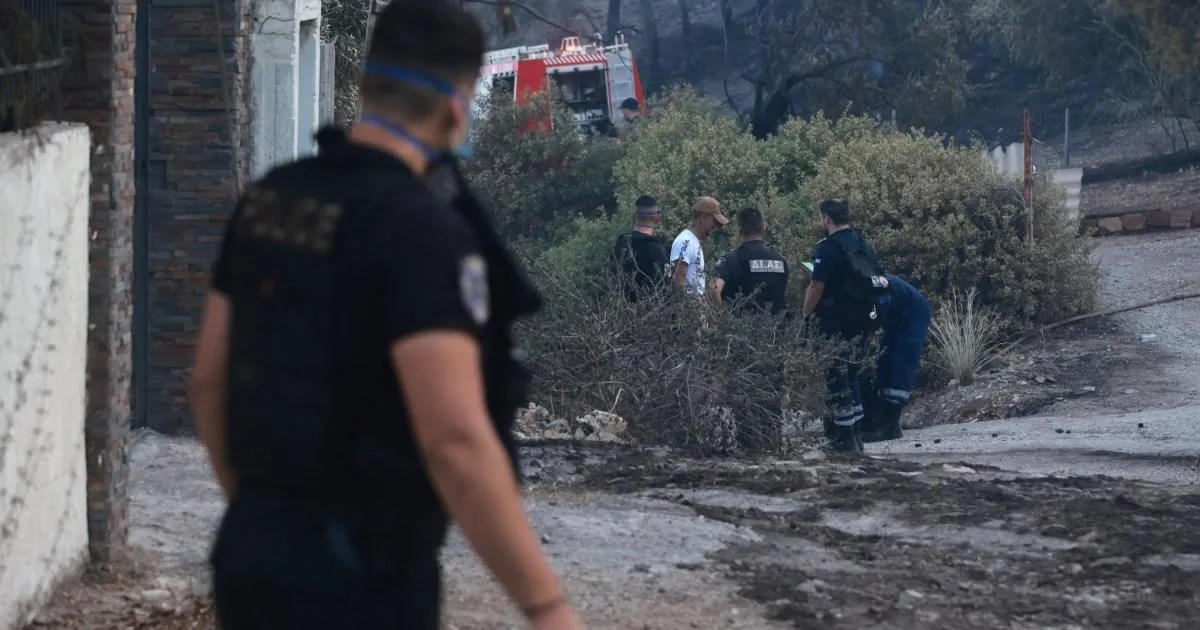
The Kypseli neighbourhood of Athens is not the kind of place where anyone expects to find a dead child hidden inside a suitcase. It is a dense, lively, working-class quarter of the Greek capital, home to families, migrants, students and elderly pensioners, a place where washing hangs from balconies and women gossip on street corners in the afternoon heat. But it was in a second-floor holiday flat on Thasos Street that police made a discovery that has shaken the entire country. Acting on a landlord’s suspicion, investigators entered the apartment and found a baby boy’s body preserved in a jar, tucked away inside a suitcase as if someone had tried to erase the evidence of a life that had ended in violence. Forensic pathologist Symeon Mesogitis later confirmed that the child had been stabbed ten times in the back. The wounds were so severe, and the body in such a condition, that it was impossible to determine the baby’s age with certainty. Initial inquiries, however, suggested that the child might have been between eight and nine months old when he died, and that his body may have been moved from another location in Athens before being hidden in the flat. A 38-year-old German woman, the child’s mother, and a Greek man, the child’s father, were arrested. Neighbours described the flat as a place of strange comings and goings, of children who seemed unattended, of a family that did not seem to fit together. But nothing in their quiet suspicions could have prepared anyone for the horror that was behind that door.
Even in a case so grim, the father’s alleged words stand out as extraordinarily chilling. According to reports, he told police that the baby had ‘cried constantly’ and that he believed the child had been swapped in hospital with a ‘satanic child’. He reportedly added, with an almost terrifying sense of relief, that ‘as soon as he died our house calmed down’. These are not the words of a man who appears to understand the gravity of what he is accused of. They are the words of someone whose mind may have been twisted by delusion, untreated mental illness, or the toxic pressure of a profoundly dysfunctional household. They also raise a disturbing possibility: that the baby was not seen as a human being by the people who should have protected him, but as a problem, an intruder, a source of chaos that had to be removed. The mother, meanwhile, initially claimed that the baby was her own fetus and that she had aborted it about eight months earlier. That claim is now being investigated, but it collides with the physical evidence: a child who had been born and lived for months, who had a body that showed multiple stab wounds to the back, and whose remains were deliberately hidden. Whether these statements are lies designed to escape responsibility, or the product of a shared delusional belief, they reveal a catastrophic failure of human empathy at the centre of this tragedy. To describe a living child as ‘satanic’ is not merely an act of superstition; it is a way of dehumanising that child, of making violence feel justified, or even necessary.
The forensic investigation is now at the heart of the case. The coroner was unable to determine the age of the baby because of the condition of the body, and because of the injuries to the back. This is a detail that should stop every reader cold: the very violence that ended the child’s life has also made it harder to say how old he was, to reconstruct his short history, to give him a timeline and a name. Investigators believe he may have been eight or nine months old when he died, meaning he would have been a baby with a personality, with preferences, with the beginning of a relationship with the world around him. He may have learned to sit up, to recognise faces, to reach for things. He may have been on the cusp of crawling or even walking. And at some point, somewhere in Athens, he was stabbed ten times in the back. The fact that the body may have been moved from another location suggests a calculated effort to cover up the crime. The mother’s story about an abortion, too, is an attempt to rewrite the past, to shrink the child back into the womb and deny that he ever lived outside of it. But the forensic evidence will not be easily silenced. DNA tests are being carried out on the children found in the flat to establish whether they are related to the adults, and local reports indicate that the children are being tested for sexually transmitted infections. Those tests, if they come back positive, would open a whole other layer of horror: not just a dead baby, but a household in which vulnerable children may have been exposed to abuse and exploitation.
Perhaps the most troubling part of this case is that the dead baby was not the only vulnerable child in that flat. When police arrived, they found three children living there, including a 15-year-old girl who was pregnant. They also arrested a 25-year-old Afghan man, although it is not yet clear what his role in the household was. The flat, which had been rented for just two people, was filled with items that made little sense for an ordinary family: police found many sex toys, a camera, a laptop and drugs. Those discoveries, combined with the presence of a pregnant teenager, the reports of strange relationships, and the decision to DNA-test the children, have fuelled disturbing speculation that the apartment may have been used for something far darker than simply housing a struggling family. The children were reportedly seen going out onto the street alone, sometimes at odd hours, and the front door was often left open, with people waiting outside who would ring ahead to be let in. This is not the description of a safe, stable home. It is the description of a space that sounds transient, chaotic and dangerous. The children found in the flat are now the focus of a safeguarding investigation, and their futures will be shaped by what they have witnessed and experienced. No child should have to live in a place where dead bodies are hidden in suitcases, where adults claim to believe in satanic babies, where sexual paraphernalia sits alongside drugs and cameras. And yet, nobody in the building seems to have acted until the landlord grew suspicious enough to investigate.
The landlord’s account brings the story down to street level, and it is full of grief and guilt. He told local media that he suspected something was going on, so he went to the apartment to check. He had rented the flat to three people, but when he arrived, he saw six. He saw an Afghan man, and once he did, ‘some things started to not make sense.’ He described the flat as being in a dreadful state. He locked their belongings inside so that they could not vanish before the police arrived. He waited for the man to come back, but the man was not answering his phone. And while all this was happening, a little girl came out. Then a nine-year-old child appeared from one of the rooms, and the landlord said that this child ‘looked nothing like the others’. It was at that moment that he began to suspect something was deeply wrong. Inside the apartment, he found sex toys, a camera, a laptop and drugs. ‘There was no sense to the relationships between them,’ he said. ‘None of it added up.’ The landlord’s actions may well have ensured that the case came to light, and for that he deserves credit. But his words also evoke a feeling of ordinary people facing something they are not prepared for. How do you make sense of a household where children appear to belong to no one, where a baby’s body is hidden in a jar? How do you know when a neighbour’s odd behaviour has crossed the line into something criminal and lethal? The landlord did the right thing, but the case will haunt him. He will ask himself whether he should have acted sooner, whether a child would still be alive if he had. The answer is unknown, but the question will persist.
At the heart of this case is a baby boy whose life ended in violence and whose body became evidence. He was somebody’s son, somebody’s brother, a small human being who deserved to be fed, held, protected and loved. Instead, he was stabbed ten times in the back and stored inside a jar, hidden away in a suitcase, treated as a thing rather than a person. The father’s alleged words—that the house calmed down once the child died—suggest a household so broken that the presence of an infant was experienced as a curse rather than a blessing. The mother’s initial claim that the baby was merely an abortion she had eight months ago suggests an attempt to deny that the child ever lived, ever breathed, ever existed. The other children in the flat, including the pregnant 15-year-old, now carry the weight of this tragedy with them, their bodies and minds tested, interviewed, examined. This case is not just a murder investigation; it is a stark reminder of how easily society can miss the warning signs. Neighbours saw children alone. The landlord saw relationships that made no sense. The front door was left open. People rang ahead. There were drugs, cameras, sex toys. And yet, no one was able to prevent the death of a baby. This is the uncomfortable truth of such cases: they are not always invisible. Sometimes the signs are there, scattered like breadcrumbs, waiting for someone to follow them. But by the time someone does, it can already be too late. The investigation will now determine who is responsible for the baby’s death and for the conditions inside that flat. It will test DNA, examine phone records, question the children, and piece together a timeline of broken trust and misplaced loyalty. But no forensic result will bring the child back. The best that can be hoped for is that the truth is told, that justice is done, and that the living children are given the safety and care they were denied. And perhaps, in their memory, all of us can learn to look a little more closely at the families around us, to ask the difficult questions, and to act when something says, loud and clear, that none of this makes sense.