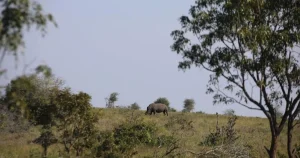

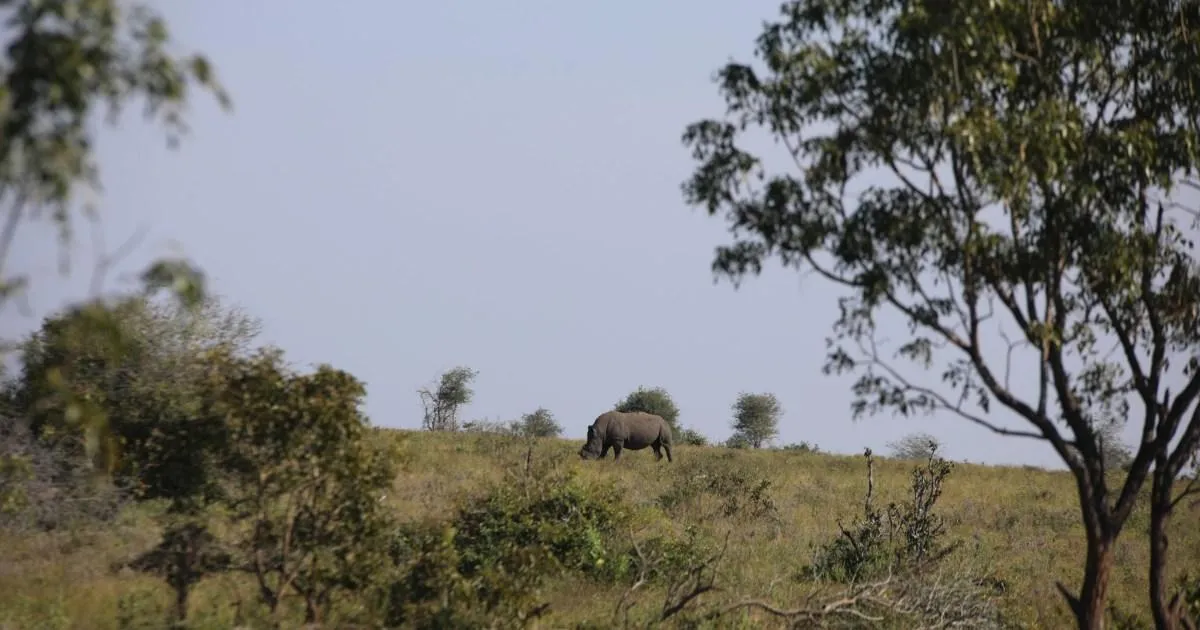
Under the blazing African sun, in a corner of the world where life and death are separated by the smallest mistakes, two men made the worst decision of their lives. They had slipped illegally into Kruger National Park, one of the world’s greatest wildlife sanctuaries, carrying high-powered rifles and an axe. They were not there to admire the landscape or to photograph the animals. They were there to kill. Their targets were white rhinos, a herd resting near a water source, unaware that human predators were approaching through the pale, dry grass. The men had a promise of roughly £10,000 in their minds, a fortune in a country where poverty drives desperate people into criminal enterprise. They raised their weapons, steadied their breathing, and prepared to take a shot that would end a rhino’s life and make them rich. But they had failed to notice the elephants. A group of African elephants had been sheltering from the harsh sun beneath the trees, their massive bodies half-hidden by leaf shadows. They must have sensed the danger before the rhinos did. As the poachers closed in, the elephants broke cover and charged with a fury that shook the earth. It was not a warning. It was an attack. The two men ran in different directions, panic overwhelming any training they might have had. The one preparing the shot was the slowest. The elephants reached him quickly, and in the chaos of tusks and feet and dust, he was overrun. A Kruger National Park source described what remained: “Basically a very large bloodstain around the clothing he was in.” In less than a minute, a man who had intended to turn a rhino into a pile of hacked meat had become nothing more than a dark stain in the soil, with no body left to bury, no funeral, no memorial. The elephants, having done their work, returned to the trees as if nothing had happened. They had no need to understand what they had just done; they had simply protected their world and the creatures in it.
Somewhere in the chaos, the second poacher escaped. His flight was not a triumph. It was the beginning of a different kind of nightmare. Park officials captured him quickly, snatching him before he could find his way out of the reserve. The alarm had been raised at Pafuri Ranger Lodge, a remote and atmospheric outpost in the northern reaches of Kruger. Rangers left the lodge and hiked roughly six kilometers inland, following tracks that led them toward a river. There, near the water, they found the rhino herd still moving in its slow, peaceful rhythm. And close by, they found the evidence of the attack: the clothes, the blood, the trampled ground. The survivor was handed over to South African police to face trial, and he will now have years to sit with the memory of what happened. He will have to explain to judges and lawyers why he was in a restricted national park with a high-powered rifle and an axe. He will have to live with the knowledge that his accomplice died screaming while he ran. Perhaps he will even dream of the elephants, their enormous shapes rising out of the heat, their eyes, their silence. This is a moment that will define the rest of his life. The tragedy is that he may not recognize that he was also a victim of the same system that drives so many young men into poaching: poverty, inequality, and the false promise of a golden payday. But in the eyes of the law, he is a poacher, a criminal, and a would-be murderer of endangered animals. There is little room for sympathy when 175 rhinos were slaughtered in Kruger last year. The survivor’s fate will be decided in a courtroom, but he has already been judged by the bush itself.
To understand why these men took such a huge risk, you have to understand the ruthless arithmetic of the illegal wildlife trade. Kruger National Park is a colossal reserve, roughly the same size as Wales, and it remains one of the last safe places on Earth for white rhinos. Around 1,850 of these enormous, gentle-looking animals wander its plains and woodlands, part of a landscape that also supports the famous Big Five: elephant, rhino, buffalo, lion, and leopard. But the rhino is under siege because its horn has become one of the most expensive materials on the planet. The horn is made almost entirely of keratin, the same protein found in human fingernails and hair. It has no proven medicinal value. None. Yet in parts of East Asia, it is treasured as a “magic cure” for fevers, liver problems, cancer, and a hundred other ailments. Ancient superstition and modern greed have created a global black market that is worth billions. Poachers are paid a fraction of the final price, but even that fraction is enough to change a life. The men who enter Kruger with rifles and axes are usually not the kingpins; they are foot soldiers, often poor and desperate, deployed by criminal syndicates that operate across borders. Once a rhino is shot, the horn is hacked off and passed up a chain of handlers. After export, it can be worth up to twenty times its original value. The £10,000 promised to the poachers is pocket change to the traffickers but a life-changing fortune to a rural laborer. This is where the real tragedy lies. The men who died and the man who survived were not monsters; they were part of a machine, blinkered by poverty and lured by greed. Still, the animals pay the price, and last year alone, 175 rhinos were shot dead inside Kruger. Every one of those deaths was a violent, senseless slaughter. Every one removed a creature that had survived more than fifty million years of evolution.
The elephants in this story deserve a closer look. They have been cast as heroes, but that word is too small for what they did. African elephants are extraordinarily intelligent creatures, with large brains, complex social networks, and an astonishing capacity for memory and emotion. They grieve their children. They comfort one another. They have been known to stand beside a dying friend, stroking its skull with their trunks. They communicate over long distances using infrasound, and they recognize individual humans, sometimes holding grudges for decades. The furious charge that destroyed the poacher may not have been simple instinct. It may have been an intentional act of protection. As the park’s spokesperson noted, “Elephants are extremely intelligent and, as people say, they never forget and may well have witnessed poachers before sneaking up on rhinos and went to protect them.” It is a chilling but beautiful thought: the elephants had perhaps seen other rhinos fall to gunfire. They had perhaps encountered the scent of men who smell like guns and blood. They knew what those approaching humans were planning, and they made a choice. There is no cruelty in that choice. There is no guilt. The elephant herd was sheltering from the sun when their peace was invaded by armed intruders. They could have run away. They could have ignored the danger. Instead, they moved toward it, using their immense bodies and their coordinated strength to overwhelm the threat. In doing so, they became the rhinos’ protectors, the guardians of the water source, and perhaps the greatest defense force that nature could provide. It is not anthropomorphic to say that they acted with purpose. Any mother elephant would understand. They were not punishing a man; they were defending a family. And in the silent world of the African bush, that distinction matters.
The public has responded the way people often do when they are exhausted by tragedy: with raw, unfiltered emotion. On Facebook, where the story spread quickly, the dead poacher found little sympathy. One person wrote: “The elephants are the gatekeepers! I wish the hyenas got to them after they did.” Another posted: “Elephants have done justice for the targeted rhinos! Big ups to the elephant family for helping the game rangers do their job out there.” The comments are not especially kind, but they are honest. They reflect the frustration of people who have watched the world largely fail to stop the killing of rhinos. For years, each new story from Kruger has been a story of corpses with missing horns, calves orphaned by bullets, rangers ambushed by armed gangs. The animals never get a chance to fight back. Then, suddenly, an elephant herd delivered what many see as natural justice. It is worth pausing, though, to consider the human dimension of this loss. The man who was trampled was not a faceless villain in the minds of everyone. Somewhere, someone waited for him to come home. Somewhere, a mother may be mourning. He made a terrible choice, a criminal and immoral choice, and he paid for it in the most brutal way imaginable. But the fact that so many people feel no pity reveals how deep the wounds of the poaching crisis have become. It is not that people are joyfully heartless; it is that they are desperately protective of the animals who have no one else. The elephants did not need to celebrate their victory. They simply did what had to be done. And for many, that is enough.
Kruger National Park will carry the memory of this moment long after the bloodstains have been washed by rain. The rangers who answered the alert from Pafuri Ranger Lodge will continue their patrols, walking the same six kilometers from the lodge toward the river, watching for fresh footprints, listening for distant gunshots. The surviving poacher will go to trial, and the world will likely forget his name. The rhino herd will keep moving through the bush, ignorant of how close they came to being hacked apart. And the elephants will remain, enormous and ancient and ever watchful. There is something deeply reassuring about the fact that a herd of elephants, embodying all that is wild and uncontrollable, can still make that kind of decision. They are not weapons of war. They are not hired guards. They are living creatures, with minds and hearts and memories that we are only beginning to understand. They may never tell us what they were thinking that day. But their actions have become a powerful symbol. The wild is not a passive victim. It is dangerous. It is awake. It is capable of defending itself. The men who broke into Kruger with rifles and an axe thought they were entering a hunting ground. They discovered too late that they had entered a world that does not tolerate cruelty. The elephants are still there, under the trees, beside the water, listening to the rhythm of the land. They remember the poachers who came. They remember their own dead. They remember everything. And as long as there are rhinos to protect and fools willing to kill them for money, the elephants will keep watch.