
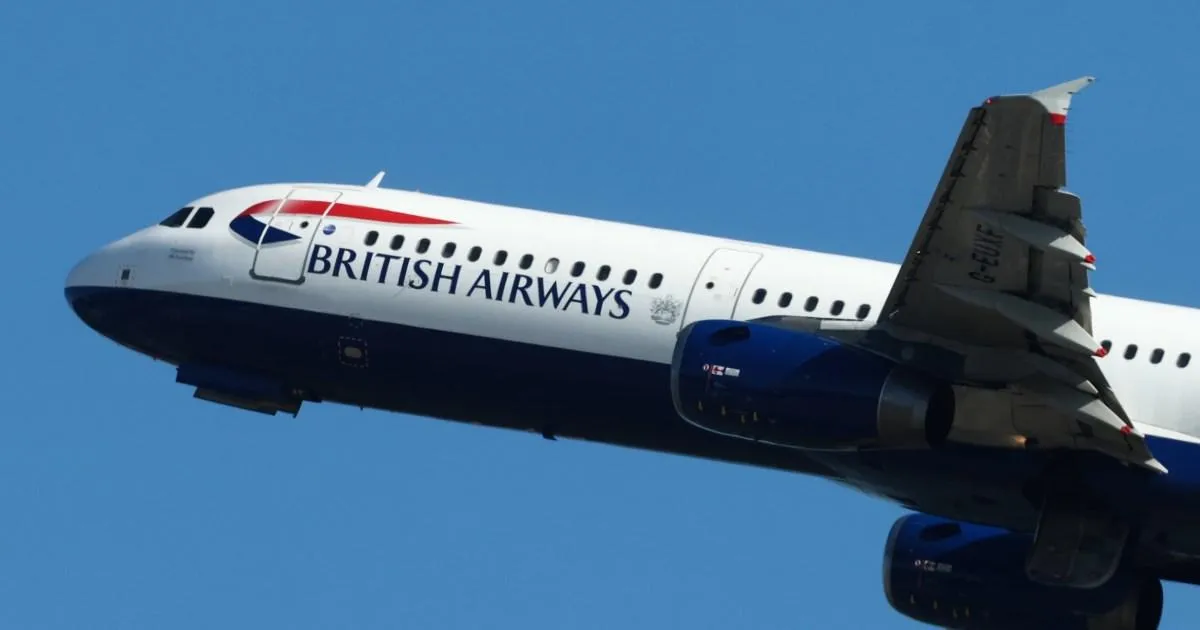
It was supposed to be a smooth, sun-drenched escape: a morning departure from London Gatwick, a short hop across the English Channel, and a touchdown in Faro on Portugal’s stunning Algarve coast. For the passengers on British Airways flight BA2660, the day had started with the usual holiday excitement—suitcases stuffed with swimwear, sun cream, and paperbacks, children squirming in their seats, and the quiet relief that comes with finally being airborne after months of planning. The Airbus A321-231, operated by BA EuroFlyer, lifted off from the UK’s second-busiest airport at around 9am, climbing into a crisp morning sky. The flight plan was simple enough: head south, cross over France, and within about two and a half hours, begin the descent into Portugal. But roughly an hour into the journey, as the aircraft cruised somewhere beyond the coast of Brittany, something changed. Tracking websites showed the plane suddenly make a sharp U-turn. AirNav Radar, which monitors aircraft movements, raised the alarm: the flight had declared an emergency. The pilots were not continuing to Faro; they were turning back to Gatwick. For the passengers onboard, the announcement must have been jarring—a break in the cabin’s calm routine, a flicker of unease as the plane banked and the Atlantic coastline slid beneath the wings. What had looked like a routine holiday flight had suddenly become something else entirely.
The exact nature of the problem began to emerge through aviation tracking and incident-monitoring channels. AirLive, a source that tracks such events, reported that the pilots had spotted “structural damage to a window panel on the right side of the aircraft.” In layman’s terms, a passenger window was cracked. It was an unconfirmed report at first, but AirNav Radar echoed the concern on social media, posting: “A passenger window is cracked. Flight deck going through checks before deciding where to divert.” For anyone who has ever sat beside an airplane window and watched the world shrink to patchwork fields and cotton-wool clouds, the thought of a cracked pane is unsettling. Aircraft windows are built with multiple layers, and a small crack in one pane does not mean the window is about to blow out. Still, in the pressurized environment of a cruising airliner, even a seemingly minor crack cannot be ignored. The flight deck’s response was measured and professional: they carried out checks, weighed their options, and made the call to return to London. The plane’s path, tracked by Flightradar24, showed the aircraft performing a U-turn and heading back the way it came. For the cabin crew, the priority would have been to keep passengers calm, to reassure them that the aircraft was still flying safely, and to explain only as much as needed. For the passengers, it was likely a mix of anxiety and frustration—anxiety at the unknown, and frustration at the prospect of a ruined holiday, or at least a long delay before they could get to the beach.
The aircraft involved was no newcomer to the skies. According to aircraft registration details, the Airbus A321-231 was 22 years old and configured with 218 seats. While 22 years may sound elderly for a passenger plane, commercial aircraft are built to fly for decades, and they undergo rigorous, continuous maintenance. Still, the age of the plane adds a layer of context to the incident. Older aircraft are more likely to experience superficial wear and tear—scuffed panels, aging seals, the occasional cracked window pane—but these are precisely the kinds of issues that engineers and pilots are trained to take seriously. A cracked window on the right side of the aircraft is not necessarily a structural catastrophe, but at 36,000 feet, where the air outside is thin and the pressure inside is maintained artificially, any compromise to the fuselage demands attention. The pilots did exactly what they were supposed to do: they consulted their checklists, communicated with ground control, and made a decision that prioritized safety above all else. The fact that the flight turned back to Gatwick rather than diverting to a closer airport suggests the aircraft was never in danger of sudden decompression; it was simply a precautionary move, an abundance of caution in the face of an anomaly. For the passengers, the news that the plane was returning to London may have felt like a letdown, but it was also a quiet demonstration of how carefully aviation safety works. No one wants to be on a flight that turns back, but everyone wants to be on a flight where the pilots ignore nothing.
British Airways quickly confirmed the details and sought to reassure the public. A spokesperson for the airline told Metro: “The aircraft diverted following a minor technical issue and landed safely back at London Gatwick. We have apologised to customers for the delay to their journey, and our teams are working hard to get their travel plans back on track.” The word “minor” was carefully chosen. In the world of aviation, a cracked window panel is indeed minor when compared to engine failures, hydraulic leaks, or other more serious emergencies. The aircraft landed safely, and no injuries were reported. But for the passengers, the word “minor” can feel out of step with the reality of an unscheduled return to the departure airport. They had boarded with plans, expectations, and perhaps a week’s worth of hotel reservations. Now they were back at Gatwick, staring at departures boards and waiting for the airline to rebook them. The airline’s apology was a recognition of the human cost of the disruption: the missed connections, the missed beach days, the children who had to be told that the holiday would have to wait. Customer service teams were deployed to help with rebooking, but the inconvenience was real. In an era of tight travel schedules, budget-conscious holiday planning, and limited spare capacity on flights, a single incident can ripple outward, causing hours of waiting and frustration. Still, the airline’s response was swift and transparent, and the passengers were safe. That is the lens through which such events must ultimately be viewed.
This incident did not happen in isolation. The original report carried links to other recent travel disruptions, including a plane evacuated from New York at an Israeli airport after an anonymous bomb threat, a flight chaos scare involving bed bugs that left passengers covered in bites, and a Jet2 decision to cancel all flights and holiday packages to a popular Canary Islands destination. These stories, taken together, paint a picture of an industry that is constantly navigating the unpredictable. Travel is a miracle of engineering and coordination, but it is also profoundly human. Things go wrong. Planes get delayed. Windows crack. Bags get lost. And yet, for every headline-worthy disruption, thousands of flights take off and land without incident. The story of BA2660 is a reminder that safety is not an accident—it is a process. It is the pilots who notice a small anomaly and decide to act. It is the ground crew who respond to the emergency and guide the aircraft home. It is the cabin crew who keep passengers calm while the plane makes its turn. And it is the airline’s follow-up, the apology, the rebooking, that turns a frightening experience into merely an inconvenient one. The passengers on flight BA2660 will likely remember this journey for a long time, but not because they were in danger. They were not. They were on a plane that developed a minor issue, and the people in charge made sure they landed safely.
In the end, the story of BA2660 is not one of panic or tragedy, but of caution, competence, and the quiet resilience of air travel. It began with the promise of a Portuguese holiday and ended, hours later, with the same passengers back where they started, perhaps disappointed, perhaps relieved, certainly with a story to tell. The cracked window will be repaired or replaced. The aircraft will be thoroughly inspected before it returns to service. The passengers, one hopes, were rebooked on another flight to Faro, where the Algarve’s golden cliffs and warm waters were waiting for them, just a little later than planned. For the rest of us, the incident is a small but meaningful reminder of what happens every day in the world of aviation: systems are tested, anomalies are caught, and decisions are made with safety as the absolute priority. It would have been easy for the pilots to press on, to hope that the crack was cosmetic, to save everyone the trouble of a diversion. But that is not how aviation works. In the cockpit, there is no such thing as “probably fine” when lives are in your hands. The turn back to Gatwick was a moment of professional discipline, and the airline’s swift apology was an acknowledgment that the disruption, however minor in the grand scheme, mattered to the people affected. So let the passengers board their next flight with a little extra appreciation. Let them look at the window and think about the layers of engineering and training that protect them. And let the rest of us remember that when an aircraft turns back, it is not always a sign of danger—it is often the clearest sign that safety is in good hands. The sun over Portugal would still be shining when they arrived. The sea would still be warm. And the journey, for all its turbulence, would end safely. That is the promise of modern flight: not perfection, but protection.