


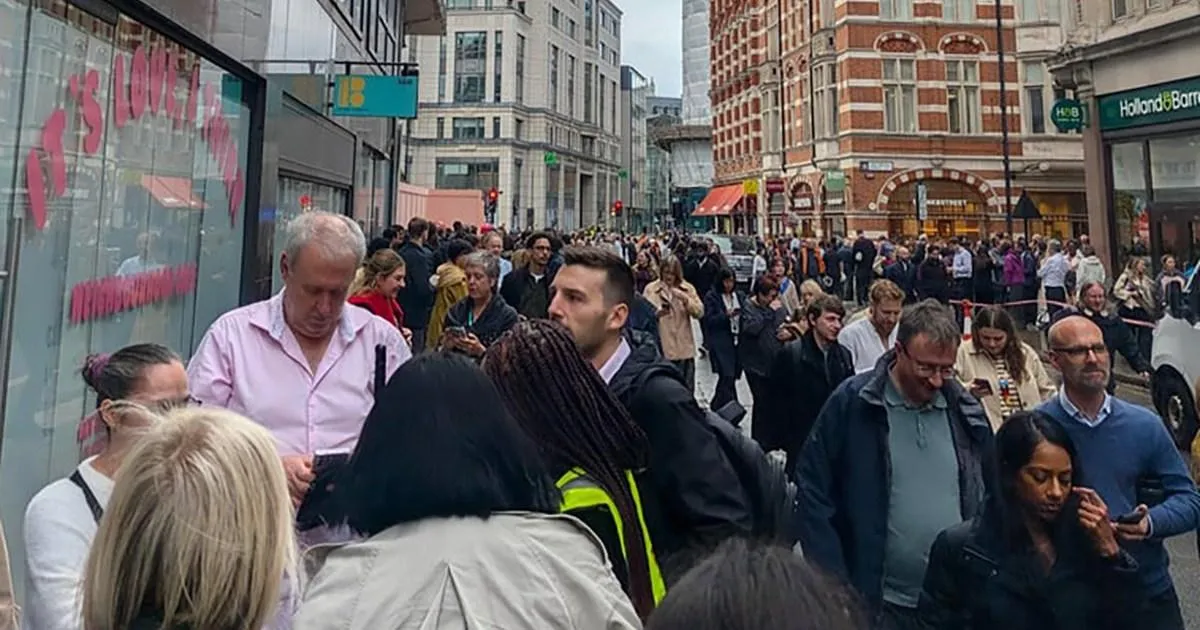
Just before lunchtime in the City of London, the usual focused rhythm of the working day was suddenly broken. Thousands of office workers who had started the morning inside the glassy towers around Liverpool Street and Bishopsgate found themselves out on the pavement, clutching phones, coats and laptops, watching emergency vehicles flash through the narrow streets. The cause was the unmistakable smell of gas, a heavy, chemical presence in the air that had grown strong enough to be noticed from street level. A suspected gas leak near Old Broad Street had quickly turned into a major incident, and by mid-morning the area around London Wall and Wormwood Street was filled with the kind of tension that is impossible to ignore. One social media user reported that the street “reeks of gas” shortly before 10am, an observation that would prove to be the first sign of something far more serious. Security teams and building managers began issuing evacuation orders, and soon a huge crowd was streaming out of offices and into the open air. What had been a normal, busy morning in one of the most important financial districts in the world had become an emergency waiting room, with thousands of people standing in clusters, trying to work out what was happening and how long they would be forced to wait. The evacuation was not a drill, and the scale of it was immediately obvious.
The London Fire Brigade was first called at 10:56am, and by the time crews arrived the situation had already escalated. A six-inch gas main inside a six-storey office block had ruptured, which is exactly the kind of problem that no one wants to hear about in a crowded urban environment. A gas main of that size carries a great deal of pressure, and a rupture cannot be treated as a minor leak. Firefighters quickly established a 200-metre cordon around the affected area, a wide perimeter designed to keep people safe in the event of an explosion. Around 4,700 people were evacuated from nearby buildings, with the total number later described as almost 5,000. It was a dramatic sight: streets that are usually filled with traffic and hurried pedestrians became pedestrian-only zones, with police officers and fire crews directing people away from the danger area. The fire service confirmed that two fire engines from Dowgate and Shadwell fire stations were in attendance, along with a Fire Rescue Unit from Bethnal Green. For the emergency services, the priority was not simply to find and stop the leak, but to make sure that no spark, no cigarette and no electrical fault could turn an already serious incident into something much worse. In a densely packed part of London, where offices sit directly next to busy roads and railway infrastructure, the margin for error is very small.
For the evacuated workers, the experience was one of waiting, watching and trying to make sense of an abrupt interruption to the day. People stood in small groups on the pavement, some staring at their phones, others speaking quietly in the way people do when they are not sure whether they are safe yet. They had been told not to smoke in the area, a warning that made the invisible danger feel entirely real. The smell of gas had been obvious before the evacuation order, and as the morning went on it remained heavy in the air around Old Broad Street and London Wall. Social media quickly filled with photographs and videos showing the scale of the disruption, with crowds spilling across roads that would normally be filled with buses and cars. Some workers used the time to call friends and family, while others tried to find alternative places to work, knowing that their offices would be inaccessible for hours. The evacuation itself was orderly, but there was an undercurrent of anxiety. Gas is a familiar but deeply unpredictable substance, and the sight of firefighters in full gear moving in and out of buildings, measuring the air and inspecting the damaged main, did little to settle anyone’s nerves. No one could say exactly how long the situation would last, and for many people the uncertainty was the hardest part. What was meant to be another ordinary day had become a strange, suspended period of time, spent standing in the cold, watching and waiting for answers.
The disruption extended well beyond the immediate cordon. With Wormwood Street, part of the A1211, closed in both directions between Bishopsgate and London Wall, traffic in the surrounding area quickly became chaotic. Drivers approaching the City found their usual routes blocked, and congestion built up quickly on the roads that remained open. Several bus routes were forced to divert, including the 21, 43, 100, 141 and 153, much to the frustration of commuters who had no idea that a gas leak was causing the delays. The roads around Liverpool Street are always busy, but on this morning they were busier than ever, with cars, vans and pedestrians all trying to find their way around the emergency response. Travel apps and traffic alerts began updating with warnings, advising people to avoid the area entirely. There was, however, some good news for those trying to get out of London or move around the city by rail: Underground and national rail services at Liverpool Street station remained unaffected. That must have been a relief to the thousands of people who had been evacuated from their offices, many of whom would have been looking at the station as their quickest way home. But above ground, the streets around the cordon were a tangle of diverted buses, stopped traffic and pedestrians trying to work out alternative routes through a part of the city that had suddenly become very difficult to navigate.
The London Ambulance Service was alerted to the incident on Wormwood Street shortly before 11:30am, and it responded by sending the hazardous area response team, along with an incident response officer. The presence of that specialist team, trained to work in dangerous environments and deal with potentially contaminated or hazardous scenes, underlined how seriously the authorities were treating the leak. In the end, though, the outcome was far better than it might have been. No injuries or patients were reported. No one had been harmed by the gas, and the evacuation had achieved exactly what it was designed to achieve, moving people out of harm’s way before anything could go wrong. The fire service’s later statement confirmed the details: a ruptured six-inch gas main at a six-storey office block, a 200-metre cordon, and crews remaining at the scene to ensure the area could be made safe. The response involved a coordinated effort between the London Fire Brigade, the police, the London Ambulance Service and, no doubt, gas network engineers working to isolate and repair the damaged main. For those watching from the edges of the cordon, the number of emergency vehicles in one place was both reassuring and alarming. It was a powerful reminder that when something goes wrong underneath a modern city, the response has to be immediate, carefully planned and absolutely thorough.
By the time the afternoon began to settle over the City, the wider world had moved on to other things, but for the thousands of people directly affected by the leak, the day remained suspended. Workers whose offices had been evacuated had little choice but to stand outside and wait, comforted by the knowledge that no one had been injured. The incident, though frightening, was also a reminder of how much of London’s daily life depends on infrastructure that almost no one ever thinks about. Beneath the streets, running under the pavements and the roads and the office blocks, there is a vast network of gas mains, water pipes, electric cables and data lines, carrying the essentials of modern life silently and reliably. It is only when one of those elements fails that people truly understand how vital it is. A single ruptured pipe was enough to close roads, disrupt buses, empty office buildings and send hundreds of emergency workers into action. Yet the response also showed how resilient the city can be. The evacuation was swift, the coordination between services was effective, and the public, for the most part, did exactly what they were asked to do. For now, the priority was simply to let the gas dissipate, repair the main and allow life to return to the streets. That process would take time, but London has a way of recovering quickly. Even so, for those who stood on Bishopsgate and Old Broad Street that morning, with the smell of gas hanging in the air and the sound of sirens echoing through the streets, the memory of the day would not disappear as quickly as the emergency cordon. It was a reminder of how fragile the routine of the city can be, and how quickly everything can change.