
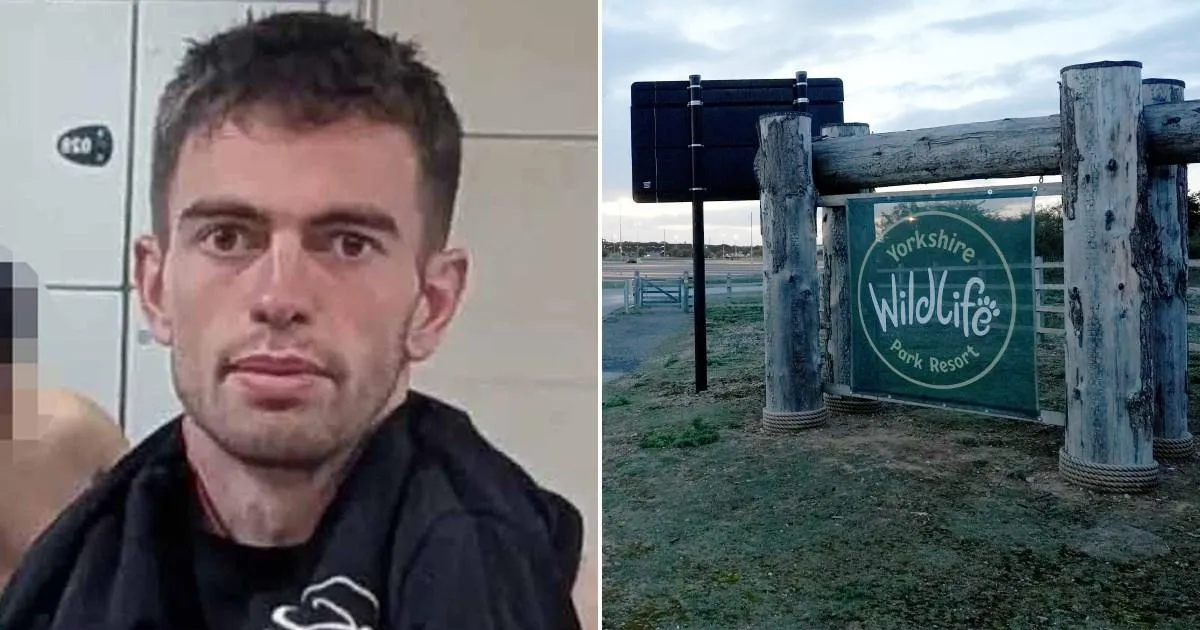
1. A Life Cut Short in a Place Meant for Wonder
On an otherwise quiet Saturday afternoon, the familiar sounds of a family day out at Yorkshire Wildlife Park were shattered by a moment of pure terror. The man at the center of that tragedy has been named in media reports as William Chapman, a visitor believed to be in his twenties, who had come to the attraction near Doncaster alone. What should have been a day of curiosity and connection with wildlife became an unfathomable catastrophe when he entered the enclosure of Altai, a five-year-old endangered Amur tiger, and was fatally mauled. His death was confirmed at the scene, despite the frantic efforts of medical personnel. The news has sent ripples of shock and grief through the local community and far beyond, not only because of the violence of the incident but because of the heartbreaking details that have emerged. William, by all accounts, appeared to be a young man caught up in a moment of impulsive excitement, perhaps unaware of the grave danger he was placing himself in. The fact that he was visiting alone lends a lonely, aching quality to the story—a young life, full of potential, ended in a space designed for education, conservation, and the quiet awe of watching magnificent creatures from a safe distance. In the aftermath, floral tributes were left outside the park gates, a simple but powerful expression of sorrow from strangers who felt the weight of the loss. The park itself remained closed in the days that followed, a somber silence settling over the animal enclosures and empty walkways where laughter and footsteps had only recently echoed.
2. The Final Moments Before the Attack
The minutes leading up to the attack have been pieced together through witness accounts and since-deleted social media footage, and they paint a deeply unsettling picture. William was seen near Altai’s enclosure, reportedly asking if someone could take a photo of him with the tiger in the background. He was wearing headphones, seemingly lost in his own world, pacing back and forth near the edge of the habitat. Witnesses described his behavior as unusual—some said he appeared to be dancing, almost as if he were trying to “psyche himself up” for something. In footage he filmed himself, he could be seen walking purposefully toward the tiger, which was resting calmly on a platform. His breathing was heavy, audible in the video, while in the background other visitors could be heard shouting and crying out “Oh my God,” as they realized what was unfolding. Whether William was attempting to get a closer look, seeking some kind of thrill, or simply misjudging the boundary between observation and intrusion, remains unclear. What is certain is the unbearable sequence that followed: the tiger lunged, and William began screaming, pleading “stop” and “no” as he was dragged away. Some witnesses believed he made gestures consistent with Makaton, a language system using signs and symbols to support communication, though this has not been confirmed. The image of a young man crying out for help while a powerful animal does what its instincts command is almost too terrible to contemplate, yet it is a reality that those present will never be able to forget.
3. A Desperate Response and a Devastating Outcome
The emergency response was swift but ultimately unable to save William Chapman. Park rangers fired warning shots in a desperate attempt to drive the 400-pound tiger away from the victim, and the terrifying sound of gunfire added to the chaos and confusion of the scene. Police, paramedics, and an air ambulance were called to the park, but despite their best efforts, William was pronounced dead at the scene. South Yorkshire Police later issued a statement confirming the details of the incident, expressing their condolences to the family and noting that they were being supported by specially trained officers. The statement also addressed the swirling rumors about the tiger, confirming that Altai had not been injured during the incident and had remained in the enclosure throughout. Officials were clear that there was no wider risk to the public, which brought some relief to those worried about other visitors or staff members. Yet the sense of loss was overwhelming. A young man had come to a wildlife park on his own, perhaps seeking a connection with nature or simply a pleasant afternoon away from everyday life. Instead, his family received the kind of news that no one is ever prepared for. The witnesses, too, were left traumatized, having watched helplessly as a human life was extinguished in front of them. In the days after, the park remained closed, gates locked in silent tribute, while visitors and well-wishers left flowers and messages, struggling to reconcile the beauty of such a place with the horror that had occurred there.
4. Altai the Tiger: An Animal Acting on Instinct
In the midst of the grief and outrage, questions naturally turned to Altai, the five-year-old Amur tiger at the center of the tragedy. Amur tigers, also known as Siberian tigers, are among the most endangered big cats in the world, with only a few hundred remaining in the wild. Altai is a magnificent animal, powerful and rare, a living symbol of conservation efforts that zoos and wildlife parks around the globe fight every day to protect. When news of the attack broke, there was immediate concern about what would happen to him. Some speculated that he might be euthanized, as has sometimes been the case in other incidents involving captive animals. But Yorkshire Wildlife Park quickly confirmed that Altai was well and would not be put down. This was not a decision made out of carelessness, but out of an understanding that Altai was not a villain in this story. He was an animal acting on instinct, responding to a perceived threat or an unfamiliar presence within his territory. Tigers are apex predators, built to hunt and defend themselves, and while they can coexist peacefully with humans in controlled environments, they remain wild at heart. The decision to spare Altai was met with relief by many, who recognized that placing blame on the animal would be a profound injustice. It also sparked a deeper conversation about the nature of wildlife parks, the boundaries between humans and animals, and the responsibility that visitors bear when they step into spaces where the line between captivity and wildness grows dangerously thin.
5. Grief, Questions, and the Search for Understanding
In the wake of William Chapman’s death, a heavy silence has settled over the community. There are no neat answers to the questions that linger in the air. Could this have been prevented? Was there a moment when someone could have intervened? Why did William enter the enclosure, and what drove him to take such a reckless risk? Some have wondered about his state of mind, noting that he was wearing headphones and appeared to be dancing moments before the attack, seemingly disconnected from the reality of his surroundings. Others have pointed to the park’s design and safety measures, asking how it was possible for a visitor to gain access to an enclosure housing a tiger. Authorities have not yet provided a full account of the circumstances, and it may be some time before the complete picture emerges. But amid the questions, there is also a profound sense of human tragedy. William was not just a name in a news story; he was someone’s son, someone’s friend, someone with dreams and memories and a future that will now never be. The floral tributes left outside the park are a quiet reminder that even in a world where such stories become headlines, each loss carries a weight that cannot be measured. For the witnesses who watched in horror, for the park staff who tried to intervene, and for the family left behind, the memory of that Saturday afternoon will forever be marked by anguish. And yet, even in the darkness, there is an opportunity for compassion—for understanding that no one who walked into that enclosure intended for this outcome, and that the tragedy lies not in the tiger’s nature, but in the complex, fragile intersection of human behavior and wild instinct.
6. Remembering, Reflecting, and Moving Forward
As the days pass, the story of William Chapman will slowly fade from the headlines, but its echoes will remain etched in the hearts of those who encountered it. The Yorkshire Wildlife Park will reopen, visitors will once again walk through its gates, and Altai will continue to pace his enclosure, unaware of the controversy that briefly swirled around his name. But something has changed. There will be renewed focus on safety protocols, on the importance of respecting the boundaries that separate humans from wild animals, and on the need for education so that a tragedy like this never repeats itself. For William, there can be no second chance, and no amount of reflection can undo the events of that terrible afternoon. But perhaps, in remembering him, we can remember our own vulnerability, our own all-too-human capacity for misjudgment, and our profound need for connection—with each other, with nature, with the living creatures with whom we share this planet. The park gates may have closed in sorrow, but they will open again in hope, because life continues, and grief, if allowed, can transform into something that honors the lost rather than merely mourning them. William Chapman was a young man who, in his final moments, may have been seeking something extraordinary. In the end, his death became a cautionary tale, a reminder that wonder must always be tempered with respect, and that the wildest moments of our lives are best experienced with our eyes wide open, our hearts cautious, and our feet firmly on the safe side of the fence.