
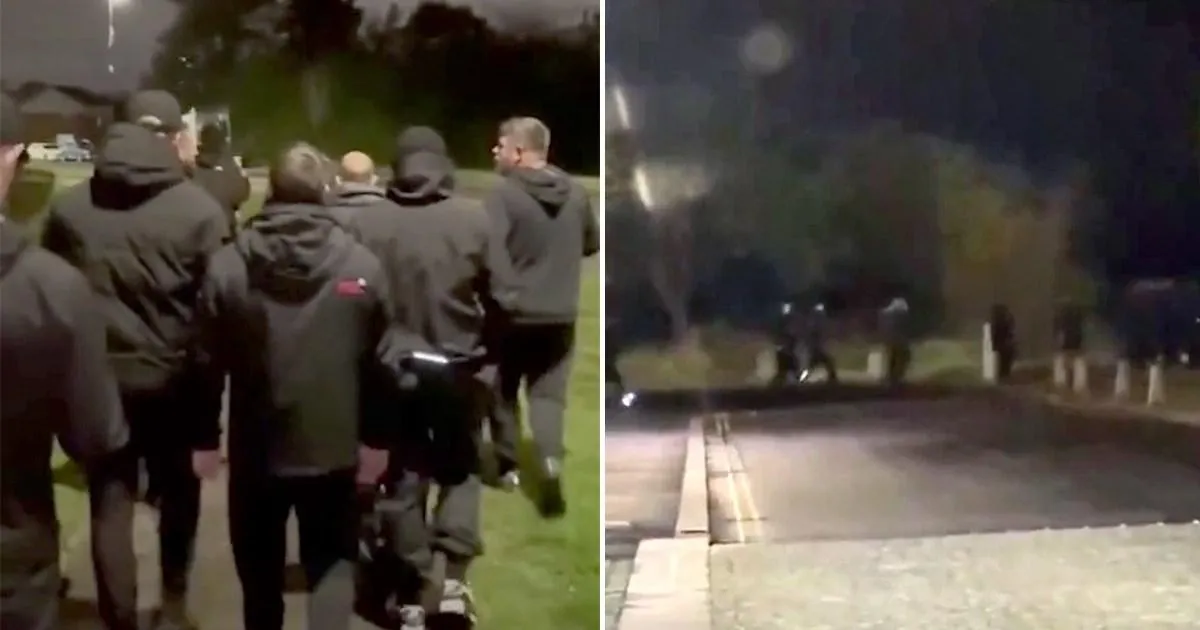
On an ordinary evening in Chelmsley Wood, a suburban community in the West Midlands, three young international students went out for a walk. They had recently moved from Birmingham, where they were studying, and were simply trying to get to know their new neighbourhood. What should have been a quiet, uneventful evening turned into something deeply frightening when they were confronted by a group of men dressed entirely in black, walking in deliberate laps around the park. The men called themselves the Chelmsley Wood Patriots, a self-styled vigilante group who claimed they were patrolling to protect women and children. But their actions told a different story. Locals and anti-racism activists soon accused the group, which was swelling in numbers as the night went on, of approaching people based on their ethnicity. The students, who had done nothing wrong, were filmed, interrogated, and issued what one of the vigilantes called a “final warning” to stay away from the public space. The video was later deleted, but the harm was done. These were not hardened criminals or suspicious strangers; they were young people far from home, trying to build a future, and they had just been taught a terrifying lesson about what it can mean to be seen as an outsider in a country they had every right to call their own.
The encounter itself was both absurd and chilling. One of the vigilantes approached the students from behind, tapped one of them on the shoulder, and demanded to know what they were doing in the park. The video footage, described by those who watched it before it was removed, shows the students being questioned as though they were committing a crime. One of the group members asked, “What made you come to England?” The question itself is loaded, implying that the students needed to justify their presence, that England was not their place. One student replied that they were usually in Birmingham and had just moved to Chelmsley Wood that day. Another explained that he had originally come to England to do a Master’s degree and had been in the country for two years. These were not suspicious answers. They were the ordinary explanations of ordinary people, yet the vigilantes were not satisfied. They delivered what they called a “final warning,” telling the students: “What you need to do is stay away from a children’s park. Do not come round here again. Do not be seen here again. This is your final warning. You will not get a warning again, stay away, stay away!” The cruelty of the language was deliberate. They told the students to go back to their house, back to the HMO, the shared accommodation so familiar to international students, and to disappear from public life. It is impossible not to imagine the fear and humiliation those young men felt as they stood in a park, outnumbered, filmed, and ordered to vanish simply for existing.
The group later attempted to justify their actions in a Facebook post, claiming that they were patrolling because of missing children and reported rapes in the area. They described how one of their “patriots walked around in silence up behind the man, tapped his shoulder & asked what he was doing in the park.” They said they discovered two more males hiding in the darkness near the trees, and when they asked why they were in a park in the dark, they were told they were exploring. In the minds of the vigilantes, this honest answer became evidence of guilt. They wrote: “This is why we then decided to film these men show you their responses because they all fumbled with very different stories.” But there is no evidence that the students fumbled or told different stories, and even if they had, a walk in a park is not a crime. The group claimed they “politely” asked the students to leave, before adding: “Parks are for children, family units, not three grown men sitting in the dark filming when we have so many uncertainties at present.” The irony is staggering. A group of grown men, dressed in black, patrolling in formation and filming themselves, was accusing three unarmed students of being suspicious for being outside in the dark. There was no threat, no violence, no illegal act. The only reason these young men were targeted was the colour of their skin and the sound of their accent. The group’s words were wrapped in the language of patriotism, but what they were really doing was performing a cruel and dangerous form of exclusion, deciding who belonged and who did not.
The local community was not silent. Solihull Green Party issued a statement condemning the harassment, saying there was no reason for the approach other than the students’ ethnicity. They also said they were trying to track down the victims to check on their welfare, a small and necessary act of care in the wake of such intimidation. Shesh Sheshabhatter, a Green Party council candidate, spoke to BirminghamLive and put into words what many people were feeling. “These young men were doing nothing wrong,” he said. “Students are allowed to meet and walk outside, and they have every right to do so. We can see no reason they were targeted other than the colour of their skin. Nobody should be treated differently because of their skin or their accent.” He also took direct aim at the group’s self-description, saying: “The actions of people calling themselves ‘patriots’ are tarnishing the reputation of Chelmsley Wood, the community we live in and love. Real patriotism means standing up for your neighbours, not intimidating them.” Those words are important because they offer a different vision of what it means to love a community. True patriotism is not about wearing black, marching in groups, and issuing warnings to people who have broken no laws. It is about welcoming newcomers, protecting the vulnerable, and standing up for one another. The students were not just victims of a handful of bullies; they were casualties of a broader culture of suspicion that has been allowed to grow. But the response from the community shows that the vigilantes do not speak for everyone, and that there are people who refuse to let fear define them.
West Midlands Police said they were “aware of reports from last night, and there is a measured and appropriate policing response taking place.” It was a careful, understated acknowledgement, but it did not change the fact that something deeply wrong had happened. The incident in Chelmsley Wood did not occur in isolation. It came at a time of heightened anti-migrant sentiment across the country, when protests outside accommodation for asylum seekers have become more common, and when the language of hostility is increasingly creeping into everyday life. The story of the Chelmsley Wood Patriots is part of a larger pattern of intimidation, a pattern that has real consequences. In a separate but related development, a coach company called BM Coaches announced that it would no longer take on Home Office jobs to transport migrants, after its drivers suffered abuse and faced protests, including a smashed window. In a statement, the company said that following “careful consideration of recent incidents and the increased sensitivity surrounding the provision of transport services connected to the Home Office,” it had ceased providing vehicles for such work on October 7, after being called up on October 3. The company thanked its staff, some of whom, “through absolutely no fault of their own, have suffered significant abuse from members of the general public.” It is a sad reflection of the times when a company has to retreat from legitimate work because of the hatred of crowds, and when drivers doing their jobs are subjected to violence and intimidation. The same ugly energy that emboldened the “patriots” in the park is also shaping decisions across the country, forcing businesses, institutions, and individuals to adjust to a climate of fear.
In the end, the story of the Chelmsley Wood Patriots is not about patriotism at all. It is about the false belief that some people have more of a right to public space than others, and the dangerous way that belief can be dressed up as virtue. The three young men who were driven from that park are not statistics or political symbols. They are human beings, far from their families, already navigating the challenges of living in a new country, and now carrying the trauma of being treated as enemies by their own neighbours. They were told to go home, but they were already home; England was their home because they lived there, studied there, and were building their lives there. Real patriotism, the kind that needs no uniforms and no cameras, is about opening a door for a stranger, welcoming the student who just moved in, and refusing to let fear turn a community into a battlefield. The people of Chelmsley Wood have shown, through their candidates and their residents, that they will not let a small group of bullies define them. But the incident should be a warning to every town and city in Britain: hatred does not disappear on its own, and the language of “us” and “them” must be challenged before it hardens into violence. The students are safe, but the memory of being told to stay away from a children’s park simply for existing will not fade quickly. Their only comfort, and ours, is that for every person who called them intruders, there were others who called them neighbours. That is the story we must choose to tell, and the future we must choose to build.