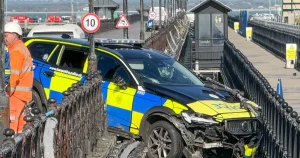

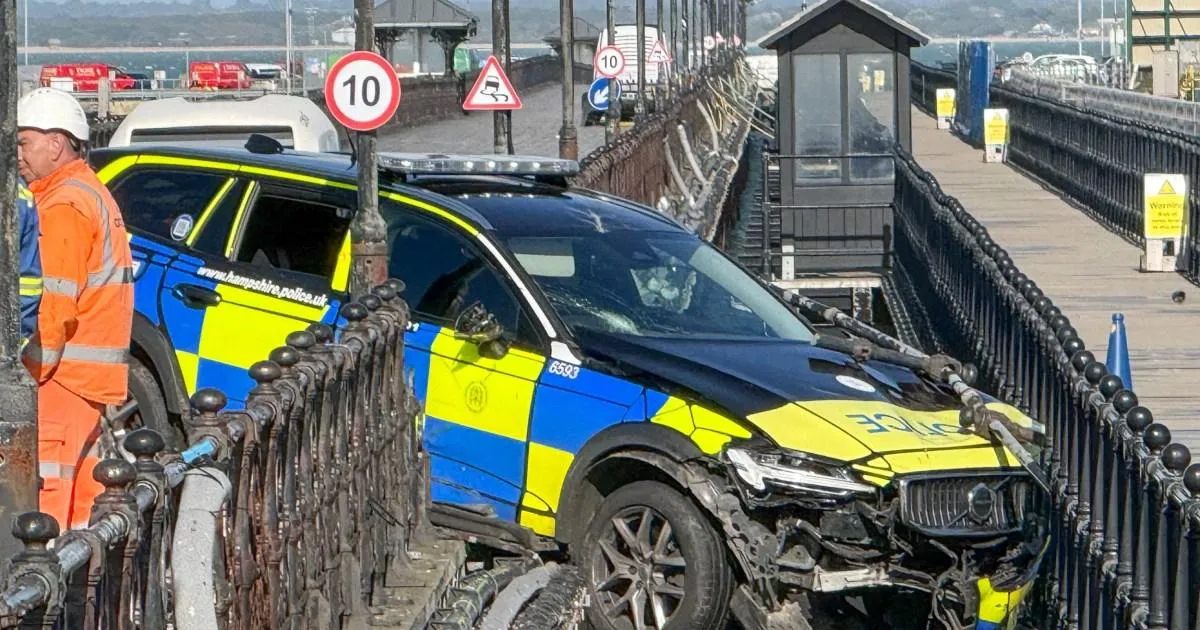
The peace of a Tuesday morning on the Isle of Wight was shattered in an instant when a police car tore through the railings of Ryde Pier and came to rest on the edge of the English Channel. It was shortly before 10am when the alarm was raised, and suddenly the historic pier, one of the island’s most treasured landmarks, was transformed into a scene of flashing blue lights, shouted instructions and desperate urgency. The vehicle, which had been involved in a collision with a taxi, had smashed through the old barriers in a way that seemed almost impossible to believe. Two police officers were trapped inside, and firefighters had to work with heavy cutting equipment to free them from the wreckage. The car had narrowly avoided plunging into the sea, leaving the two officers suspended over the water in a crumpled mass of metal. Ambulance crews, fire teams, coastguard officers and additional police personnel all converged on the scene, turning the normally peaceful pier into a hive of emergency activity. For anyone who knows Ryde Pier, the sight was deeply unsettling; this is a place where families stroll, where anglers cast lines, and where visitors arriving from the mainland take their first steps onto island soil. To see a patrol car hanging over the edge, with rescue workers fighting to save the people inside, was a chilling reminder that disaster can strike in the most unexpected of places. The rescue effort was painstaking and delicate, because any sudden movement could have sent the car sliding into the water. Eventually, after what must have felt like an eternity, the officers were cut free and taken into the care of medical teams. Their injuries were not described in detail, but the fact that they had to be physically extracted from the vehicle spoke volumes about the severity of the crash. As news spread across the island, the first reaction was shock, followed by a collective sense of relief that the outcome had not been even worse. The images of the damaged police car, wedged against the broken railings with the sea glinting below, were already circulating across news outlets, but for those who saw it in person, the scene was far more visceral.
The circumstances surrounding the crash remain shrouded in confusion. Hampshire and Isle of Wight Constabulary confirmed that two vehicles were involved, and it is understood that the police car was involved in a collision with a taxi before it careered through the railings. Strangely, despite the damage and the dramatic rescue, no one else was reported to have been injured. The taxi driver, if not physically harmed, must have been left in a state of profound shock after witnessing a police car crashing through the edge of a pier in front of them. Perhaps the most puzzling detail is that Ryde Pier has a strict 10mph speed limit for vehicles. It is not a road where high-speed driving is possible or even imaginable; the narrow roadway, the presence of pedestrians and the fragile nature of the historic structure all demand caution. How a car could end up through the railings at such a low speed limit is a question that investigators will need to answer. Police have not said whether the officers were in pursuit of another vehicle at the time of the collision, and that silence has only fuelled speculation. Was there a mechanical failure? Did the driver suffer a medical emergency? Was there some sudden, unexpected hazard on the road? Or was this simply a freak accident, the kind of bizarre event that defies logical explanation? Whatever the cause, the incident has highlighted the vulnerability of the pier, a structure never designed to withstand the impact of a vehicle breaking through its barriers. The collision also raises serious questions about vehicle safety on such a narrow, exposed structure, and whether the existing railings are strong enough to protect people from the sea below. For now, the answers are not available, and the island is left to wait while investigators piece together the sequence of events that led to such an extraordinary and frightening scene. Until then, the people of the Isle of Wight can only shake their heads at the sheer strangeness of it all. A police car, a pier, a taxi and the sea: these are not ingredients that belong together, and yet they were combined in a single, terrifying moment.
To appreciate the full weight of what happened, one must understand the significance of Ryde Pier. Opened on 26 July 1814, it is officially the world’s oldest surviving seaside pleasure pier, a remarkable distinction that speaks to its resilience and enduring appeal. Designed by John Kent of Southampton, the pier was built during the golden age of seaside resorts, when a trip to the coast was seen as a remedy for both body and soul. For more than two centuries, it has served as a vital link between the Isle of Wight and the mainland, carrying countless passengers, vehicles and goods across the water. It has witnessed the arrival of steamers, the construction of railway lines and the transformation of Ryde from a modest fishing village into a popular Victorian resort. It has survived storms, collisions, fires and the general wear and tear of centuries, standing tall while many of its contemporaries have vanished. The pier is not merely a functional piece of infrastructure; it is a beloved symbol of the island’s identity, a place where memories are made and where the sea feels close enough to touch. Its deck, stretching out into the Solent, offers panoramic views that have inspired painters, photographers and poets. To walk along it is to walk through history, with each step echoing over the timbers that have borne the weight of so many thousands of feet. The fact that cars are permitted to drive on this venerable structure, albeit at a strictly enforced 10mph, is a testament to its strength. But Tuesday’s crash has shown that even the strongest structure has its limits, and that the railings meant to keep people safe can be breached. The image of a police car embedded in those railings is a jarring contrast to the pier’s usual charm, and it serves as a stark reminder that age and beauty do not make a place invulnerable. For locals, the pier has always been a source of pride. It appears in countless photographs, on postcards and in holiday memories. The thought of it being damaged is almost as painful as the thought of the officers being hurt. It is a double wound, one that cuts at both the heart and the history of the island.
Amid the drama of the rescue, it is all too easy to forget the human beings at the centre of the story. Two police officers went to work on Tuesday morning expecting to serve and protect their community. Instead, they found themselves fighting for their lives, trapped in a damaged vehicle above the cold, dark waters of the English Channel. The firefighters who arrived on the scene faced a terrifying challenge. They had to cut through the wreckage with hydraulic tools, carefully and methodically, without knowing whether the car would remain stable. Every twist of metal, every vibration of the cutting equipment, could have caused the vehicle to shift and plunge into the sea. It was a high-pressure operation that required nerve, skill and complete concentration. Ambulance crews stood by, ready to provide immediate treatment the moment the officers were freed. Coastguard personnel monitored the situation, ensuring that the scene was secure and that no one else was in danger. The officers’ injuries were not disclosed in detail, but any incident requiring extrication is serious enough to warrant concern and sympathy. Their colleagues, their families and the wider community will be hoping and praying for their full recovery. The sight of blue lights on the pier, of rescue workers in high-visibility jackets crowded around a crumpled patrol car, was a sobering reminder of the risks that emergency services take every day. People often take for granted the safety that police officers provide, forgetting that the job carries real danger. This crash was a random, freakish event, but it also highlights the unpredictable nature of emergency work. On any given day, a routine patrol can turn into a life-or-death situation. The officers involved in this incident will likely carry both physical and emotional scars, but they can also take comfort in the knowledge that the entire island is thinking of them. The rescue itself was a testament to the training and bravery of the emergency services, and their efforts should not be underestimated. In a place where the margin for error was so small, they managed to do their jobs with professionalism and humanity, and for that, the whole community owes them a debt of gratitude.
There is a strange, almost cinematic quality to the incident, and Ryde Pier is no stranger to the world of film. In 2005, it appeared in the supernatural horror movie Fragile, starring Calista Flockhart. In the film, the pier is shown briefly as Flockhart’s character is driven along it after arriving from the mainland. It is a small moment, but it is enough to give the pier a place in the annals of horror cinema. There is something fitting about that, because there has always been an eerie beauty to a long pier stretching into the misty sea. On a foggy morning, when the end of the pier disappears into the grey and the waves are barely visible below, it is not hard to imagine ghosts and strange happenings. The pier has seen more than two centuries of human drama: happy reunions, tearful goodbyes, the hustle of holidaymakers and the quiet contemplation of fishermen. Now, it has added a real-life scene of suspense and terror, one that no film could have scripted better. The image of a patrol car, its front end through the railings and the sea churning below, is the kind of visual that stays with people for a long time. It is a stark, surreal image, made all the more powerful because it is real. There were no stunt drivers and no special effects; just the grim reality of an accident that could have been catastrophic. Fortunately, the outcome was not the worst-case scenario, but the memory of the crash will become part of the pier’s long and storied history. Visitors who walk along the repaired railings in the future may not know exactly what happened, but the story will be told, a strange footnote to a place that has already seen so much. It is a story that will be passed down, retold by grandparents to grandchildren, and recalled whenever someone mentions the day the police car nearly went into the sea. The pier has always had a life of its own, and this incident has become part of that living memory.
In the end, this is a story of survival and resilience, of a community grateful that a terrifying incident did not end in tragedy. Ryde Pier has stood for over 200 years, enduring storms, tides and the passage of time. It has been a gateway to the Isle of Wight, a place of leisure and pleasure, and a backdrop for both cinematic fiction and real-life drama. On Tuesday morning, it became the scene of a dramatic rescue, as two police officers were pulled from a wrecked car that had come within a heartbeat of plunging into the English Channel. The fact that no lives were lost is something to hold onto, even as the questions about what happened continue to grow. The damaged railings will be repaired, the wreckage will be cleared, and the pier will eventually return to its usual role as a beloved seaside landmark. But the incident will not be forgotten easily. It will be the subject of an investigation, and it may prompt changes to ensure that vehicles on the pier are even safer. It may also serve as a reminder of the fragility of human life and the unpredictability of the world around us. For the officers involved, the road to recovery may be long, but they will have the support of their colleagues and the goodwill of the community. For the rest of us, the crash is a reminder to appreciate the everyday places we take for granted, because they can become the stage for extraordinary events in an instant. As the tide continues to rise and fall beneath the old pier, and as the islanders go about their daily lives, the memory of Tuesday’s crash will gradually fade into the fabric of Ryde Pier’s long history. But it will always be there, a strange and sobering chapter in the life of a structure that has seen so much and survived it all. The officers will recover, the pier will be repaired, and the sea will keep rolling in. But for one bright, alarming moment, a piece of history was nearly lost, and everyone who loves Ryde Pier knows just how close they came to a tragedy. In the end, the old structure is still standing, and so are the people who protect it. That is the real story, and it is one worth telling.