


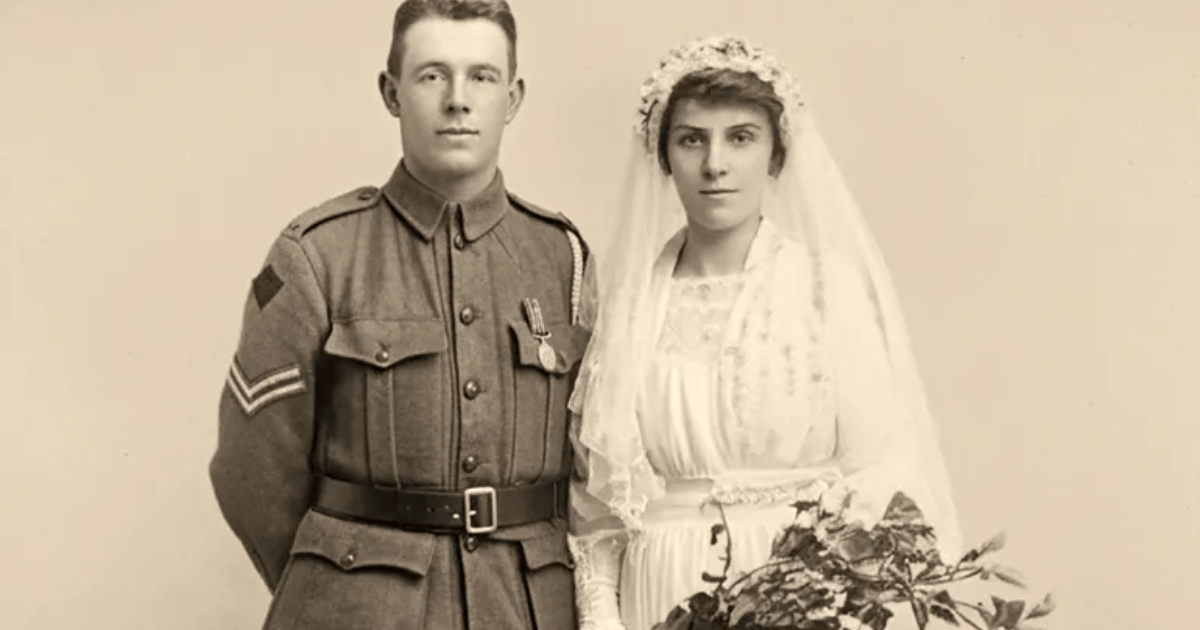
Some stories wait a long time to be found, and the story of Corporal Claude Nuttall might have stayed lost forever if a boy had not been looking for toys. In 1965, twelve-year-old Alan Southall was rummaging through a rubbish tip near his home in Stourbridge, West Midlands, when he pulled out a small, battered diary. It was stained with old blood and had a bullet hole straight through it. His father read it and explained that it had belonged to an Australian soldier. That soldier was Claude Nuttall, a young man from the 23rd Battalion of the Australian Army. Claude had been wounded on the Somme, sent to hospital in England, and while recovering at Wordsley Hospital in Stourbridge he met and fell in love with a young woman named Violet Palfreyman. They married in March 1918, but the war would not let them keep each other. Claude was sent back to France, and on August 13, 1918, three months before the Armistice, he was killed by a sniper at the Battle of Amiens. The diary that Alan found ended on August 10, the last time Claude ever wrote. The bullet hole and the dark bloodstains were not just damage to an old book; they were the physical marks of a man’s final days. For a boy searching for toys, it was the find of a lifetime, though he could not have understood all that it meant. For the rest of us, it is a reminder that history is not made of dates and battle lines alone, but of people who loved and were loved, who wrote letters home, and who carried photographs and wedding memories into the horror of war.
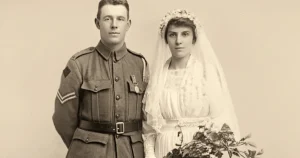
Claude Nuttall had already shown extraordinary courage before he ever met Violet. He enlisted in the Australian Army after his twentieth birthday in 1915, motivated by loyalty to an empire far from his home. He was sent first to Egypt with the 23rd Battalion, but the heavy losses on the Western Front soon pulled him into the mud and blood of France. In 1916, he was decorated with the Military Medal by King George V himself, an honor awarded for rescuing fallen comrades in No Man’s Land in front of the German trenches. He had stared into the face of death and carried his friends out of it, and he had been wounded at the end of the Somme. That wound brought him to Wordsley Hospital in Stourbridge, where he was supposed to rest and heal. Instead, he found something he had probably not dared to hope for: a future. Violet Palfreyman was a local woman who walked into his life and changed everything. In the middle of a war that had already taken so much, they chose each other. Their wedding day was recorded in Claude’s diary with the simple joy of a man who could not quite believe his good fortune. “All excited,” he wrote. “Went to Stourbridge met Maurine. Married 12.30pm, all went well. Photos taken 1.15pm. Wedding breakfast 3pm. All having very good time.” It is a small, ordinary entry, but set against the horror he had survived, it feels extraordinary. They had only five weeks together before the army sent him back to the front line, and those five weeks had to carry him through everything that followed.
Back in France, Claude returned to a world of heavy guns, advancing troops, prisoners streaming to the rear, and the constant threat of death. His diary entries from those final days are terse and tired, but they are also full of his need to stay connected to Violet. He wrote about the bombardment of his own guns, the capture of an 11¼-inch gun by the 31st Battalion, and the steady movement forward into battle. He wrote about packing up, ready to move again, and he wrote to Violet. On August 10, 1918, during the intense and terrible Battle of Amiens, he made his final entry: “Heavy bombardment by our guns. Push still in progress. Started letter to Vi. 11 ¼ inch gun captured by 31st Btn and train came back from forward. Packed up ready to move forward again. Prisoners still coming back. Wrote to Violet.” The last words in the diary are not about glory or victory. They are about a letter to the woman he had married a few months before. Three days later, a sniper found him, and the diary that had traveled through his war, absorbing the dirt and stress and longing of a soldier’s life, took a bullet too. The bullet hole and the blood that stained the pages tell the rest of the story more clearly than any military report. He never made it home, never got to hold Violet again, and never saw the end of the war that he had fought so hard to survive. He was killed three months before Armistice Day, close enough to peace that it almost feels cruel.
After Claude’s death, Violet was left to make sense of a future that had been stolen. She remarried five or six years later, emigrated to New Zealand, eventually returned to England, and died from complications during childbirth. She carried the memory of Claude with her, and her son and her husband kept the diary safe in the years after she was gone. How it ended up in a rubbish tip in Stourbridge remains something of a mystery. Perhaps a house clearance went wrong, perhaps someone accidentally threw away a box of old belongings, or perhaps the diary was simply lost in the movements of a family that had already known too much loss. But in 1965, Alan Southall found it, and the strange journey of the little book took another turn. It was not until author Colin Reid came across the diary that the story began to be pieced together. Colin, who was sixty-nine when he completed his research, spent years tracking down Claude’s family and Violet’s relatives, placing adverts in local papers and following the faint trail of photographs and memories. “Right from the very first moment that I held the diary,” he said, “I had that real sense of connection with it. I was really hooked.” Someone eventually came forward with photographs of Claude and Violet, and slowly, photograph by photograph, memory by memory, the full shape of their love story emerged.
When Colin learned the details of Claude’s life and death, he knew he had to bring the story into the open. He described the moment of discovery with the same quiet intensity that marks the diary itself: “I was able to put together most of the story, he’d been killed in action three days after his last entry. He’d been decorated by the King in person for saving comrades in front of German trenches. He was wounded at the end of the Somme.” Claude was also one of around eight thousand Australian soldiers who married English women while serving in the war. Those marriages were often rushed, passionate, and heartbreakingly brief, built on the knowledge that there might be no tomorrow. Claude and Violet were part of that larger story, a generation of young people who reached for love while the world was burning. Colin eventually wrote a book about the diary, which he called “The Digger’s Diary.” His goal was not just to tell the story of one soldier’s death, but to celebrate the life that Claude lived and the love that he left behind. The research connected him to villagers on the Somme, where Claude is now commemorated every year by local people who have not forgotten the Australian soldier who died in their fields. It also connected him to Alan Southall, the boy who found the diary in the rubbish tip, and to the families who had kept Claude and Violet’s memory alive in photographs and stories.
The book is set to launch at Stourbridge Library on October 15 as part of the Dudley History Festival, and it could not arrive at a better time. We are now a century and more away from the First World War, and the last living voices of that conflict have gone silent. What remains are diaries, letters, photographs, and the artifacts that surface in unexpected places, like a bloodstained notebook found by a child looking for toys. Colin Reid said that he was “twinged by his conscience” to write the book, and that he had to find the diary again, track down Alan, and trace Claude’s family. He put adverts in local papers and slowly, surely, the responses came. In the end, the diary became not just a piece of personal history but a bridge between past and present, between Australia and England, between the living and the dead. Claude Nuttall never got to grow old with Violet, never got to see his children or know a life beyond the war. But his words survived, and they still reach us today. When we read his final entry, “Wrote to Violet,” we are reading the last act of a man who refused to stop loving, even as the shellfire fell around him. The bullet hole in his diary is not merely a mark of death; it is proof that he lived, and that he loved, and that in a world full of loss, some things cannot be buried forever.