
In the quiet hours of Sunday night, while most of France lay asleep, something deeply unsettling began to happen inside hundreds of supermarkets. Refrigeration systems that should have been keeping frozen peas, ice cream, poultry, and ready meals at safe sub-zero temperatures started to heat up, and then kept climbing. Hackers, operating remotely and from afar, had somehow gained access to the cooling controls of several major French grocery chains — Coopérative U, Intermarché, E.Leclerc, Monoprix, and Carrefour — and deliberately turned the freezers against their owners. By the time staff arrived for early morning shifts, the damage had already been done. Some freezers were showing temperatures as high as 50°C. In one Intermarché supermarket in La Haye, in the Manche region, cold units reportedly reached 80°C and began to smoke. Across the country, millions of euros’ worth of food was ruined in a single night. It was not a mechanical failure or a power cut; it was a cyberattack, an act of sabotage that struck at the very last place many people would expect: the frozen food aisle. The attack was methodical and ruthless. It exploited the quiet trust we place in the humming machinery behind supermarket walls, turning an ordinary shopping trip into an encounter with vulnerability. Managers who had checked their stores before closing noticed nothing wrong, and no alarms sounded in the night. It was only when the first employee opened the door to the freezer section, feeling a wave of warm air instead of the usual blast of cold, that the nightmare was finally discovered.
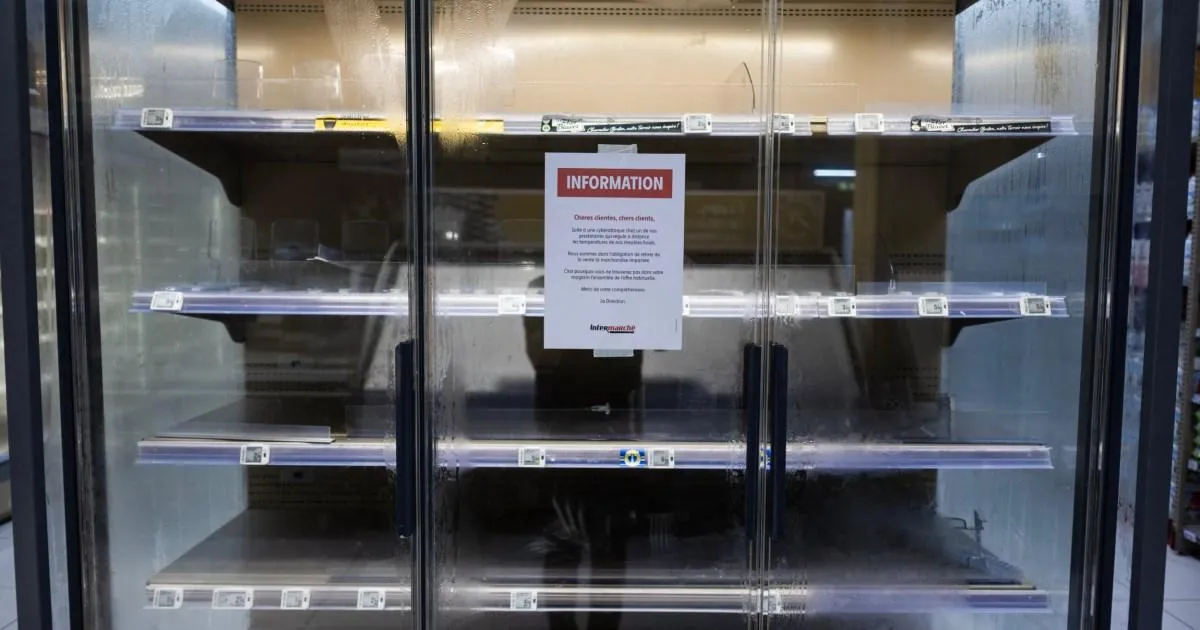
The scale of the cyberattack was enormous. More than 100 Coopérative U supermarkets, roughly 300 stores belonging to Intermarché and its discount chain Netto, and 80 Carrefour branches were affected, along with locations operated by E.Leclerc and Monoprix. In town after town, managers woke up to a crisis. Employees who clocked in for morning shifts opened the doors of freezer rooms and were met by dripping water, foggy air, and the sour smell of thawing food. Many branches took to social media with heavy hearts, warning customers that the frozen sections would be closed, perhaps for days. The Intermarché in Haguenau posted a deeply human message, saying: “Like many other stores, we have unfortunately suffered a computer hack of our cold storage system. The consequences are severe: we are deeply sorry to have to discard all our frozen products. A real heartbreak for our entire team, who work every day to offer you well-stocked shelves and quality products.” Photographs shared throughout the day showed the wreckage: empty freezers, closed aisles, and sad piles of melting ice cream, mini-pizzas, and bags of broccoli at a Super U in Morcenx-la-Nouvelle. At one ice cream aisle, a digital thermometer displayed 26.5°C — a reading closer to a summer afternoon than a freezer. For the staff who had spent hours stocking those shelves, the loss was more than inventory; it was the destruction of their daily labor and pride. They had not just lost products; they had lost a part of the work they care about, and they knew the deeper consequence: families all over France would be going without their usual groceries.
The financial damage is staggering, and it will be felt long after the melted ice cream has been mopped up. In the Alsace region alone, two supermarkets reported combined losses of £228,000, and the total national bill is expected to reach millions of euros. But behind the numbers are human and environmental costs that do not fit neatly into a spreadsheet. For every ruined pallet of frozen fish, there are workers who must haul it away, clean the contaminated surfaces, and dispose of the waste in an environmentally responsible way. For every empty shelf, there is a family trying to plan meals on a budget, suddenly forced to change shopping habits or pay more for fresh alternatives. Some stores, such as the E.Leclerc in Pierry, were quick to reassure customers that fresh fruit and vegetables and other groceries were not affected, but that is little comfort for people who rely on frozen food for quick weeknight dinners or affordable staples. The attack also represents a huge waste of resources. Every chicken, every bag of spinach, every carton of soup that had to be discarded took water, energy, fuel, packaging, and transportation to produce. To see it destroyed by a criminal act is not only a financial blow; it is an insult to the farmers, drivers, and stockworkers who brought it to the store. And for supermarket operators, the cleanup is only the beginning. Insurance claims, legal investigations, replacement of contaminated stock, repairs to overworked cooling units, and the slow work of rebuilding customer trust will all take time, and none of it will be easy.
The technical details of the attack are deeply concerning, because they show how easily everyday infrastructure can be turned into a weapon. The hackers targeted software made by Danfoss, a Danish industrial technology company that produces systems to manage refrigeration and cooling equipment in supermarkets. The software includes a defrost cycle, normally scheduled in two-hour bursts overnight to prevent ice from building up on the coils. But the attackers discovered a way to hijack older versions of this software, forcing the units into a continuous defrost loop that lasted as long as six hours. Instead of a brief, controlled thaw, the freezers were effectively turned into heaters, blasting hot air into enclosed spaces until the goods inside were ruined. Danfoss acknowledged that the affected units were older models that could not be updated to fix the vulnerability. France’s cybersecurity agency, ANSSI, has identified a hole in the older versions of the software, and investigators are now trying to trace who was behind the sabotage and why. What makes this so unsettling is that the attack did not target data or money directly. It targeted the physical world, the machines that keep food safe, and it did so remotely. For years, cybersecurity experts have warned that our growing reliance on connected devices creates new risks, and this attack proves that warning was not theoretical. A cold chain is only as strong as its weakest link, and when a criminal can make a refrigerator turn up the heat from a distance, every supermarket in the world has to wonder if it is next.
Officials responded with alarm, and their words reflect how seriously this attack is being taken. Dominique Schelcher, the chief executive of Coopérative U, confirmed the cyberattack on X and described it as an act of rare gravity. “Targeting equipment essential to the preservation of fresh products and to the food supply of the French people is of extreme gravity and is unprecedented. It is unacceptable,” he wrote. The Paris prosecutor’s office quickly opened an investigation into what it called a “large-scale cyber-attack affecting the refrigerators of several major food retail chains across France.” Perhaps the most striking response came from Christophe Hansen, the European food commissioner, who said on X that he “strongly condemns” the attack on French food products. “Food security requires more attention at all levels,” he wrote, “because the weaponisation of food has become a reality.” Those words should send a shiver through every country with a modern food supply chain. Food is fundamental. It is health, culture, survival, and comfort rolled into one. When an attacker deliberately disrupts the systems that keep food safe and available, they are not just causing inconvenience; they are striking at something essential to life. The fact that this happened to supermarket freezers, rather than a nuclear plant or a hospital, does not make it less serious. If anything, it makes it more frightening, because it shows that no part of ordinary life is off-limits. The investigation will likely take months, and it may never be clear exactly who carried out the attack or what their motivation was, but the precedent is set: food infrastructure is now a target.
Yet in the midst of this mess, the human response has been striking. Supermarket workers showed up, faced the wreckage, and did the unglamorous work of protecting what they could and cleaning up what they couldn’t. Customers shared messages of sympathy and frustration, and local communities rallied around stores that were suddenly struggling to keep their freezers cold. The empty aisles were a strange, almost surreal sight in a country where food is celebrated as a cornerstone of daily life. But the deeper meaning of the attack goes beyond any single supermarket or brand. It reveals how much of modern existence rests on invisible systems we rarely think about until they fail. We open a freezer and assume the ice cream will be solid; we buy frozen pizza and trust that it was kept safe all the way from the factory to our home. That trust is a luxury, bought with careful engineering and constant maintenance. When a hacker reaches into that system and switches it from cold to hot, it shakes not only the shelves but our faith in the infrastructure that feeds us. In the months ahead, retailers will need to do more than restock. They will need to invest in newer, safer equipment, patch vulnerabilities, and reconsider the risks of connecting refrigeration to the internet. But no technology can replace the simple need for vigilance and care. For the people of France, this attack will be remembered as the night the freezers turned against them. And for the rest of the world, it should be a wake-up call. Food is not just a product to be bought and sold; it is a promise. It is the dinner shared with family, the emergency meal in the freezer, the small comfort of knowing there is something to eat when you need it. To attack that promise is to attack life itself, and all the melted ice cream in the world cannot hide how cruel that truly is.