
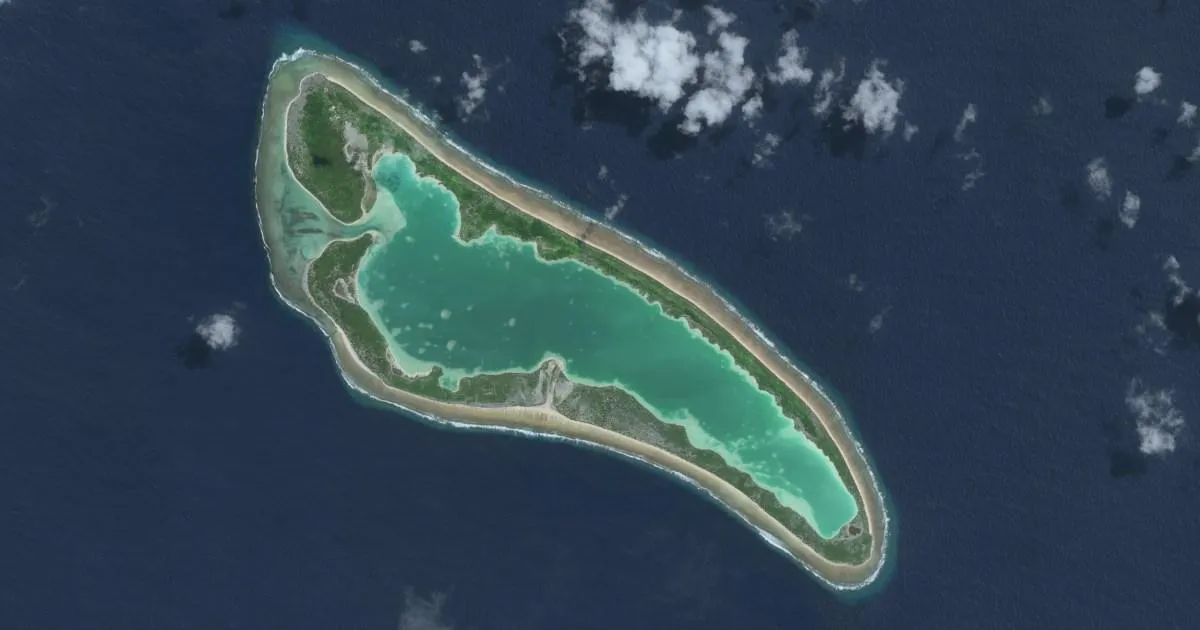
Nearly a century after Amelia Earhart vanished into the vast blue emptiness of the Pacific, a small team of researchers has returned to a tiny, uninhabited island with a simple but tantalizing hope: to find the wreckage of her plane. The expedition, led by the Archaeological Legacy Institute in partnership with Purdue University, has set its sights on Nikumaroro Island, a remote coral atoll in the southwestern Pacific nation of Kiribati. The team is acting on fresh satellite imagery that appears to show what could be the tail, wing and body of a Lockheed Electra resting just metres from the shoreline. If those shapes are what they seem to be, they could finally answer the question that has haunted aviation history for generations: What really happened to Amelia Earhart? The researchers plan to spend about five days on the island, combing through dense vegetation and tidal flats with a mix of hope and scientific caution. Richard Pettigrew, executive director of the Archaeological Legacy Institute, has long suspected that Earhart and her navigator, Fred Noonan, miscalculated their position and ended up on Nikumaroro instead of Howland Island, the tiny speck of land they were desperately trying to find. It is a theory that has gained traction over the decades, and now, with modern satellite technology offering a fresh set of eyes, the search has taken on new urgency. For the team, this is not just an archaeological dig; it is a chance to bring closure to one of the most enduring mysteries of the twentieth century, and to honour the memory of a woman who refused to stay grounded.
The story begins on July 2, 1937, when Earhart and Noonan took off from Lae, New Guinea, in their twin-engine Lockheed Electra, bound for Howland Island, a tiny strip of coral roughly halfway between Australia and Hawaii. It was the final leg of their ambitious attempt to fly around the world, and Earhart had already become a household name for her daring and determination. But something went terribly wrong. During the flight, Earhart radioed the United States Coast Guard cutter Itasca, which was waiting near Howland Island to guide her in. She reported that she could not find the island, and that fuel was running low. Her last messages were garbled and faint, and then the radio went silent. Neither Earhart, Noonan, nor the plane was ever seen again. For years, the official explanation was that they ran out of fuel and crashed into the ocean, but that never sat well with many investigators. The new theory, championed by Pettigrew and others, is far more human and more tragic: Earhart and Noonan, tired, low on fuel, and perhaps confused by navigation errors, may have spotted Nikumaroro instead of Howland Island. Nikumaroro lies about 400 miles southeast of Howland, and at low tide it would have looked like a long, flat runway of sand and coral, a tempting place to attempt a landing. If they did land there, they would have been stranded on a remote, waterless island, with no way to call for help and no rescue coming.
Nikumaroro, however, is far from a gentle paradise. It is a rugged, isolated place, covered in dense scrub and surrounded by treacherous reefs, and it is home to one of the most formidable creatures imaginable: the coconut crab. These giant land crabs, which can have a leg span of up to three feet, are the largest land-dwelling arthropods in the world. They are powerful enough to climb trees, crack open coconuts with their massive claws, and feast on small mammals and birds. For the researchers, the crabs are more than just a curiosity; they are a real threat. To stay safe, the team plans to sleep on their research vessel at night, well away from the island’s shore, rather than camping on land. The crabs are not aggressive toward humans in the way a predator might be, but their size and strength make them a serious hazard, especially in the dark. There have even been theories, both grim and fascinating, that Earhart and Noonan may have died on the island after their plane crashed, and that their bodies were carried away and consumed by these giant crabs. It is a disturbing image, but it is not without precedent; coconut crabs have been known to drag off animals much larger than themselves. The idea that the remains of one of history’s most celebrated aviators might have been scattered by crabs adds a layer of horror to an already tragic story. Yet for the researchers, it is simply one more detail to consider as they comb the island for any trace of the lost plane.
The evidence that has drawn the team to Nikumaroro is compelling, though not conclusive. In 1940, more than three years after Earhart disappeared, a British colonial officer on the island discovered a partial human skeleton, along with a few personal items. The bones were sent to Fiji, where they were examined, but the analysis at the time concluded they were likely from a male, and the case was shelved. Then, in 2017, forensic anthropologists re-examined the measurements and made a startling discovery: the bone dimensions matched Earhart’s body proportions more closely than they matched 99 percent of the general population. That was not proof, but it was a strong hint. Alongside the bones, the officer had found a woman’s shoe, a compact case, a jar of freckle cream, and a small medicine vial, all items that seemed out of place on an uninhabited island. Another clue came from a photograph taken just three months after Earhart’s disappearance, which appears to show what looks like the landing gear of her plane protruding from the reef on Nikumaroro. Decades later, in 2020, a satellite image captured what appears to be the same object, now known as the Bevington Object, still sitting in the same spot. Skeptics have argued that the object could be a natural rock formation or a piece of debris from another source, but the researchers believe it is worth a closer look. Together, these pieces of evidence have transformed Nikumaroro from a remote speck on the map into the most promising lead in the search for Earhart’s final resting place.
To understand why this mystery still grips the world, it helps to remember who Amelia Earhart was. Born in Atchison, Kansas, in 1897, she grew up in a family that was often struggling, as her father, a railroad lawyer, battled alcoholism. She left junior college early to work as a nurse’s aide, caring for soldiers wounded in World War I, and later began a premedical programme, but she quit when her parents asked her to move back to California. It was there, in 1920, that she took her first flight as a passenger, and it changed her life forever. “As soon as I left the ground,” she later said, “I knew I had to fly.” She took lessons, bought her first plane, and by 1922 became the first woman to fly at 14,000 feet. In 1928, she was chosen to be the first female passenger to fly across the Atlantic, and she became a celebrity overnight. Then, in 1932, she became the first woman, and only the second person in history, to fly solo nonstop across the Atlantic. The flight took fifteen hours, during which she battled mechanical problems, freezing cold, exhaustion, and a terrifying drop of 3,000 feet on her descent. She was not just a pilot; she was a symbol of courage and independence, a woman who broke barriers in a world that told women to stay grounded. Her disappearance in 1937 cut short a life that seemed destined for even greater heights, and that is why her story still resonates today.
As the research team begins its work on Nikumaroro, the world will be watching with bated breath. The search is expected to last only about five days, but the implications of any discovery would be enormous. If the satellite images do lead to the wreckage of Earhart’s plane, it would not only solve a nearly century-old mystery; it would also rewrite the final chapter of a remarkable life. It would confirm that Earhart and Noonan did not simply vanish into the sea, but that they survived long enough to reach land, and perhaps even to wait for help that never came. It would also raise new questions: How long did they live? What did they do in their final days? Did they try to signal passing aircraft? The researchers are careful not to overpromise, knowing that the island has a way of hiding its secrets. The coconut crabs, the dense vegetation, and the shifting tides could all obscure the evidence. But the team is driven by the belief that the truth is out there, waiting to be uncovered. For the family of Amelia Earhart, for historians, and for anyone who has ever looked up at the sky and wondered, this is more than an archaeological expedition. It is a pilgrimage, a final attempt to honour a woman who dared to chase the horizon. Whether they find the plane or not, the search itself is a reminder that some mysteries are too important to let go, and that the human spirit, like Earhart herself, refuses to disappear without a trace.