

It was supposed to be nothing more than a routine domestic flight, the kind that millions of people board every day without a second thought. The Sepehran Airlines Boeing 737 was packed with passengers, families, workers, and travelers heading from Mashhad, Iran’s second-largest city, to Kermanshah, a journey of roughly 864 miles that should have taken just over an hour. As the aircraft accelerated down the runway and lifted off into the sky, the passengers likely settled into their seats, glanced out the windows, or thought about the day ahead. But within moments of leaving the ground, that ordinary journey turned into something terrifying. A serious malfunction struck the plane, and reports suggest that the landing gear either burst or detached during takeoff. The aircraft began to vibrate violently, and what should have been a smooth climb became a desperate fight for control. For the people inside, the familiar hum of the engines gave way to shuddering, banging, and the unmistakable feeling that something was badly wrong. The routine trip to Kermanshah had suddenly become every flyer’s worst nightmare, a scenario no one ever truly expects to live through.
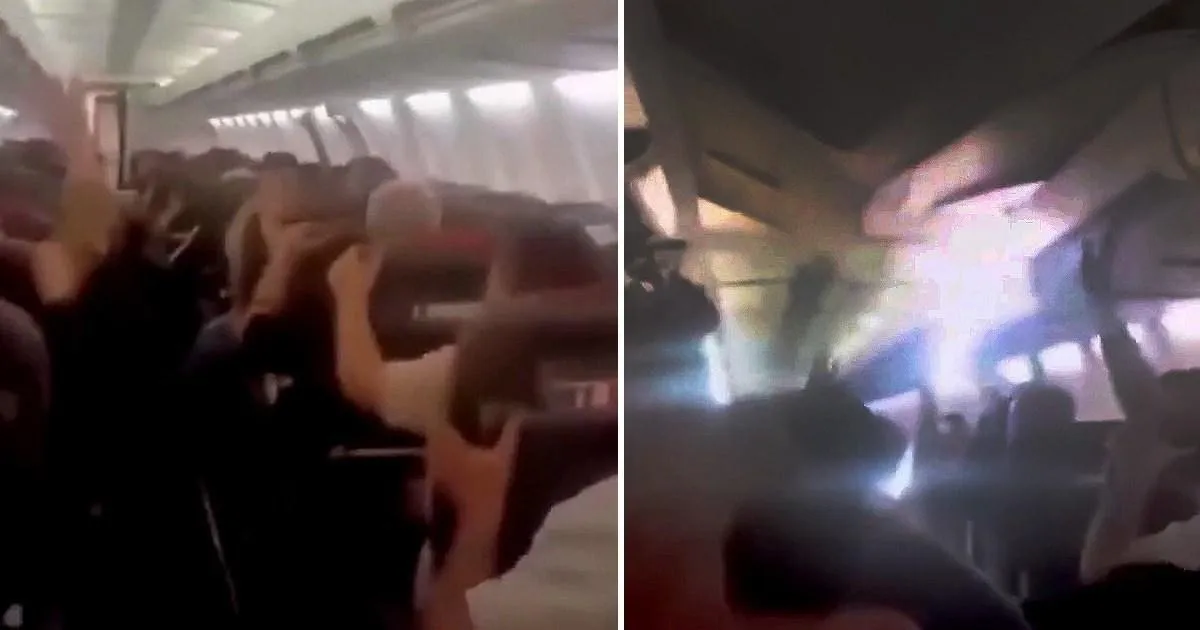
Inside the cabin, chaos erupted as the full force of the malfunction made itself known. The plane shook with such intensity that passengers instinctively gripped the seats in front of them, their knuckles white, their eyes wide with fear. The overhead compartments, which normally hold carry-on bags and personal belongings, rattled violently above them. Then came the moment that turned fear into outright panic: a loud, crushing bang, followed by the sight of the interior ceiling caving in. Large chunks of the overhead panels torn loose, hanging down into the aisle and above passengers’ heads, exposing wires, insulation, and the metal skeleton of the aircraft. Dust and debris filled the air, and the cabin became a scene of screaming, crying, and desperate prayer. Some passengers reached for their phones, not to make small talk but to capture the nightmare unfolding around them. One person managed to film the terrifying sequence: the shaking, the collapse, the cries of grown men and women pleading for safety. The footage shows a plane in distress, with shattered panels dangling overhead while the aircraft trundles on, its pilots working against time and gravity to bring it back to earth. For those aboard, the seconds stretched into what felt like an eternity of helplessness.
The technical picture that emerged after the incident painted a clearer, though still incomplete, portrait of just how close the flight came to disaster. The landing gear is believed to have failed, possibly bursting or detaching as the plane left the runway, and that failure likely caused further damage to the aircraft, including to one of its engines. While the exact details remain unconfirmed pending investigation, the visible effects inside the cabin were undeniable: the interior fittings that hold equipment and overhead luggage bins had been compromised, causing the ceiling to collapse under the stress of the violent vibrations. Despite the severity of the situation, the pilots managed to regain enough control to turn the damaged aircraft around and make an emergency return to Mashhad. The plane touched down on the runway, met by ambulances, emergency personnel, and medics who were ready for the worst. The airport runway was briefly locked down as crews responded, and the sight of the battered aircraft sitting on the tarmac must have been striking to everyone who saw it. Yet, against all expectations, no one was killed and no one was even seriously injured. Passengers were able to walk out of the plane under their own power, shaken but alive. According to the airline’s spokesperson, Hassan Jafari, all passengers were rebooked on a later flight, as if such an experience could simply be followed by another departure. Authorities have opened an investigation into the cause of the fault, but no official findings have been released yet.
This terrifying flight cannot be fully understood without looking at the wider context of Iranian civil aviation, which has been struggling under immense pressure for years. Decades of sanctions, economic isolation, and geopolitical conflict have made it extraordinarily difficult for Iran’s airlines to maintain their aging fleets, obtain spare parts, and meet international safety standards. Although exporting aircraft parts to Iran is not specifically banned by international law, the sweeping sanctions imposed on banking, finance, and other critical industries have had a devastating knock-on effect. The Trump administration, in particular, sanctioned dozens of Iranian airlines as part of broad economic measures aimed at pressuring the regime, and those measures have only deepened the crisis. Aviation accidents and emergency landings have become common in Iran, even before the escalation of wider regional conflict, which has further strained the country’s infrastructure and diverted resources toward military priorities. Just weeks before this incident, on August 25, another Sepehran Airlines flight experienced an emergency when its nose landing gear collapsed upon arrival from Tehran to Mashhad. Miraculously, there were no injuries in that incident either, and all 127 people on board were safely evacuated. But the pattern is troubling: a fleet that cannot be properly maintained, crews that must work with limited resources, and passengers who board planes with no choice but to trust that everything will be all right.
For the passengers on this latest flight, the trauma will not end with a safe landing. Even as they walked off the aircraft and onto the runway, wrapped in the relief of survival, their minds were sure to replay the moments when the ceiling came down and the plane shuddered beneath them. They screamed, they cried, they prayed, and now they carry that memory with them. In a world where air travel has become so routine that many of us forget the extraordinary physics and engineering that keep us aloft, this incident is a brutal reminder of how fragile that safety truly is. Every time we buckle our seatbelts and listen to the safety demonstration, we are placing our lives in the hands of pilots, mechanics, and the thousands of unseen systems working together. When those systems fail, as they did here, the result is raw, primal fear. The passengers aboard this flight experienced something that no one should have to endure, and their survival is a testament to their own resilience, the skill of the pilots who brought the damaged plane home, and perhaps a measure of pure luck. The crew, too, deserve recognition for managing a terrifying situation with professionalism, guiding the aircraft back to Mashhad while the cabin was in chaos and the aircraft itself was physically breaking apart around passengers.
As investigators begin to piece together what went wrong, the rest of us are left to reflect on the deeper meaning of this harrowing story. Aviation safety is not just a matter of technology and regulation; it is a human issue. When sanctions and political conflicts erode the ability of airlines to maintain their planes, it is not politicians who pay the price, but ordinary people—passengers, crew members, families, and children—who board those planes every day hoping to reach their destinations safely. The Sepehran Airlines flight could have ended in tragedy, with a cabin full of people lost to a preventable mechanical failure. Instead, it ended with everyone walking away, shaken but alive, and for that there is immense gratitude. Yet every near miss is also a warning. Until Iran’s airlines are given the resources they need to operate safely, these incidents will continue to occur, and not all of them will have such fortunate endings. The passengers on this flight are safe now, their ordeal over, but their story is a reminder that the sky is not always peaceful, and that the freedom to fly safely is a privilege that should never be taken for granted. As they try to sleep in the coming nights, they will likely hear the echo of that loud bang, see the ceiling sagging above them, and feel the vibration in their bones. They survived, but they will never forget the flight that turned from a simple journey into a fight for their lives.