

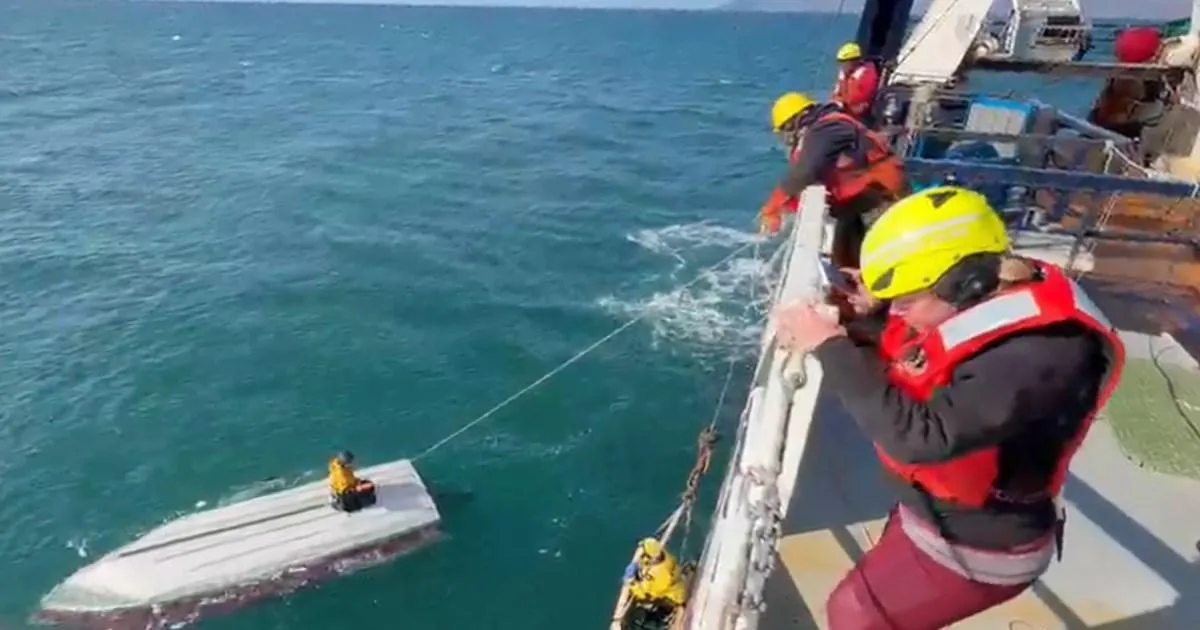
Video footage from Alaska’s Bering Sea captures a moment that seems almost impossible: a young boy, barely visible against the vast, grey expanse of water, being pulled from the wreckage of an overturned boat. The boy is Derek Parker Aghnaanga, just fifteen years old, and he has spent roughly two days perched on top of the capsized skiff, exposed to freezing temperatures, wind, and the relentless ocean. In the footage, his rescue appears as a small but profound miracle—a tiny human figure clinging to life in one of the most unforgiving environments on Earth. A United States Coast Guard helicopter had spotted him from above, and the crew directed the nearby fishing vessel Northwest Explorer to make the rescue. When the fishermen reached him, they found a teenager whose survival defied explanation. Captain Adam White of the Northwest Explorer later described him in words that would be repeated around the world: “That’s one tough kid.” But even as the boy was being hoisted to safety, a heartbreaking detail emerged through chattering teeth: his older brother, Sidney Kulowiy, was still beneath the overturned skiff. The rescue was not a simple story of survival. It was also a story of loss, family, and the deep bonds that can carry a person through unimaginable darkness.
The tragedy began on a Saturday night, when Derek, his 35-year-old brother Sidney, and a cousin left their hometown of Savoonga on St. Lawrence Island, an isolated community in the northern Bering Sea. They were heading out to fish for halibut, a trip that Derek had taken many times before. For Derek, the outing was about more than fishing: it was time spent with Sidney, whom he looked up to as a father figure. Their father had died years earlier, and Sidney had stepped into that role, guiding his younger brother through life with patience and love. When the three did not return by the early hours of Sunday morning, their family grew alarmed. They raised the alarm, and search efforts began. But the Bering Sea is not forgiving. At some point during the trip, the boat capsized, throwing the three into shockingly cold water. Sidney did not survive the accident. Their cousin, whose name the family chose not to disclose, held on through the night but eventually “slipped away,” as family members would later describe it. That left Derek alone on the overturned hull, sitting above the body of his brother, waiting in the freezing dark for someone to find him. The scale of the tragedy and the weight of his solitude are difficult to comprehend. Yet somehow, the teenager did not panic. He did not give up. He held on.
What makes Derek’s survival so remarkable is not just the physical endurance it required, but the emotional and spiritual strength he displayed during the ordeal. For two days, he had no food and no water. He was soaked, cold, and surrounded by the remains of his family’s lost expedition. At night, he was alone. The winds howled, and the ocean moved beneath him, threatening to take him at any moment. The famous title of Hemingway’s novel comes to mind: The Old Man and the Sea. But this was a boy, not an old man, and the sea had already claimed two of his loved ones. Yet Derek remained strangely calm. His mother, Vina Kulowiyi, would later say that her son was never afraid the whole time. That astonishing statement is hard to reconcile with the circumstances. But according to his mother, Derek knew he would be okay because his big brother was under the boat. To him, Sidney’s presence, even in death, was a form of protection. He prayed, he waited, and he kept faith. The image of a teenager alone in the vast ocean, speaking to a brother he could not see but could sense, is both heartbreaking and inspiring. It speaks to the resilience of the human spirit, and to the power of faith in a culture where family and tradition run deep.
The rescue itself unfolded like a scene from a film. The Coast Guard helicopter thundered overhead, scanning the churning water. Somehow, they spotted the tiny shape of the overturned skiff and the boy clinging to it. The helicopter crew could not land on the water, so they radioed the Northwest Explorer, a commercial fishing vessel in the area, and directed it toward the survivor. When the boat arrived, the crew saw Derek shivering and exhausted, but alive. Captain Adam White pulled the boy to safety. In the aftermath, White recalled that through the chattering of his teeth, Derek found the strength to speak, not about himself, but about his brother. “He had mentioned that his brother was still under the skiff,” White said. Even in the moment of his own rescue, Derek was thinking of Sidney. The captain’s words, “That’s one tough kid,” took on a deeper meaning: this was not just physical toughness, but a kind of courage rooted in love. The crew wrapped him in blankets and did what they could to warm him, but the emotional weight of what Derek had been through would take much longer to heal. The Coast Guard and the Northwest Explorer had pulled him from the sea, but the pain of losing his brother and cousin would stay with him for a lifetime.
Back in Savoonga, Derek’s family had been glued to every piece of news, every radio transmission, every word from the search. His mother, Vina, listened as the rescue unfolded in real time. When the captain announced over the radio, “We found a kid, he’s alive, he’s alive,” she and her family members cried and jumped for joy. But their celebration was quickly tempered by a question that hung in the air like a cold wind: “Where’s the rest of them?” The joy of finding Derek was inseparable from the devastating realization that Sidney and their cousin were gone. The family was left to grieve even as they celebrated the one survivor. They decided not to disclose the cousin’s name, a small guard against the crushing publicity that sometimes surrounds such tragedies. Vina took to Facebook to publicly honor her son and the brother who had helped shape him. “My survivor. His story is amazing. He was never afraid the whole time,” she wrote. “He knew he would be OK knowing his big brother was under the boat. He lived on prayer with no food and water. Love you son.” The words are simple, but they carry an ocean of meaning: pride, grief, faith, and love.
Derek Parker Aghnaanga’s story is one of those rare moments that remind us what survival really looks like. It is not simply about beating the odds; it is about carrying the people we love with us, even when they are no longer there. The teenager’s two days atop the overturned boat in the freezing Bering Sea will likely stay with him for the rest of his life. He will never stop grieving for Sidney, the brother who was also a father figure, and for his cousin who slipped away in the night. But he will also never be able to separate that grief from the incredible bond he shared with them. In a community like Savoonga, where everyone is connected through family, culture, and the sea, this story will be told for generations. It will be remembered as a miracle, but also as a tragedy. The toughest kid in the Bering Sea is home now, surrounded by a family that almost lost him, and a community that held its breath for two agonizing days. He survived because he believed his brother was still with him. That belief, more than anything, is what makes his story so human—and so unforgettable.