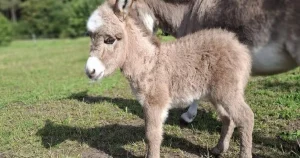

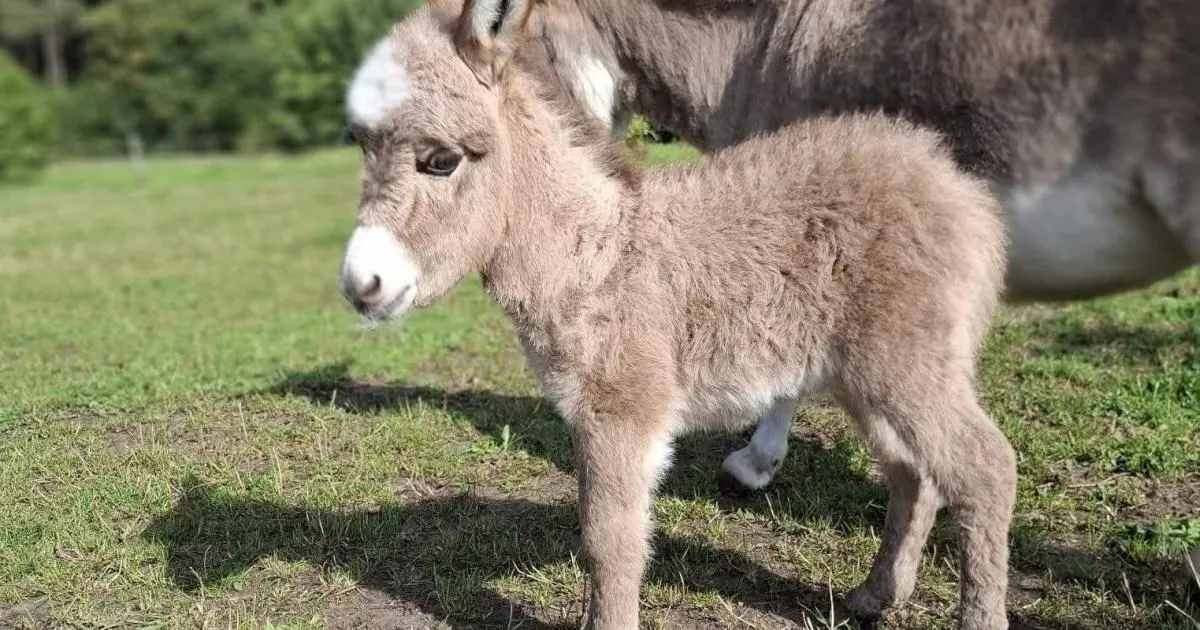
Some stories are terrible because they take something small and innocent and break it in a way that leaves everyone who loved it shattered. This is the story of Pleuntje, a two-week-old miniature donkey who lived at Stichting Het Ezelpaleis, the Donkey Palace, a sanctuary for neglected and abused donkeys in the village of Baarle-Nassau, in the south of the Netherlands. The sanctuary is exactly what its name promises: a peaceful place with quiet paddocks, caring keepers, and animals who have often arrived from dark histories of cruelty and abandonment. For the donkeys who come through its gate, life finally becomes gentle. They get regular food, clean water, proper veterinary care, and the kind of patient attention that helps frightened animals learn to trust again. Pleuntje was one of the newest residents, not because she had been rescued, but because she had been born into this safe and loving world. She was a rare reddish-coated filly, a small flash of warmth in a herd of more common grays and browns. She was so young that she had no teeth, no real strength, and no understanding of danger. Her entire universe was a paddock, her mother’s side, and the familiar hands of the people who fed her every day. To those people, she represented everything good about their work: a new beginning, born in safety, surrounded by devotion. Her legs were still learning to balance. Her ears still flopped in that comical, oversized way that makes baby donkeys so painfully beautiful. She had not yet learned to bray with any authority. She still smelled of milk and straw and newborn warmth. That is why the events of a single Monday evening would leave her human family stunned, heartbroken, and desperate. She did not simply wander away. She was taken, and the people who took her did not do it gently.
Marlhene Mouws, the sanctuary’s owner, locked up at around half past seven on Monday evening, after checking that the animals were settled and safe. When she returned to feed the herd, she found that Pleuntje was gone. A wave of panic moved through the staff. Six people launched a search, spreading out through the fields and calling the little donkey’s name. They searched for hours, until 1:30 in the morning, flashing lights into every shadow and checking every corner where a tiny creature could hide. At first light, exhausted but refusing to give up, they searched again. There was no trace of Pleuntje anywhere. The sanctuary offered a reward of £850 and sent an appeal across borders, reaching the Netherlands, Belgium, Germany, and France. It was the kind of desperate, far-reaching plea that people make when they know time is running out. But then, on Tuesday afternoon, the world shifted. Mouws was showing visitors around the property when she saw Pleuntje’s body lying in the same paddock where the foal had disappeared. The searchers were stunned. This was not some distant field they had missed. They had walked over that ground dozens of times, in the dark and in the daylight, on their hands and knees at some points, hoping to find any clue. Yet somehow, in a gap between those patrols, the thieves had brought the little body back. Mouws could barely speak. “She was lying there with a gunshot wound in the side of her chest,” she said. “We had been over that field fifty times.” The grief was not just because Pleuntje was dead. It was because someone had taken her, hurt her, and then returned her to the one place where she was supposed to be safe.
The details of Pleuntje’s injuries made the cruelty impossible to ignore. The bullet had entered above the foal’s left hip and exited through the right side of her chest, a wound that would have killed her, if she was lucky enough to die before the other horrors. Her neck and legs were injured. One eye hung from its socket. These were not the marks of an accident or a clean, quick death. They were the marks of violence, of struggle, of a tiny creature being hurt by people who felt nothing for her. Mouws described the scene in a way that no one who heard it could forget. “Who would do something like this to a baby that still has no teeth?” she asked. The question was not rhetorical. It was a cry of real confusion, the kind that comes when you try to understand a mind that finds pleasure or profit in breaking a newborn animal. Pleuntje had no microchip, no passport, no vaccinations. In the cold language of animal breeding, she was invisible, unregistered, a life with no paperwork to prove she existed. That made her difficult to sell on the black market, where miniature donkeys with proper documents are reportedly worth up to £13,000. But by dumping her body back in the paddock, the thieves did something worse than simply disposing of evidence. They made the sanctuary find her. They made the people who loved her look at what they had done. They turned a theft into a spectacle, a horror that would be photographed, shared, and remembered. The police were called. The sanctuary has CCTV cameras, but none of them cover the meadow itself. There was no clear image of the people who climbed over the fence, no shot of the vehicle that must have been waiting nearby, no face that could be put before the public. The whole crime happened, as far as anyone could tell, in a blind spot.
Mouws had no doubt that Pleuntje was deliberately selected. The foal’s reddish coat was unusual, eye-catching, valuable to someone who knew what rare animals can be worth. The thieves left behind another foal, a detail that seemed to prove the choice was based on money and appearance. They had climbed over a fence, lifted the little donkey into what must have been a waiting vehicle, and disappeared into the night. Their plan, if it was ever much of a plan, probably depended on selling Pleuntje quickly to someone who would not ask questions. But a two-week-old miniature donkey without papers is not a simple thing to move. She had no lineage documentation, no health records, no microchip, no proof of vaccination. Any legitimate buyer would refuse her, and even in the underground world of animal trading, a stolen newborn is a risk. The owner believes that this is why Pleuntje was returned. When the thieves realised that she would be difficult to sell, they made a choice. Instead of burying her somewhere remote, instead of leaving her in a ditch where no one would ever find her, they carried her back to the paddock where she had vanished. That decision says something dark about the kind of people they are. It was not just practicality. It was cruelty designed to be seen. They wanted the sanctuary to know that they had won. They wanted the people who had searched all night to find a corpse in the place where they had once found a living, breathing foal. The value of Pleuntje’s life was not measured in pounds or euros. It was measured in the hours of searching, the sleepless nights, the tears of grown adults who had dedicated their lives to rescuing animals from people exactly like this. The thieves thought they were disposing of a failed investment. What they actually threw away was a small soul that had never been given a chance to grow.
This was not just a story about one little donkey. It was a story about the kind of world we live in and the kind of people who work, every day, to make it softer. Stichting Het Ezelpaleis is not a breeding farm. It is a rescue, a place where donkeys come after being abandoned, starved, beaten, or simply left behind by a society that no longer wanted them. The people who run it spend their days cleaning hooves, mixing feed, mending fences, and tending to wounds that animals carry both on their bodies and in their hearts. Those same people spent Monday night and Tuesday morning searching for Pleuntje, not because she belonged to them, but because they belonged to her. When her body was found, the grief moved outward through the small community and far beyond it. The appeal had already been shared across the Netherlands, Belgium, Germany, and France. People who had never visited the sanctuary found themselves staring at photographs of a tiny reddish donkey and feeling sick about what human beings can do. The police urged anyone who saw or heard anything suspicious on Monday evening to come forward. But in a quiet rural area, after dark, there may have been no witnesses. The sanctuary’s CCTV cameras, which cover parts of the property, were not pointed at the meadow. That fact haunts Mouws. If the cameras had caught something, perhaps the little foal could have been saved. If a neighbour had glanced out a window at the right moment, perhaps the thieves would have panicked and run. Instead, there is only a body, a gunshot wound, and a collection of questions that may never be answered. The emotional toll on the staff is impossible to measure. They had not simply lost an animal. They had failed to protect a newborn from the very thing this sanctuary exists to protect against: human cruelty. No amount of experience in rescue work can prepare a person for that feeling.
And yet, even in the darkest moments, there is something worth holding on to. The outrage over Pleuntje’s death has brought attention to the sanctuary’s mission. People have shared her story, sent donations, and demanded answers. The strangers who learned her name will not forget her quickly. The photograph of a little reddish donkey, alive and curious, will remain online long after the headlines move on. But her death should do more than make people sad. It should make them question why some people are capable of hurting a baby animal, and what can be done to stop it. The owner’s question, “Who would do something like this to a baby that still has no teeth?” is a challenge. It asks us to imagine the emptiness inside a person who can look into the eyes of a trusting foal and choose violence. It asks us to recognise that animals in sanctuaries are not property. They are individuals with personalities, mothers, fears, and the right to live without being tortured. It asks us to be the kind of people who speak up when we see something wrong, who pay attention when a story like this feels too heavy to bear. Pleuntje was only two weeks old. She never had the chance to grow into a stubborn, affectionate, long-lived miniature donkey. She never learned what it meant to be safe, because safety was taken from her before she understood it existed. But her short life has come to mean something. She has become a symbol of the vulnerability of every creature that depends on human mercy, and a symbol of how urgently we need to be better. To be human, in the deepest sense, is to feel the weight of a tiny life stolen away. If Pleuntje’s story makes one person think twice, one witness come forward, one lawmaker close a loophole, then her death will not have been entirely meaningless. She was taken and tortured and shot, but she was also loved. She was searched for in the dark. She was mourned by people who could not save her, but who will never stop trying to save others like her. And she will not be forgotten.