


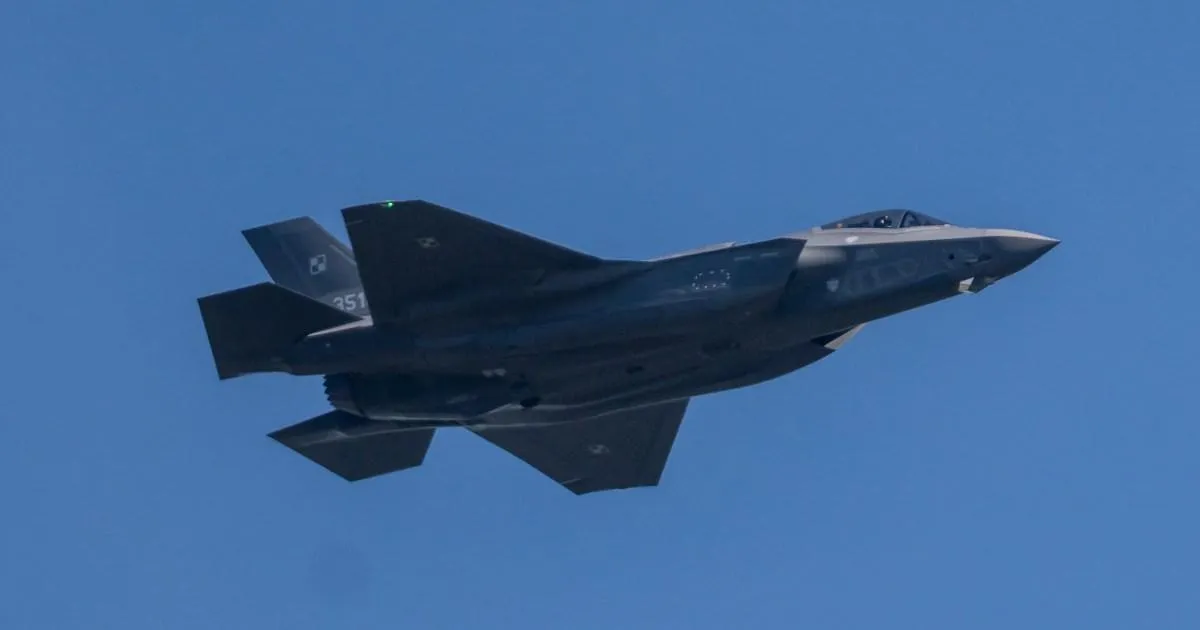
It was meant to be a routine Sunday morning in Vilnius, the kind of quiet, sunlit start that should have been dominated by the sounds of marathon runners pounding the cobbled streets and spectators cheering them on. Instead, the skies above the Lithuanian capital turned tense. A NATO fighter jet tore through the air, summoned from its base in northern Lithuania to intercept what radar operators believed to be an unidentified drone encroaching on the country’s airspace. Vilnius Airport was immediately closed. An air alert was declared. People on the ground, some of them mid-race, some of them trying to catch flights, were suddenly thrust into a moment of raw uncertainty. It was the kind of moment that has become all too familiar in this part of Europe, where the war in Ukraine has turned every blip on a radar screen into a potential threat. But then, as the fighter jet closed in on the target, the pilot realized the truth: the mysterious object was not a drone at all. It was a flock of birds. The tension, at least for this brief moment, evaporated into something almost absurd, a comedy of errors played out against the grim backdrop of modern geopolitical reality.
The details of the false alarm, as confirmed by Lithuania’s National Crisis Management Centre, offered a sobering reminder of just how difficult it is to tell friend from foe, or indeed bird from machine, when the stakes are so high. On initial radar readings, the marks left by birds and drones can look almost identical, the centre explained in a statement. That single sentence speaks volumes about the challenges faced by air defense forces across NATO’s eastern flank. The fighter jet, part of the NATO Baltic Air Defense mission and flown by the Italian air force, was based in northern Lithuania, ready to respond at a moment’s notice to any incursion into allied airspace. The pilot’s task was to identify, intercept, and, if necessary, neutralize the threat. Instead, the mission ended with a sigh of relief and a lesson in avian behavior. It is easy to imagine the scene in the cockpit, the initial surge of adrenaline, the careful maneuvering to get a visual on the target, and then the almost anticlimactic realization that the radar had been fooled by a bunch of birds. It is a moment that might be laughable if it did not underline the constant, hair-trigger vigilance required in a region where real drones, carrying real explosives, have become a genuine and present danger.
For the people of Vilnius, the disruption was brief but unsettling. The air alert was lifted and the airport reopened within 38 minutes of the initial warning, a swift resolution that allowed the city to exhale. Organizers confirmed that the Vilnius Marathon, which was taking place at the time, was not interrupted. Runners kept running, spectators kept cheering, and the city returned to its Sunday rhythms almost as quickly as the fighter jet had appeared in the sky. But the psychological impact of those 38 minutes cannot be measured so easily. For a few fleeting moments, the ordinary rhythms of life were suspended. Passengers waiting at the airport may have heard the announcement and felt their stomachs drop. Runners who glanced up at the sky may have wondered whether they were witnessing history or a drill. The fact that it was all a false alarm, a trick of the radar, does not erase the visceral fear that such moments produce. In an era where drone attacks have moved from the battlefield to civilian infrastructure, where a small unmanned aircraft can carry enough explosives to cause catastrophic damage, every unidentified object is treated as a potential assassin. Vilnius learned on that Sunday that even a flock of birds can trigger the full machinery of collective defense, and that the cost of vigilance is measured not only in money and resources, but in the quiet erosion of everyday normalcy.
Yet the false alarm in Vilnius did not happen in a vacuum. It came at a time of heightened tensions between NATO and Moscow, a period in which the skies and borders of Eastern Europe have become a new front line in the shadow war between Russia and the West. Lithuania’s military had said earlier that week that drones aimed at Ukraine had landed on Lithuanian territory, a chilling reminder that the war, though fought hundreds of miles away, has a way of spilling over into neighboring countries. For the Baltic states, which share borders and painful history with Russia, this is not a distant conflict. It is an existential concern. The presence of stray drones, whether armed or merely lost, raises alarms about espionage, sabotage, and the possibility of a deliberate provocation. Every false alarm, every bird mistaken for a drone, risks creating a boy-who-cried-wolf scenario, where real threats might one day be dismissed as another flock of geese. But for now, the response in Vilnius reflects the prevailing logic: better to scramble a fighter jet and be wrong than to ignore a possible threat and be tragically right. This is the new reality of living on NATO’s eastern edge, where the difference between a bird and a bomb can be a matter of seconds, and where the price of peace is eternal vigilance.
The incident at Vilnius Airport also resonates far beyond Lithuania, because it is part of a broader pattern of drone-related incidents and sabotage alarms that have rattled European nerves in recent months. In August, in the German city of Leipzig, authorities found a drone rigged with explosives and an unknown substance next to a Ukrainian cargo plane. The discovery prompted police to call in a bomb squad for a remote detonation. There were no injuries, but the message was clear: someone was testing the defenses of European aviation infrastructure. Germany immediately pointed the finger at Russia, closing the Russian consulate in Bonn and terminating the contract for the Russian House in Berlin, a cultural center that Moscow had long used as a diplomatic and soft-power outpost. Russia, for its part, denied any involvement, with officials claiming that Germany was trying to start a “real war” by blaming the Kremlin for the incident. The war of words was as heated as the actual threat, a classic exchange in the increasingly hostile relationship between Moscow and the West. The Leipzig drone was not an isolated event. Just months earlier, a firebomb had detonated at a DHL warehouse in Birmingham, an attack believed to be the work of Russian-backed saboteurs. European intelligence officials, including those at MI6, described it as a “test run” for a wider campaign of sabotage aimed at disrupting supply chains, sowing chaos, and undermining trust in Western institutions.
The episode in Vilnius ended without injury, without damage, and without any real threat being realized. The birds flew on, the fighter jet returned to base, and the airport reopened in time for the next flight. But the false alarm is a valuable lens through which to examine the strange, anxious moment in which we live. On one hand, it is reassuring that NATO’s defenses are so responsive, that a single radar blip can trigger an interception attempt within minutes. On the other hand, it is deeply unsettling that the threat of drones has become so pervasive that even nature itself can be mistaken for an enemy strike. For the people of Lithuania, and for Europeans more broadly, the incident is a reminder that the security environment has changed. The war in Ukraine has normalized the idea that drones can cross borders, that explosive devices can appear in unexpected places, and that no airport, warehouse, or marathon is entirely beyond the reach of those who wish to cause harm. The fact that this particular scare was caused by birds may elicit a wry smile, but the underlying truth is no laughing matter. It is a testament to the tension that has settled over the continent, a tension that will not disappear with a joke about radar and migration patterns. As European authorities continue to investigate and respond to the expanding campaign of sabotage that intelligence agencies attribute to Russia, moments like this serve as a warning: the threat is real, even when the specific alarm is false. And for now, the best defense remains the courage to act on every potential danger, no matter how unlikely, and the resilience to carry on living, running, and traveling in the face of so much uncertainty.