

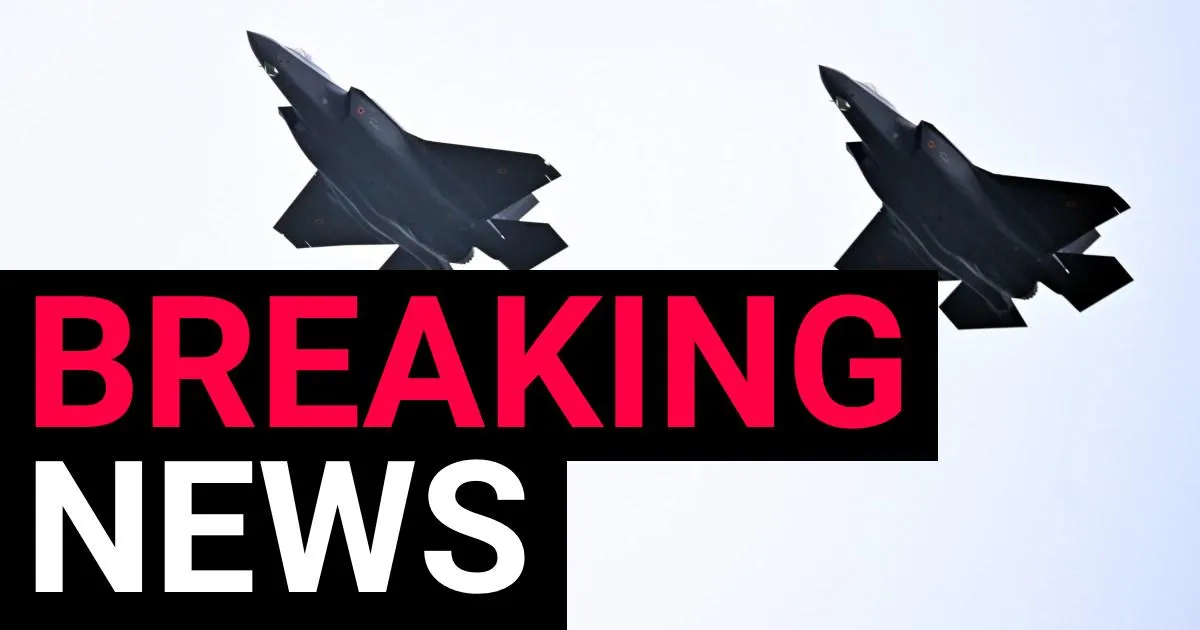
Deep in the night, while most people in Kaunas were asleep, the quiet of the Lithuanian city was shattered by an unmistakable signal of danger. A drone, unidentified and uninvited, had slipped across the border from Belarus and entered Nato airspace. Within moments, fighter jets were scrambled, and the intruder was shot down before it could travel any further. For the people of Lithuania, this was not just another news headline; it was a wake-up call in the most literal sense. Reports quickly spread that drone alarms had sounded over the capital Vilnius and surrounding villages, pulling ordinary people from their beds with the kind of fear that has become all too familiar on Nato’s eastern flank. President Gitanas Nausėda addressed the situation with a mixture of urgency and clarity, confirming that the drone had come from neighbouring Belarus and making it clear that Lithuania was ready to defend itself. “With Russia intensifying its aggression against Ukraine, such readiness is vital for our region. Together with our Nato Allies, Lithuania will defend its airspace,” he said. These are not empty political words. For a country that shares borders with both Russia and Belarus, and which remembers decades of Soviet occupation, the presence of an armed or surveillance drone overhead carries a weight that many in Western Europe struggle to fully understand. It is the kind of moment that turns geopolitical briefing documents into real, tangible anxiety in the middle of the night.
The fact that Russia has not taken responsibility for this particular drone changes little, because the subtext is unmistakable. Belarus, the country from which the drone entered Lithuanian airspace, is widely regarded as a puppet state of the Kremlin, with its military and security apparatus almost entirely financed and supplied by Moscow. For all intents and purposes, an incursion from Belarus is an incursion from Russia. That distinction, of course, is precisely the kind of ambiguity Moscow and Minsk have learned to exploit over the years. By using proxies and denying involvement, they can probe Nato’s defences while maintaining a layer of plausible deniability. This is not the first time Lithuania has faced such a threat, and it certainly will not be the last. The country occupies a uniquely exposed position, wedged between Russia’s Kaliningrad exclave to the southwest and Belarus to the east. In any future conflict between Nato and Russia, the Baltic states would almost certainly be among the first targets. This is why the Lithuanian president’s words matter so much. When he says that readiness is vital, he is not being rhetorical. He is describing the daily reality of a nation that has watched Vladimir Putin’s aggression in Ukraine with grim recognition. Ukrainians are not strangers to them; they are neighbours and symbols of what could happen if Europe looks away. The decision to shoot down the drone rather than simply track it is a signal that Nato’s tolerance for violations is wearing thin. It is a warning that the alliance will no longer treat these incidents as mere provocations to be logged and forgotten, but as serious threats to be met with force.
This incident, unsettling as it is, is not an isolated event. Over the past year, a much larger and more alarming pattern has emerged across the entire continent. Intelligence reports have revealed that Russia is behind hundreds of mystery drone operations across Europe and the European Union, many of which appear to be part of a deliberate preparation for a future conflict. One of the most sobering assessments came from the International Institute for Strategic Studies, which found that Moscow has been using so-called shadow fleet ships to launch drones into British and European airspace. These unmanned aircraft have been detected near airports, military bases, and even nuclear sites, raising serious concerns about what exactly Russia is trying to achieve. In the United Kingdom, the list of affected installations reads like a map of the country’s most sensitive security infrastructure: RAF Fairford, RAF Feltwell, RAF Lakenheath, and RAF Mildenhall have all been targeted by mysterious drones since 2024. Some sightings have been dismissed as coincidence or civilian misidentification, but the sheer frequency and coordination of the activity strongly suggest otherwise. The drones were not just flying around aimlessly; they were documenting, testing, and observing. They were probing the gaps in Europe’s air defences, learning how quickly jets could be scrambled, how radar systems reacted, and where the blind spots were. It is hard to overstate how disturbing this is. In a way, these drones are like burglars watching a house to see when the owners are home and where the cameras are pointed. They are gathering intelligence that could be used to guide missiles, disrupt communications, or overwhelm defensive systems at the outbreak of a real war.
The most frightening implication of all this drone activity is that it is not necessarily about what happens tonight, but about what might happen years from now. According to the International Institute for Strategic Studies, the Kremlin was likely able to map reaction times, coverage gaps, and limitations across European integrated air defences. That is a chilling thought, because it means every drone that buzzes over a military base or nuclear facility is a tiny fragment of a much larger puzzle Moscow is trying to solve. Every scrambled jet and every radar lock is information that can be analysed and turned into a tactical advantage. This is the quiet, patient work of preparing a battlefield long before the first shot is fired. The drones themselves may be slow, noisy, and primitive in many ways, but their purpose is far from simple. They are tools of intelligence gathering, psychological warfare, and strategic rehearsal. For the people responsible for defending Europe, this is a nightmare scenario. You cannot shoot down every suspicious object without risking a catastrophic mistake, but you also cannot ignore them without leaving yourself vulnerable. The fact that Russia has been able to carry out these operations with such impunity, using civilian ships and off-the-shelf technology, shows how difficult it is for modern militaries to protect themselves against low-cost surveillance. In a strange way, a drone costing a few thousand dollars can tie up millions in fighter jets, radar systems, and personnel. It is an economy of force that benefits the attacker and exhausts the defender.
For the people living in the affected areas, however, it is not just about abstract military strategy. It is about the sudden, disorienting feeling of not being safe in your own home. In June, jets were scrambled over Lithuania again after a suspected kamikaze drone was believed to have entered the country’s airspace. Residents of Vilnius were told to take precautions as an alert went off, with officials describing a radar signal characteristic of unmanned aerial vehicles. Families were forced to consider what they would do if the drone turned out to be armed, if the threat was real, if the next few minutes would change their lives forever. In the end, the incursion turned out to be something much more benign, perhaps a weather balloon. But the fear it generated was real, and that fear is exactly what Russia wants. The uncertainty is part of the weapon. By sending drones into Nato airspace, disappearing them, mixing them with balloons and even flocks of birds, the Kremlin creates a paranoid fog that makes it harder for defence forces to distinguish between genuine threats and false alarms. Every noise in the sky invites a moment of hesitation. Every false alarm dulls the senses. And in a real crisis, that erosion of attention could be fatal. The psychological impact is perhaps most intense in Lithuania, where memories of Soviet occupation are still raw and where every incursion feels like a reminder that freedom is never guaranteed. But the same anxiety is spreading to other parts of Europe, to the British bases where drones have been seen hovering over runways, and to the nuclear sites where security teams have had to respond to unknown aircraft. It is a strange and unsettling way to live: constantly looking up, wondering if the shadow moving across the clouds is a bird, a weather balloon, or the beginning of something much more dangerous.
Ultimately, the shooting down of this drone in Lithuania is a small but significant moment in a broader story of escalating tension between Russia and the West. It shows that Nato is willing to act, that the era of ignoring or simply tracking incursions is over, and that the alliance understands what is at stake. But it also exposes the fragility of the peace that Europe has enjoyed for decades. A drone from Belarus is not just a mechanical object; it is a message, deliberately sent and fully understood. It says that no border is secure, no night is completely peaceful, and no country can afford to take its safety for granted. The human cost of this reality is impossible to measure in statistics. It is felt in the sleepless hours after an air raid siren, in the anxious conversations between parents trying to explain why the fighter jets roared overhead, in the quiet resignation of people who know they are living on the front lines of a new Cold War. There are no easy answers. Nato must balance vigilance with restraint, protect its citizens without provoking a larger conflict, and stand firm against an opponent that thrives on ambiguity and fear. But for the people of Lithuania, and for everyone who calls Europe home, the message is clear: this is not abstract geopolitics. It is real. It is personal. And it is unfolding in the skies above them every single day. The world is paying attention, at last, and perhaps that is the most important thing. Whether it is enough to prevent the future conflict Russia seems to be preparing for remains to be seen. But one thing is certain: the night is no longer quiet, and nobody can pretend otherwise.