
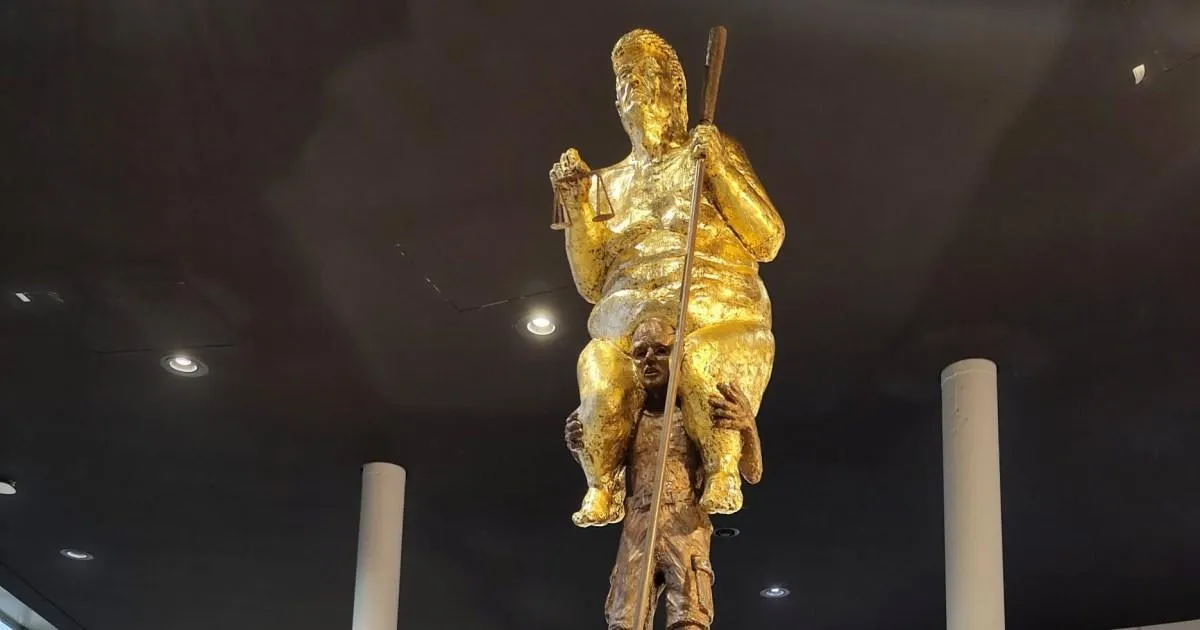
If you were walking through the European Parliament in Strasbourg, expecting the usual marble corridors, hushed diplomacy, and the quiet hum of institutional power, you might be forgiven for doing a double take. There, in the middle of it all, stands a towering golden statue of Donald Trump — naked, rotund, and unmistakably confident, perched on the shoulders of a man who looks as though he has been carrying the weight of the world for far too long. The statue is more than eight feet tall, coated in 23-karat leaf gold, and it holds a giant golf club in one hand, a ball-shaped world in the other, and a set of scales draped nearby as a nod to justice. It is called “Orange Plague” or “The King of Injustice,” and it was created by Danish sculptor Jens Galschiot as a satirical attack on Trump’s climate policies. But before you laugh, before you take a photo, before you share it with someone who might not believe it’s real, the statue asks a much heavier question: what does it mean when the people we elect to lead us become burdens we carry on our backs? The man beneath Trump is strained, tired, almost buckling under the weight. He isn’t a villain or a hero. He’s just a person — and in that way, he looks a lot like all of us.
The details of the statue are deliberately loud, almost absurd, and yet they carry a seriousness that is hard to shake. Trump’s figure is drenched in gold, but it doesn’t make him look majestic. Instead, the gold makes his nakedness more glaring, more vulnerable, more ridiculous. He is not a king in fine robes; he is a leader exposed, with nothing to hide behind except the symbols of wealth and power he has gathered around himself. The golf club is a nod to his love of the game and his frequent escapes from the pressures of office, while the ball-shaped world suggests a man who treats the planet like a toy to be whacked around rather than a fragile home to be protected. The scales of justice hang there too, but they are not balanced. They seem decorative, almost forgotten, as if justice is something Trump holds up for show but never actually uses. The man carrying him appears exhausted, his posture bent, his face strained, and that image is perhaps the most powerful part of the entire installation. A card placed next to the statue drives the point home, accusing Trump of holding back attempts to tackle the climate crisis and reading, “I would do anything to help him. Except stepping down from his back.” That line is chilling because it captures the strange loyalty people feel toward leaders who hurt them. We want to help, we want to believe, we want to support — but at some point, we have to recognize that the help we are giving is actually enabling the harm. The statue has been shown before, in Brazil, Copenhagen, and Munich, at conferences and protests, but its placement at the European Parliament gives it a new kind of weight. It is no longer just street art or protest theater. It is a message delivered to the heart of European democracy, and it refuses to be ignored.
Galschiot has said that the sculpture is inspired by Hans Christian Andersen’s classic tale “The Emperor’s New Clothes,” and once you know that, the whole piece clicks into place. In the story, a vain emperor parades through the streets wearing nothing at all, convinced that he is dressed in the finest garments imaginable. His courtiers and subjects go along with the illusion because they are afraid of looking foolish or disloyal. They praise his invisible clothes, they nod approvingly, they pretend to see what is not there. It is only when a small child cries out, “But he isn’t wearing anything!” that the spell is broken, and the emperor is exposed as a ridiculous figure. Galschiot’s statue does exactly what that child did. It names the truth that too many people are afraid to say out loud. Trump, like the emperor, has built his public image on bluster, bravado, and the willing participation of those around him. He projects strength, wealth, and certainty, but the statue strips all of that away. It shows him as he is: naked, fragile, and utterly dependent on the people who carry him. The climate crisis is not an illusion, though. It is real, it is urgent, and it is being worsened by leaders who refuse to act. The fairy tale gives us a way to talk about that refusal without turning away. It lets us laugh at the absurdity of power while also recognizing the danger of our own silence. We are the courtiers in the story, and the statue is the child’s voice. The question is whether we will listen before it is too late.
One of the most interesting aspects of the installation is how it invites people to take part in the protest themselves. Visitors to the European Parliament were handed miniature, 3D-printed versions of the statue, described as “protest tokens.” If you have a 3D printer, you can download the files for free from Galschiot’s website and create your own tiny golden Trump to place on your desk, your shelf, or your dashboard. There is something wonderfully democratic about this. Art is often seen as something distant, something to be admired from behind a rope or a glass case, but Galschiot has made his art portable, shareable, and personal. You don’t have to travel to Strasbourg to see it. You can make it yourself, hold it in your hands, and give it to someone else. It becomes a conversation starter, a small act of resistance, a way of saying that you see what is happening and you refuse to pretend otherwise. Social media reacted exactly as you might expect. When images of the statue first emerged, people could not believe their eyes. Some assumed it was artificial intelligence, a clever digital trick, and commented, “Please make this be true.” That reaction says a lot about the moment we are living in. We have become so used to seeing fake images, manipulated videos, and AI-generated content that we no longer trust our own eyes. But this statue is real. It is physically there, taking up space, gleaming under the lights, making people stop and think. The fact that people hoped it was real — or hoped it wasn’t — only adds to its power. It forces us to ask what is real, what matters, and what we are going to do about it.
The political reaction has been predictably mixed, but the artist and the politicians who invited him are not backing down. Per Clausen, a left-wing Danish MEP who invited Galschiot to display the statue, told Deutsche Welle that he is not worried about potential backlash from Trump. His response was blunt and memorable: “If someone is so thin-skinned that they cannot tolerate this sculpture being exhibited in the European Parliament, then they have no place on the world stage.” That is a strong statement, but it is also a reminder of what democratic institutions are supposed to be. Parliaments are not just places where laws are written and budgets are approved. They are also places where ideas are challenged, where power is held accountable, and where uncomfortable truths can be spoken without fear. Satire has always been a part of that tradition. It is a way of deflating arrogance, exposing hypocrisy, and reminding the powerful that they are not above the rest of us. Trump has not yet reacted to the installation, and perhaps he never will. He may dismiss it as the work of a washed-up artist or ignore it entirely, the way he ignores so many things he does not like. But the statue does not need his reaction to be effective. It has already started conversations, sparked debates, and made people think. After its time at the European Parliament, the piece is scheduled to travel to the United Nations COP31 Climate Conference in Turkey next month. That is a fitting destination. The statue will be there, in the middle of global climate negotiations, reminding everyone why they came and what is at stake.
In the end, “Orange Plague” is more than just a caricature of a controversial president. It is a mirror held up to all of us. It asks us to think about the leaders we carry, the burdens we accept, and the truths we are willing to speak. The man under Trump’s weight is tired, but he is still standing. He could, at any moment, decide that he has had enough. He could shrug his shoulders, straighten his back, and let the golden figure tumble to the ground. That choice is ours too. We are the ones who carry our leaders, whether through votes, loyalty, or simple inaction. We are the ones who allow them to stay on our shoulders long after they have stopped serving us. And we are the ones who have the power to put them down. The statue is a warning, but it is also an invitation. It invites us to be the child in the story, to speak the truth even when it is uncomfortable, even when everyone around us is pretending to see something that is not there. The climate crisis is the greatest challenge of our time, and it will not be solved by leaders who refuse to acknowledge it. It will be solved by ordinary people who refuse to stay silent. Galschiot’s golden Trump is ridiculous, yes. It is funny, strange, and hard to ignore. But underneath the laughter, there is a serious message: the emperor has no clothes, the world is burning, and we cannot afford to carry the people who are fanning the flames. So look at the statue, take your miniature protest token, and ask yourself what you are willing to do. Because the child has already spoken. The only question is whether we are ready to listen.