

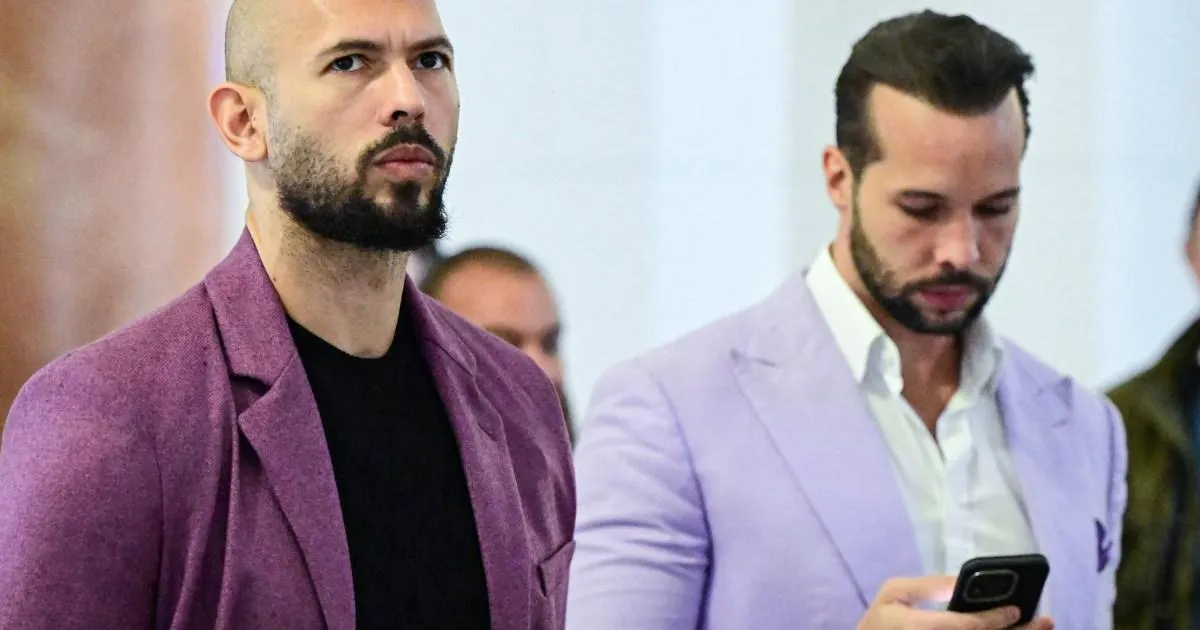
In a case that feels almost impossible to reconcile with the polished, hyper-confident persona Andrew Tate projects to millions of followers online, British prosecutors have now formally alleged that he was involved in making a sexualised video with a child. The accusation, filed as part of a UK extradition request, has landed like a thunderbolt in a story already crowded with scandal. According to court documents, the influencer is accused of creating or sharing indecent images of a girl who was just 17 at the time. The footage and pictures were allegedly discovered on devices seized from his home in Hitchin, Hertfordshire, after his arrest in July 2015 on suspicion of rape and sexual assault. Among the evidence, prosecutors say, were dozens of images classified as Category A — the most serious level of indecent imagery. This is not a footnote or a distant rumour; it is a detailed legal claim, now sitting in public view, that paints a deeply disturbing picture of what was happening behind closed doors. And at the heart of it all is a young woman whose life, at 17, became entangled with a man who would later become one of the most controversial figures on the internet. The human reality here is heavy: a teenager, far from home, caught in a web of power, money, and exploitation, while the man accused of using her for profit and pleasure continued to build a brand built on dominance and control.
The specific details of the alleged evidence are harrowing. Prosecutors say that 168 indecent images and videos of the girl were found on a Samsung mobile phone and a laptop belonging to Tate. Of these, 66 were classified as Category A images — the most extreme and graphic category — and 26 as Category B. At least one video allegedly showed Tate himself with the girl in a sexualised context. Another Category B video reportedly showed Tate sitting on a bed while the girl, wearing lingerie, positioned herself behind him and kissed his neck. A female adult then joins them and begins kissing the child. The documents also state that the girl travelled to the UK in 2014 and began working for Tate’s webcam business shortly afterwards. Her passport, found in Tate’s home, confirmed she was 17 at the time of his arrest. Tate, prosecutors allege, was 28 and fully aware that she was underage. It is difficult to read these details without feeling a visceral sense of unease. Behind every statistic, every category, every legal term, there is a real person — someone who was barely out of childhood, navigating an unfamiliar country, likely vulnerable and reliant on the very person who is now accused of exploiting her. The images are not just evidence; they are fragments of a lived experience, a record of moments that should never have happened, preserved in digital form and later used as the basis for criminal allegations. For anyone who has ever wondered how such cases unfold, the documents offer a chilling window into the mechanics of alleged abuse: the travel, the job offer, the power imbalance, the recording, the sharing, the bragging.
Perhaps most disturbing is the alleged aftermath — the way the footage and images were reportedly treated not as secrets to be hidden, but as something to be shown off. According to the court documents, Tate is accused of sharing videos of the girl with three other people in a WhatsApp group in June 2015. In that group, he allegedly boasted that the girl worked for his webcam business, and one man reportedly offered to pay $1,000 (£750) every day if she performed a specific sexual act on camera. The casualness of that exchange is chilling. It reduces a teenage girl to a product, a commodity, a spectacle for men with money and power. It also reveals the cold, transactional world of the webcam industry, where vulnerability is often monetised and boundaries are blurred or broken entirely. The girl had come to the UK, likely hoping for work or opportunity, and instead found herself at the centre of an alleged exploitation network. Her passport was in Tate’s home, a detail that speaks to how much control he allegedly had over her life. The image of that passport — a young woman’s identity, her age, her nationality, her entire existence reduced to a document in a man’s house — is deeply symbolic. It represents the way alleged abusers often isolate and control their victims, holding onto the very paperwork that could have helped her escape. And it is a reminder that behind the legal language of “Category A images” and “indecent videos” is a story of human betrayal, one that should provoke not just anger but also compassion for the survivor.
Tate’s public trajectory after those alleged events is now well known. He appeared on Big Brother in 2016, but was removed after just six episodes when producers became aware of a video showing him hitting a woman with a belt. He and his brother Tristan later moved their webcam business to Romania, and in 2022 they were arrested there as part of a human-trafficking investigation. Romanian authorities indicted the pair, though they were released to house arrest while the case progressed. Then, in 2024, British authorities applied for further warrants for their arrest, and in July 2026 the brothers were arrested in Miami. The UK has now filed a formal request to extradite them from the United States to face a total of 59 charges, including rape and sex trafficking. This is not a single allegation, but a sprawling web of legal claims spanning years, countries, and dozens of alleged victims. The sheer scale of the charges is staggering. Yet for all the legal complexity, the human story remains simple: people were hurt, allegedly, by someone who built his career on telling young men that strength means domination and that women are objects to be conquered. Tate and his brother have denied all the accusations, insisting that their interactions with women were consensual. They are entitled to that defence, and the legal system must presume their innocence until proven otherwise. But the weight of the evidence, as described in court documents, is heavy. And for the young woman at the centre of the UK allegations, the wait for justice has already been measured in years, not months.
The extradition proceedings mark a pivotal moment, not just for Tate and his brother, but for the many people who have followed the case from afar. It is easy to get lost in the drama of it all — the flashy cars, the social media rants, the celebrity arrests, the conspiracy theories. But at its core, this is a case about accountability. The legal system is now being asked to decide whether a man with millions of followers and enormous wealth can be held to the same standards as anyone else. The charges against the Tate brothers include rape, assault, human trafficking, controlling prostitution for gain, and possession of extreme pornography. These are not victimless crimes. They involve real people, real bodies, real trauma. The young woman whose passport was found in Tate’s home has had to live with the knowledge that intimate images of her, taken when she was a teenager, may have been viewed by others and used as evidence in a global legal battle. Her identity has been protected in the media, but her story is now part of a public record. That takes courage, even when the decision to testify or cooperate is not entirely voluntary. The legal process is slow, and for survivors of sexual abuse and exploitation, the wait can feel like a second punishment. Every delay, every appeal, every procedural move can reopen old wounds. And yet, the fact that these allegations are being taken seriously by prosecutors in multiple countries is itself a form of validation — a signal that the world is finally paying attention.
What does this case mean for the rest of us? It is a stark reminder that the internet is not a separate world, but a reflection of the one we live in — with all its power imbalances, its exploitative industries, and its capacity for harm. Andrew Tate did not become famous in a vacuum. His rhetoric resonated with millions of young men because it spoke to their insecurities and offered them a fantasy of wealth, status, and control. But the allegations against him reveal the dark underbelly of that fantasy: a world where young women are recruited, filmed, shared, and discarded. The case should prompt all of us to think more critically about the content we consume, the influencers we elevate, and the way we talk about sex, power, and consent. It should also remind us to support survivors — not just in high-profile cases, but in our own communities, where abuse often happens silently, far from the cameras. For every 17-year-old whose passport ends up in the hands of someone who exploits them, there are countless others whose stories never make it to court. The humanisation of this case matters because it is all too easy to reduce it to a celebrity scandal. But Andrew Tate is not the protagonist of this story. The real focus should be on the alleged victims, the survivors, and the slow, painful pursuit of justice. In the end, the court documents are not just legal filings. They are a collection of human experiences — some traumatic, some hopeful, all deserving of dignity. And as the extradition case unfolds, the world will be watching, not for drama, but for answers.