
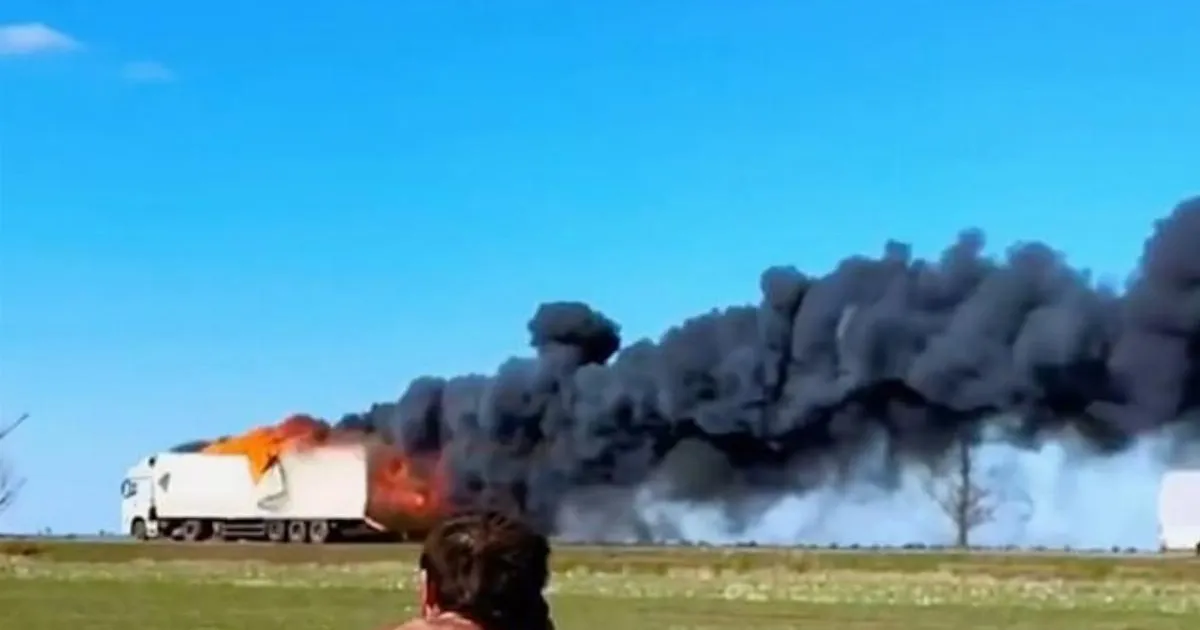
On a stretch of road that has become one of the most dangerous in Ukraine, the war arrived in a sudden burst of fire. A cargo lorry, loaded with supplies meant for Russian troops on the front lines of occupied Crimea, was struck by a drone and erupted into a ball of flames. Footage posted on Wednesday, filmed by passing motorists, shows the driver of one burning truck desperately trying to speed away, as if he could outrun the fire that was already consuming the vehicle. Thick black smoke rolls across the asphalt, and the charred remains of at least three trucks are left behind, scattered along the roadside like broken toys. This is the R-280 land corridor, the crucial road that connects Russia to occupied Crimea, and it has become a hunting zone. Ukrainian forces have turned this once-busy supply artery into a graveyard of burned-out vehicles and abandoned cargo. For the men who drive these routes, every journey is now a gamble. They know that Ukrainian drones are watching from above, waiting for the right moment to strike. They know that the cargo they carry—fuel, ammunition, food, spare parts—is exactly what keeps the Russian war effort alive. And they know that if they are seen, they may not reach their destination. The war, for them, is not a distant headline or a political debate. It is a fireball on the horizon and a desperate foot on the accelerator. It is also a reminder that Ukraine’s strategy has shifted. Instead of trying to match Russia’s brute force on every front, Kyiv is methodically cutting the threads that hold the invasion together, one supply truck at a time, hoping to cripple Vladimir Putin’s war machine from the inside out.
This is not a random act of sabotage. It is a deliberate, sustained campaign. Russian Telegram channels have reported that Ukrainian medium-range drones have intensified operations in recent weeks, focusing on supply traffic and logistics hubs that feed Russian forces in southern Ukraine. The R-280 corridor is particularly important because it connects the Russian mainland to the occupied Crimean peninsula, through which Moscow funnels troops, weapons, and equipment to the front. By turning this corridor into a hunting zone, Ukraine is forcing Russian commanders to make impossible choices. Do they send convoys during the day, knowing they will be visible to drones? Do they move at night, slowing everything down and still risking ambush? Do they spread their supplies across smaller vehicles, making each run less efficient but harder to target? Every choice has a cost. Every destroyed truck has a ripple effect. A delayed ammunition shipment means a battery of artillery falls silent. A burned fuel tanker means tanks and armored vehicles sit idle. A lost food supply means soldiers at the front go hungry. The human cost is not only on the battlefield; it is also in the rear areas, where Russian logistics crews now work under constant fear of drones humming overhead. Ukrainian forces have become experts at picking off military trucks with ease, using precision strikes to turn a once-secure road into a killing field. The area, as one military observer put it, has become a graveyard. But it is a graveyard with a purpose. Every strike is a message to Moscow: no matter how many missiles you launch at Ukrainian cities, no matter how many apartment blocks you destroy, Ukraine will keep fighting. And it will keep finding ways to make the war too expensive, too painful, and too unsustainable for the Kremlin to continue.
While the world’s attention was fixed on the burning trucks along the R-280, Ukraine launched another strike hundreds of miles away, in a place that could not feel more different from the dusty roads of the southern front. Last night, Kyiv sent a marine drone to attack an oil tanker passing near Sochi, the glamorous Russian resort town on the Black Sea coast. Sochi is known as Russia’s playground for the rich and famous, a place of luxury hotels, palm trees, and sunbathers. But on this night, the sea turned hostile. The tanker was hit and began to burn, spewing thick plumes of smoke over the resort and raining ash on the holidaymakers below. Footage from the scene showed the vessel engulfed in flames, a dark stain against the glittering coastline. The attack was a dramatic demonstration of Ukraine’s expanding reach. It showed that the war is not confined to the trenches of eastern Ukraine or the steppes of the south. It can reach into the heart of Russia’s leisure economy, into the waters where oligarchs sail their yachts and tourists sip cocktails on the beach. For the people of Sochi, the smoke on the horizon was a jarring reminder that the war they have watched from a comfortable distance is no longer so distant. For Ukraine, it was another step in a campaign to disrupt Russia’s economy and infrastructure, to make the war felt not just by soldiers but by the civilians and elites who have largely been shielded from its consequences. The burning tanker was not just a military target; it was a symbol. It said that no corner of Russia is safe from the consequences of Vladimir Putin’s invasion. It also said that Ukraine is willing to use every tool it has—drones in the sky, drones in the sea, sabotage, and strikes—to push the war back toward Moscow and its allies.
But even as Ukraine strikes at Russian supply lines and symbols of wealth, the cost of the war at home remains devastating. In the town of Pryluky, in the Chernihiv region, three days of mourning have been declared from October 7 to 9. The cause of the grief is a Russian missile strike on an apartment building that took place on October 7, a strike that killed 18 people, including four children. The names of the youngest victims have now become part of Ukraine’s collective sorrow: Oleksandr, Kyrylo, and Serhii, all of whom were only one year old, and eight-year-old Maksym. It is impossible to read those names without feeling the weight of what was lost. Three babies who had barely begun to live. A little boy who should have been in school, playing with friends, dreaming of the future. Instead, they are counted among the dead in a war that Moscow insists is not targeting civilians. The apartment building where they lived was not a military base. It was not a weapons depot or a command center. It was a home, filled with ordinary people going about ordinary lives. The missile that struck it was part of a broader barrage that has become a grim pattern: Russian forces launching deadly overnight strikes on Ukrainian cities, often while the world is sleeping. In Pryluky, the flags are at half-mast, the streets are quiet, and the survivors are left to pick through the rubble of their homes and their lives. The mourning period is a time for tears, but it is also a time for anger—anger at a leadership in Moscow that chooses to celebrate its own milestones with violence, and anger at a world that has not yet found a way to stop it.
President Volodymyr Zelensky responded to the Pryluky massacre with words that combined grief, fury, and a desperate appeal to the international community. Expressing his condolences, he said: “The Russians know very well that they are striking ordinary cities, ordinary life. And the continued use of missiles against Ukraine, against our people, our children, is an absolutely deliberate choice of terror. This is what Moscow chooses—despite all our efforts with partners to bring peace closer. And this is a clear reason why more pressure on Russia is needed and why Ukraine needs more defence packages. It is important that leaders understand this. It is important that the world not remain silent today.” There is a rawness to those words that cannot be faked. Zelensky was not reading from a script; he was speaking as a leader who had just been told that three one-year-olds and an eight-year-old were killed by a Russian missile. He was speaking to a world that has grown weary of the war, a world that is tempted to look away. His message was simple: this is not an accident. It is not a mistake. It is a deliberate choice by Moscow to use terror as a weapon. And the only answer, he insisted, is more pressure on Russia and more support for Ukraine. He called on leaders to understand that the war will not end by ignoring it. He called on the world not to remain silent. The quote has been shared widely, but its power lies in its specificity. Zelensky did not speak in abstract terms about geopolitics or military strategy. He spoke about children. He spoke about ordinary cities and ordinary life. And he made clear that the world’s response—or lack of it—will be judged by history.
Taken together, the images from the past 24 hours tell a story of a war that has entered a new and brutal phase. On one side, Ukrainian drones are burning Russian supply trucks on the road to Crimea, and marine drones are setting oil tankers ablaze off the coast of Sochi. On the other side, Russian missiles are slamming into apartment buildings in towns like Pryluky, killing children and forcing entire communities into mourning. This is the grim symmetry of war: each side can inflict pain, but the pain is never evenly distributed. For Ukraine, every strike on Russian infrastructure is a small victory, a way of saying that the invasion will not go unanswered. But for the families in Pryluky, there is no victory in the rubble. There is only grief, and the terrible knowledge that their children were killed as part of a deliberate strategy of terror. The world is left to watch, to choose sides, to offer condolences or weapons or silence. Zelensky’s plea is still hanging in the air: “It is important that the world not remain silent today.” The question is whether anyone is listening. The war has already lasted far longer than many expected, and it shows no signs of ending. The burning trucks, the burning tanker, and the burning apartment building are all part of the same fire—a fire that Moscow started and continues to feed. Until the world finds the courage to act, the flames will keep spreading. And more names—Oleksandr, Kyrylo, Serhii, Maksym—will be added to the list of those who should have had a lifetime ahead of them, but instead became symbols of a war that should never have happened.