

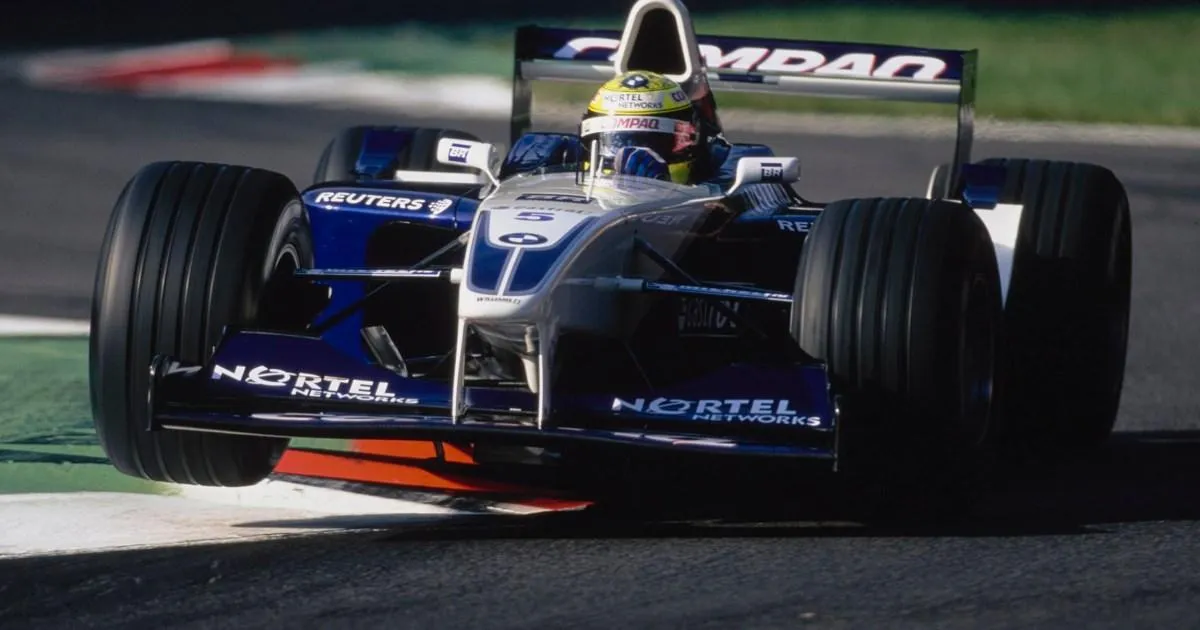
Few things in Formula One stir the imagination quite like a historic Grand Prix car. These machines are not just pieces of engineering; they are time capsules of speed, danger, and glory, carrying within their carbon-fibre bodies the echoes of screaming engines and the ghosts of legendary drivers. It is exactly this kind of reverence that makes the current legal battle involving Williams Racing so deeply strange and, for anyone who loves the sport, genuinely unsettling. The team known for its proud heritage and unmistakable blue-and-white liveries is locked in a high-stakes court fight over one of its most treasured assets: a 2001 FW23 BMW V10, a car that once carried Ralf Schumacher and Juan Pablo Montoya through a season of wheel-to-wheel combat at the highest level of motorsport. The car, valued at £750,000 and considered one of only nine ever manufactured, was reportedly loaned back in 2015 to a garage owner in Telford, Shropshire, to serve as a spectacular showpiece at the premises of Autotech Performance Ltd. But when Williams asked for its return six years later, the team says there was silence. The company had gone into liquidation, and the car had vanished. Now, Williams is suing former Autotech director and shareholder Peter Thorpe, demanding either the car’s return or more than £1 million in compensation, a story that reads less like a routine contract dispute and more like a motorsport mystery novel.
To understand why this missing car means so much, it helps to look at where the FW23 fits in the long and storied history of Williams Racing. The FW23 was the machine with which Williams challenged at the front of the grid during the 2001 Formula One World Championship. Ralf Schumacher, the younger brother of the legendary Michael Schumacher, and Juan Pablo Montoya, the fearless Colombian who had conquered Formula 3000 and CART before arriving in F1, drove the car with attacking flair and relentless determination. That season, Ralf claimed victories at Imola and the Canadian Grand Prix, while Montoya produced one of the most breathtaking overtakes of the era on Michael Schumacher at the Brazilian Grand Prix, a move that still features in highlight reels today. By the end of the championship, Ralf finished fourth in the standings and Montoya sixth, behind none other than Michael himself, who won the title in dominant fashion with Ferrari. The FW23 was a genuine contender, a beautifully engineered machine powered by a BMW V10 engine, and it would go on to be preserved as part of Williams’ private collection of heritage cars. These are not just old vehicles; they are meticulously maintained pieces of the team’s identity, used sparingly and strictly controlled, ensuring that the history of the team remains intact for future generations. It was with this mindset that Williams agreed to lend the car to Autotech Performance Ltd in 2015. The idea was simple: the FW23 would be a stunning centerpiece at the garage in Telford, a way to bring a slice of real Grand Prix history to the public. What could possibly go wrong?
According to the legal claim filed by Williams at the High Court in London, a great deal went wrong. The team’s barrister, Richard Clegg, laid out the case in stark terms, explaining that the car was part of Williams’ unique collection of heritage cars, the use or sale of which the team strictly controls to ensure, as far as possible, that they are preserved. The 2015 loan was governed by a written document called the “Historic Car Loan Agreement,” which Autotech knew and agreed to. Under those terms, Autotech was allowed to keep the car until October 2021, but when Williams wrote to the company that autumn, seeking to inspect the car and formally terminating the loan, there was no reply. The situation quickly deteriorated. Autotech entered voluntary liquidation, and at some point after that process began, the car was removed from the garage premises. Williams argues that Peter Thorpe, the man at the center of the company, had no right to take it. The claim insists that Thorpe “wrongfully claimed” to a valuer involved in the liquidation that he was the rightful owner of the car, having purchased it himself. But since the car has not reappeared, Williams has been forced to draw conclusions from the shadowy sequence of events. The legal papers suggest that it is to be inferred that Thorpe removed the car from the premises, or arranged for its removal, and that he then took possession and control of it. The team is now seeking an order for the car’s return, along with hire charges, or, failing that, a payment of more than £1 million, a figure that reflects both the car’s value and the alleged loss of its unique heritage status.
Yet Peter Thorpe’s response paints a very different picture, one filled with illness, confusion, and memory loss. The 58-year-old businessman is fighting the claim and insists, through his legal team, that he never told anyone that he owned the car, because he knew from the beginning that such a statement would be untrue. He says he does not know where the car is, and he points to a serious health event to explain his hazy memory: he suffered a stroke on October 7, 2018, which caused cognitive impairment. As a result, he claims he cannot remember speaking to the liquidators or the valuer who was brought in to assess Autotech’s assets. This is where the story becomes particularly difficult to untangle. Thorpe admits that the car was still on the premises when he last attended the garage on August 8, 2021, an occasion when he was present for the valuation of Autotech’s assets by C & K Recoveries Ltd. He says he did not return to the premises after June 30, 2021, except for that valuation, and that the car could have been removed at some point after his last visit and before the company was ultimately dissolved. His memory of events, naturally, is clouded by his medical condition, and he cannot say with certainty whether the car remained at the garage through December 2021 because that period lies outside his knowledge. He also disputes the alleged £750,000 value of the vehicle, claiming that the car was actually a show car without an engine, a detail that, if true, would significantly change the nature of the asset in question. His legal team maintains that Williams is not entitled to any order against him personally, and that the case against their client is built on inference rather than hard evidence.
At its core, this is a battle about ownership, responsibility, and the fragility of trust, complicated by the involvement of a man who says he remembers far too little to give the answers everyone wants. The case has been filed at the High Court in London, but it has not yet gone before a judge for a full trial, so the evidence remains untested. A Williams spokesperson, when contacted for comment, offered a measured but firm statement: “We have initiated proceedings to recover a car that was lent to a third party and not returned to us. As the proceedings are active, we will make no further comment but have full faith in the legal system to resolve this matter.” That is the language of a proud institution that feels it has been wronged and wants the legal process to speak on its behalf. For Thorpe, the stakes are equally high. He is being asked to account for a car he claims he has not seen for years, and his assertion that he cannot recall key conversations leaves a number of unanswered questions. The denials are consistent, but the absence of a clear explanation of the car’s whereabouts makes the situation all the more tantalizing. Where did the FW23 go? Was it moved before the company dissolved, and if so, by whom? Could a machine that once raced in front of hundreds of thousands of spectators now be sitting forgotten in some garage, collecting dust, far away from the bright lights of Silverstone and Monza? Or was it quietly dismantled, sold off, or hidden away, leaving behind only a paper trail of legal claims and counterclaims?
Beyond the courtroom drama, there is something profoundly human about this bizarre story. It speaks to the bond between people and the machines they create, and to the way that we often trust others with the things we love, only to discover that trust has been broken. Williams did not have to lend out its heritage car; it chose to, presumably out of a spirit of generosity and a desire to share history with a wider audience. That act of goodwill has now turned into an expensive and painful legal dispute, and the team is left chasing a ghost, a car that exists in photographs, memories, and racing archives, but not in its own possession. For Ralf Schumacher and Juan Pablo Montoya, the FW23 was the tool of their trade, the car that carried them through the high-speed corners of the world’s most famous circuits. For Williams, it is a piece of its own soul, a tangible link to a golden era when the team was fighting at the very front of Formula One. And for Peter Thorpe, it may simply be an object he never truly owned, but one that has now put his health, his memory, and his reputation under the harshest of spotlights. As the legal process grinds on, the motorsport world watches with a mixture of fascination and disbelief. In a sport where every detail is measured to the millimetre and every second matters, the fate of a single racing car has become a mystery that no amount of telemetry or engineering analysis can solve. Until a judge ultimately decides what happened to the missing FW23, the story remains a cautionary tale, a reminder that even the most carefully guarded treasures can slip away when you least expect them to, and that sometimes, the fastest cars in the world leave behind the most puzzling traces.