
1. The Streets of London: A City Caught Between Grief and Rage
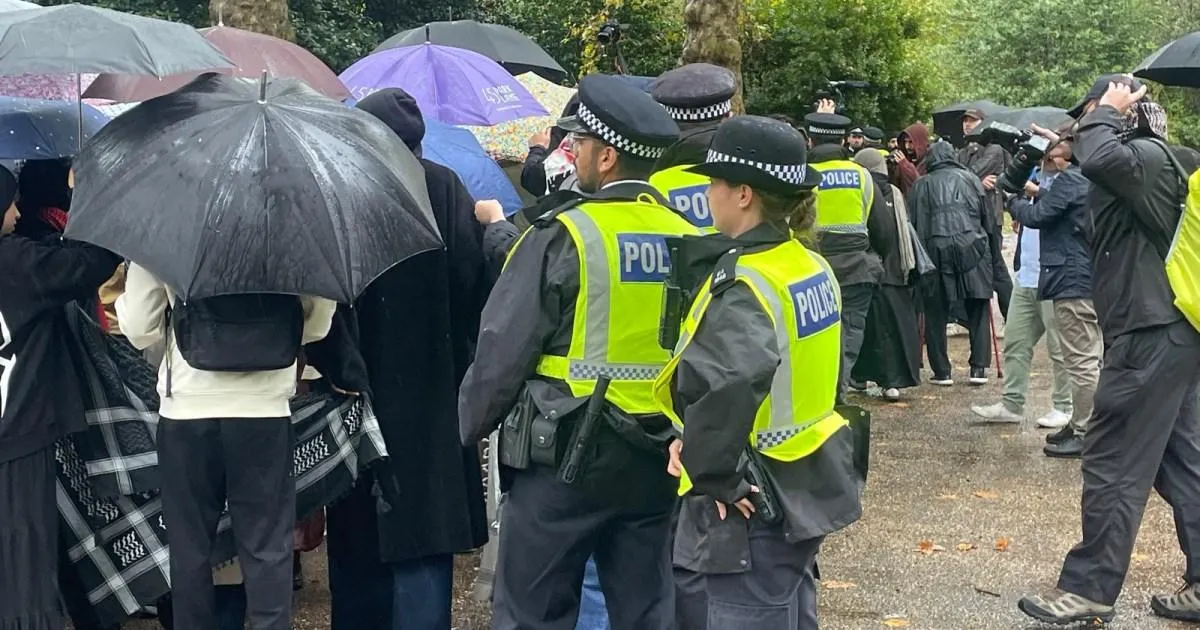
On a grey, heavy morning in central London, the air near Russell Square was not filled with the usual hum of commuters and tourists. Instead, it thrummed with something far more raw and volatile: grief, anger, and the desperate need to be heard. Three years to the day after the deadliest attack in Israel’s history, and with the war in Gaza still raging, the city became a stage for two opposing demonstrations, separated by little more than a line of police officers and a chasm of irreconcilable pain. On one side, pro-Palestinian marchers moved in a tide of flags, keffiyehs, and banners, their chants rising like a heartbeat: “Palestine will live forever.” On the other, pro-Israeli counter-protesters stood clutching Israeli flags and placards, their faces etched with defiance and sorrow, shouting back with equal fervour. The two groups exchanged abuse across the barricades, and for a time, the divide between them felt as wide and as brutal as the conflict itself. Some demonstrators on the pro-Palestinian side were described as being met with cries of “scum” and “Jew Haters,” while Palestinian activists in turn accused Israelis of genocide. It was a scene that captured, in a single chaotic hour, the profound and painful entanglement of history, identity, and politics that has defined the aftermath of October 7, 2023. The date was not just another anniversary; for many, it was a day of mourning, of remembrance, of unfinished trauma. Yet it was also a day of marching, shouting, and clashing, because for many others, the suffering in Gaza could not wait for a more diplomatic moment. Russell Square, with its leafy paths and historic hotel facades, became a strange and sombre stage for a confrontation that no one seemed able to resolve—not on the streets, not in the corridors of power, and not in the hearts of the people who stood face to face, accusing one another of losing sight of humanity.
2. The Pro-Palestinian Marchers: Speaking Up Against an Unfolding Catastrophe
Among the pro-Palestinian demonstrators, the mood was one of urgent, almost desperate conviction. They marched not only to commemorate the three years of war that had followed the Hamas-led assault on Israel, but to demand an end to what many described as an ongoing genocide in Gaza. Estimates cited by demonstrators and humanitarian organisations have placed the number of Palestinians killed at around 74,000, most of them civilians, including women and children. For the marchers, every statistic was a human face, every number a buried child, every headline a fresh wound. “We are witnessing a genocide; we have to speak up,” one protester said, her voice trembling with emotion. “We are peaceful; we come in peace.” But the peace they insisted upon was a loud, insistent peace, punctuated by chants and the rhythmic stomping of feet. Some activists wore masks over their faces, a choice that immediately drew criticism and attention, as it violated the strict conditions imposed by the Metropolitan Police for the march. Those conditions were designed to prevent the kind of disorder that had erupted at previous demonstrations, but to the marchers, they felt like yet another layer of containment, another way of muffling a message that had to be heard. They carried banners with slogans demanding freedom, justice, and an end to the siege on Gaza. They invoked the names of journalists, aid workers, and ordinary families who had been killed in the conflict, and they spoke of a world that had looked away for too long. The shadow of Al Jazeera’s Wael al-Dahdouh, who had spoken to Metro in the past about the relentless harm to Palestinians, seemed to hover over the march. “The only thing that’s really changed is that the large-scale killings have decreased, but they have not stopped,” he had said—a grim reminder that the violence was not a distant news story, but a lived reality for millions. As the marchers moved through the streets, they chanted not with joy, but with a fierce, sorrowful determination. They were not celebrating; they were bearing witness. And in their eyes, to be silent was to be complicit.
3. The Pro-Israel Counter-Protesters: Defending Memory and Confronting Accusations
On the opposite side of the divide, the pro-Israel demonstrators carried a different but no less painful weight. For them, October 7 is a date burned into the collective memory of Jewish communities around the world—a day when Hamas-led militants poured across the border into southern Israel, stormed army bases, farming villages, and a music festival, and murdered 1,200 people, most of them civilians. Women, children, and older adults were among the dead; 251 others were taken hostage, and many of them remain unaccounted for, their fates unknown or tragic. To see pro-Palestinian marchers on this exact anniversary, in the heart of London, felt to many counter-protesters like an insult of the deepest kind. “Today of all days you protest,” one pro-Israel attendee shouted, her voice cracking with anger and hurt. “It’s October 7; you are disgusting. Shame on you all.” The counter-protesters held Israeli flags high and carried placards with stark, provocative slogans, including one that read: “Stop the Gaza geno-LIE.” The wordplay was deliberate, a rejection of the genocide accusation they felt was weaponised against their homeland. They chanted back with equal intensity: “Terrorist supporters off our streets.” Some of them mocked the pro-Palestinian marchers, laughing as they chanted, a defensive reaction born of exhaustion and pain. To the outside observer, the laughter might have seemed cruel, but to those standing with Israeli flags, it was a way of refusing to be silenced, of insisting that their grief was real and their right to exist was not up for debate. They saw the pro-Palestinian marchers not as peace activists, but as sympathisers of those who had committed atrocities. The abuse they hurled—calling the marchers “scum” and “Jew Haters”—was ugly, but it came from a place of raw, unprocessed trauma. For many in the Jewish community, the date is not an abstraction; it is a personal loss, a collective nightmare, and a reminder that antisemitism is not a thing of the past. The police had acknowledged these fears. Deputy Assistant Commissioner James Harman had said that this would be “a day of mourning and reflection” for many in London, and that he understood the serious concerns the march had caused Jewish communities in particular. But understanding and reassurance, no matter how sincere, could not bridge the gap between those who stood on opposite sides of the barricades, each convinced that justice lay on their side.
4. The Clash: Anger, Accusations, and the Fragile Line of Order
As the two demonstrations pressed against each other, the emotional temperature rose. Shouts of “scumbags” rang out, directed at the pro-Palestinian protesters. Pro-Israeli supporters pushed forward, their voices sharp and unrelenting. Some Palestinian activists responded by accusing Jews of genocide, a phrase that echoed through the square and sent a chill through those who heard it. The two sides exchanged more than words; there were scuffles, pushes, and moments when it seemed the thin line of police officers might not hold. One demonstrator was already handcuffed, led away with their hands bound behind their back, a stark reminder that the law was watching. The police had imposed stringent conditions on the march—rules governing the route, the timing, the behaviour of participants. Masked activists were in clear breach of those rules, and officers were quick to intervene. Deputy Assistant Commissioner Harman had been unequivocal: “Anyone who breaches these conditions or commits offences should be under no illusion they will face arrest.” But even with such warnings, the atmosphere remained dangerously charged. The counter-protesters were not content to stand silently; they had come to make their presence felt. The pro-Palestinian marchers were not going to be intimidated; they had come to be seen and heard. And so they clashed, in a great, messy collision of anger and grief, each side accusing the other of dishonouring the dead. The police, caught in the middle, tried to maintain order while also protecting free speech—a balancing act that has become increasingly difficult in a city as diverse and divided as London. For the officers on the ground, this was not just a logistical challenge; it was a human one. They had to separate people who looked at each other with contempt, who had families affected by the conflict, who had perhaps lost friends or relatives in the violence. Every push, every shout, every tear rolling down a face was a reminder of why these tensions were so deep. The march continued despite the chaos, with chants of “Palestine will live forever” ringing out over the din. But the peace that everyone claimed to want seemed a long way off, buried under layers of accusation, pain, and the bitter weight of history.
5. The Wider Wound: Three Years of War, Loss, and Global Outrage
It is impossible to understand the scenes at Russell Square without understanding the sheer scale of loss that has marked the past three years. In the early hours of October 7, 2023, Hamas-led militants launched a surprise barrage of rockets into southern Israel, then stormed across the border. They moved with brutal efficiency, attacking military bases, farming communities, and an outdoor music festival. By the time the attacks were over, 1,200 Israelis had been murdered—the vast majority civilians, gathered together by fate at a moment of peace. More than 250 people were taken back to Gaza as hostages, some of them since released, some still in captivity, some confirmed dead. For Israel, the attack was a national trauma, a pogrom-like event that shook the country to its core and reopened wounds that had never fully healed. The response was swift and devastating. The Israeli military launched a campaign in Gaza that has killed tens of thousands of Palestinians, displaced nearly the entire population, and reduced entire neighbourhoods to rubble. Human rights organisations, medical workers, and journalists on the ground have documented unimaginable suffering: children pulled from the wreckage, hospitals running out of supplies, families fleeing from one supposed safe zone to another, only to be bombed again. The estimated death toll of 74,000, as cited by pro-Palestinian groups, includes a disproportionate number of women and children, and the numbers continue to rise. Around the world, the war has sparked an unprecedented wave of activism. Hundreds of pro-Palestine protests have been planned across the globe on this anniversary, from London to New York, from Istanbul to Jakarta. The demonstrators are not a monolith; they include students, trade unionists, religious leaders, and ordinary citizens who have been moved to action by the images and testimonies emerging from Gaza. They are diverse, but they share a common conviction: that the world cannot remain silent while so many innocent people are being killed. At the same time, pro-Israel advocates argue that the war is a necessary response to an existential threat, and that the strategy of Hamas—embedding combatants within civilian populations—makes civilian casualties inevitable. It is a debate that has torn apart families, friendships, and parliaments, and it shows no sign of resolving itself. For many, the conflict has become a test of moral consistency, a Rorschach test in which people see what they are prepared to believe about good and evil, victim and perpetrator.
6. A Divided City, a Shared Humanity: The Need for Something More Than Rage
As the afternoon wore on and the marchers dispersed, the streets of Russell Square slowly returned to their ordinary rhythms. But the echoes of the confrontation remained—in the broken voices of the demonstrators, in the heavy tread of the police, in the image of a person in handcuffs being led away. For a city like London, which prides itself on diversity and tolerance, the sight of two groups of people shouting hatred at each other on a sacred anniversary was a sobering reminder of how fragile social cohesion can be. There were no winners on this day, only people carrying their own wounds and their own truths. The pro-Palestinian marchers returned to their homes, their voices hoarse, their hearts pounding with a mixture of anger and despair. They had spoken up, as they promised themselves they would, but the world had not changed. The bombs would likely fall again in Gaza; the children would continue to die; the hunger and fear and grief would continue. The pro-Israel counter-protesters also went home, clutching their flags, their anger and fear still churning. They had stood up for their homeland and for the memory of those murdered on October 7, but they could not shake the feeling that the world was still against them, that antisemitism was rising again, that the lesson of history had not been learned. The police, too, returned to their stations, knowing that this would not be the last such demonstration. But if there is any hope in this story, it lies not in the slogans or the flags, but in the possibility that some of those who clashed might one day listen to one another’s stories. The Israeli who lost a neighbour on October 7 and the Palestinian who lost a cousin in Gaza have more in common than either would care to admit: both have been touched by violence, both feel unheard, both yearn for safety and recognition. When a pro-Israeli supporter shouted, “Today of all days you protest,” they were not just expressing anger; they were begging to be seen. When a pro-Palestinian marcher said, “We are peaceful; we come in peace,” they were not just speaking to the cameras; they were pleading for their pain to be acknowledged. Perhaps the greatest failure of the past three years is not the failure of diplomacy, or the failure of military strategy, but the failure of empathy—the inability to hold two truths at once, to see that both peoples have suffered, both have a right to exist, and both deserve a future free from fear. Until that understanding takes root, the streets of London will continue to echo with shouts, and the divide will only grow deeper. But perhaps, on some future October 7, the square will be filled not with accusations, but with silence—a silence that honours the dead, both Israeli and Palestinian, and allows the living to begin again.