



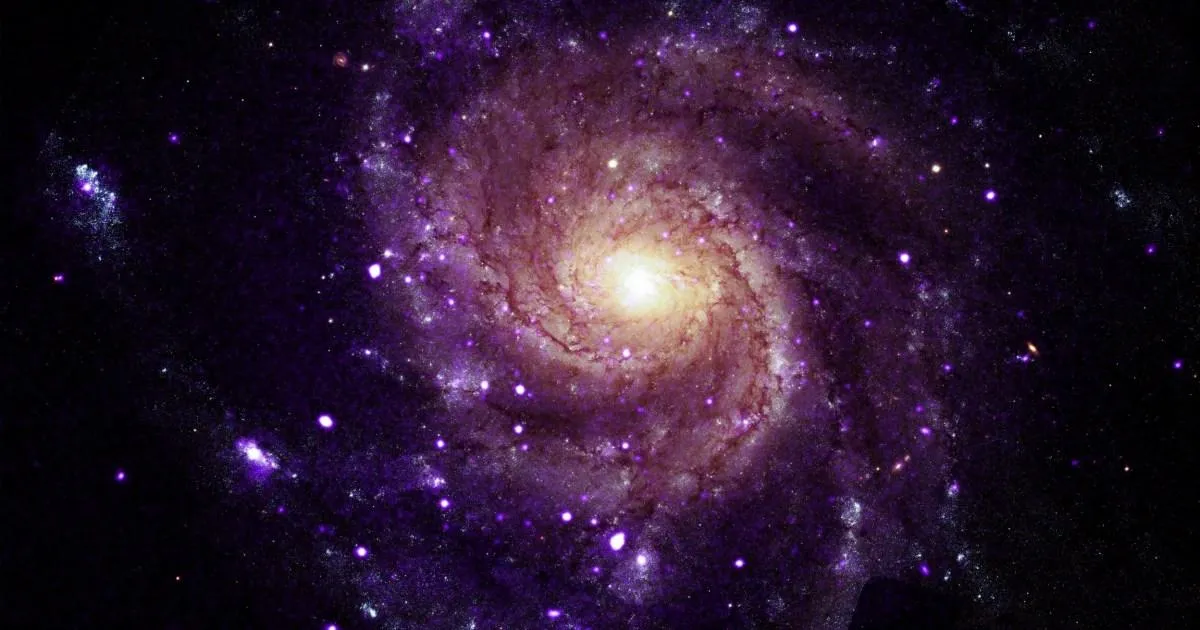
Something strange is hiding in the light of distant galaxies, and astronomers have finally begun to notice it. For the first time, researchers have detected a class of celestial objects that behaves unlike anything humanity has ever catalogued in space. These mysterious sources are not flashing, erupting, or collapsing in ways we have seen before. Instead, they are quietly radiating a combination of energy that seems almost contradictory: very gentle, low-energy X-rays paired with dazzling, intense ultraviolet light. Because their X-ray signatures are so soft and faint, scientists have called them “hypersoft X-ray sources,” and they have found no fewer than 84 of them scattered across six different galaxies. What makes this discovery even more exciting is that the objects were not found through a new telescope or an ambitious new sky survey. They were hiding in plain sight, buried in publicly available data from the Chandra archive, the vast library of X-ray observations collected by NASA’s Chandra X-ray Observatory over the years. The team behind this discovery is careful to say they still do not know exactly what these objects are. But they already suspect these bizarre, overlooked sources might hold the keys to two of the deepest and most stubborn mysteries in astrophysics.
To understand why these objects are so puzzling, it helps to see the universe through X-ray eyes. X-rays are a form of high-energy radiation, and in space they usually come from violent, extreme places: the shredded gas spiraling into a black hole, the million-degree corona of a star, the shockwaves left behind by exploded stars. Most X-ray sources astronomers have studied over the decades are powerful and hard, meaning their X-rays carry a lot of energy. But these newly identified objects are different. Their X-rays are so low-energy, so “soft,” that they barely count as X-rays at all in the traditional sense. At the same time, they are flooding their surroundings with ultraviolet radiation far more intense than their soft X-rays would suggest. That combination is not impossible, but it is unusual enough that the researchers say they have never encountered an entire group of objects acting this way. The objects are also not small or insignificant. In fact, despite their delicate nickname, they are among the most energetic members of their host galaxies. The lead researcher, Mustafi Muhibullah of the University of Alabama, put it plainly: “We’ve never encountered a group of objects that act like this.” He added that the next step was naturally to figure out what these things actually are. Calling them “clandestine X-ray sources,” he noted that these hidden objects are not just curiosities; they are some of the most energetic phenomena in galaxies, and they could be solving two cosmic mysteries at once.
The first mystery is about the death of stars, specifically a kind of stellar explosion known as a Type Ia supernova. These supernovae are extraordinarily important in modern astronomy because they act as standard candles, cosmic beacons with a predictable brightness. When astronomers compare how bright these supernovae appear from Earth with how bright they should be, they can calculate how far away the explosion happened and how fast its host galaxy is receding. That technique was central to one of the most stunning discoveries in cosmology: the universe itself is expanding faster and faster, driven by a mysterious force we now call dark energy. But there is a huge gap in the story. Type Ia supernovae are generally thought to come from white dwarfs, the hot, dense leftover cores of stars like our Sun, which pull material from a companion star until they reach a critical mass and ignite in a thermonuclear blast. The theory works beautifully on paper, but astronomers have never definitively caught a white dwarf system in the act of building up to that explosion. They know these supernovae happen, and they know they make the cosmos accelerate, but they have no idea which stars are the ancestors of the explosions they study after the fact. This has been a nagging, decades-long puzzle. Now, the hypersoft X-ray sources might be the missing pieces. If some of these strange objects are white dwarfs greedily pulling material from their companions and glowing with soft X-rays and ultraviolet light, then astronomers may finally be seeing the pre-explosion moments of Type Ia supernovae, the stars that will one day become some of the most important explosions in the universe.
The second mystery is closer to home, at least in a cosmic sense. It involves the vast, thin gas that drifts between the stars in galaxies. This interstellar gas is not empty space; it is actually the raw material for future stars and planets. But in many galaxies, this gas has been stripped of electrons, leaving atoms in an ionized state. That matters because ionized gas behaves differently from neutral gas. It cools, collapses, and forms stars at different rates, and its fate helps shape the entire life cycle of a galaxy. Astronomers have known for years that something in these galaxies is stripping electrons from the gas, but they are not sure exactly what. Hot, massive stars are part of the answer; their fierce radiation can ionize the gas around them. But observations show that even in galaxies without enough massive stars to explain the effect, the gas is still being ionized. Something else must be doing the work. This is where the hypersoft X-ray sources come back into the picture. Their intense ultraviolet radiation is exactly the kind of energy that can knock electrons off atoms. A single source might be small, but if dozens of them are scattered throughout a galaxy, their combined ultraviolet punch could explain the mysterious ionization that has confused astronomers for years. In other words, these newly found objects could be the unseen engines of galaxy evolution, quietly shaping the interstellar medium and influencing where and when new stars are born. The researchers emphasize that this is still a hypothesis, not a conclusion, but it is a compelling one that ties two separate cosmic mysteries together with a single thread.
What makes this discovery especially beautiful is how it came about. The astronomers did not need a brand-new telescope or a lucky observation during a rare celestial event. They simply went looking through the Chandra archive, a treasure trove of X-ray data that NASA has made openly available to the public. This means that anyone with an interest and the right tools could have found these strange objects. The fact that they went unnoticed for so long is a reminder that the universe is still full of surprises, even in data we have already collected. It also speaks to the power of curiosity-driven research. Muhibullah and his colleagues were not necessarily searching for hypersoft X-ray sources; they were examining X-ray data from other galaxies and noticed something odd. Instead of ignoring the weirdness or writing it off as noise, they leaned into it. That decision has opened a new window onto some of the most energetic and mysterious objects in the cosmos. The co-author of the study, Jimmy Irwin, also from the University of Alabama, highlighted the significance of the find for Type Ia supernovae, saying that if we could find a way to spot these explosions before they go off, it would be really important. Right now, astronomers study them after they have exploded and have struggled to understand what is actually being ignited. Finding the ancestors before the blast would be like seeing the fuse before the bomb goes off, and these hypersoft sources might be exactly that.
Of course, the discovery is only the beginning. The researchers now plan to follow up with further observations to pinpoint the nature of these 84 objects. They need to confirm which ones are truly white dwarfs, which might be something even more exotic, and how exactly they produce their unusual combination of low-energy X-rays and intense ultraviolet radiation. They also want to test whether these sources really are responsible for ionizing the gas in their host galaxies. This will require careful studies of each object’s surroundings, measuring the radiation field and comparing it with the state of the interstellar gas. It is painstaking work, but the stakes are high. If the hypersoft X-ray sources turn out to be the long-sought progenitors of Type Ia supernovae, they will become crucial tools for understanding dark energy and the expansion history of the universe. If they also turn out to be the missing ionizers of interstellar gas, they will change our understanding of how galaxies evolve, how stars form, and how the matter between stars is recycled into new generations of cosmic objects. Either way, these strange, quiet objects are no longer just anomalies. They are suddenly central characters in some of the biggest questions in astronomy. The universe, it seems, had been hiding them in plain sight, waiting for someone to notice that they did not fit the pattern.
In the end, this story is a wonderful reminder of how science works. It is not always about launching new missions or building bigger telescopes. Sometimes it is about looking at old data with fresh eyes and asking the simple but powerful question: “What is that?” The 84 hypersoft X-ray sources were there all along, quietly emitting their gentle X-rays and brilliant ultraviolet light across millions of light-years. They were waiting in an archive, in data freely available to anyone curious enough to dig through it. Now they have emerged as possible answers to mysteries that have puzzled astronomers for decades. There is still much to learn. The objects might turn out to be something entirely different from what the researchers expect, and that would be exciting too, because the best discoveries are the ones that make us rewrite what we thought we knew. For now, we can marvel at the fact that the universe still has secrets to reveal, and that sometimes the strangest things are hiding not in the darkest corners of the sky, but in the brightest light we had already captured. These clandestine X-ray sources, as Muhibullah called them, are a beautiful example of the unknown still waiting among the known. And with new observations on the way, we may soon find out exactly what they are, what they do, and how many more of them are out there, whispering to us from galaxies far, far away.