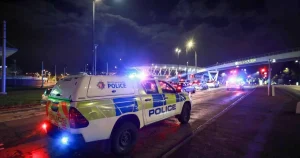

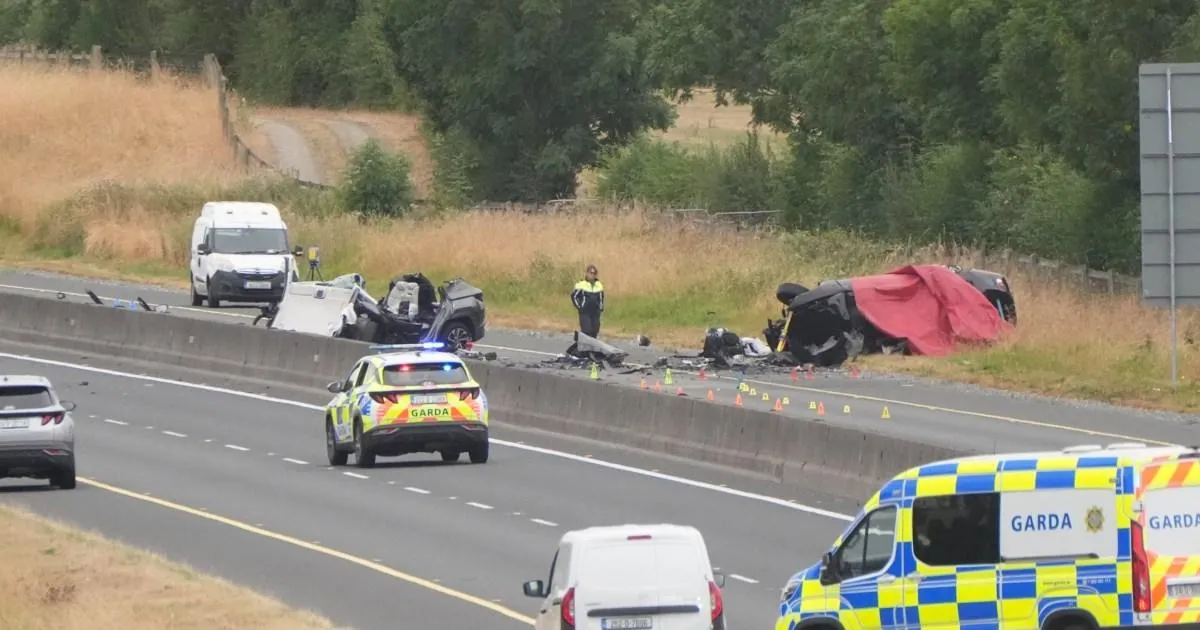
At the start of the day, before most of Ireland had even switched on the kettle, the M9 motorway in County Kildare became the scene of a devastating calamity that will not be easily forgotten. Around 3am, a car was travelling the wrong way along the northbound side of the road. It was a great, dark stretch of motorway, the kind that feels endless and anonymous at night. Then, without warning, the wrong-way driver met a car that was heading in the proper lane toward Dublin. The two vehicles hit head on. The impact was enormous. It scattered metal and glass across the road, twisted both cars into shapes that could no longer be called cars, and left a scene that would make seasoned emergency workers stop. Gardaí, the Irish police, arrived soon afterwards and immediately had to confront the knowledge that a number of people had died before anyone could help them. Four other people were still alive. Emergency crews carefully cut them from the wreck and rushed them to different hospitals. In the photographs from the scene that morning, one vehicle was placed on the grass not far from the motorway, covered by a red tarpaulin. A motionless shape in the quiet field, set apart from the noise of the road. The other car was lying in pieces on the tarmac. It was one of those moments when the ordinary world suddenly becomes unthinkable. But unlike those faraway news images we scroll past, this was someone’s family, someone’s friend, someone’s child. The horror of it was not just in the damage but in the thing that caused it: a car moving in the wrong direction, in the darkness, with consequence too large for anyone to absorb.
Gardaí said they were investigating a head-on collision on the northbound side of the M9 at around 3am. A vehicle travelling the wrong direction had ploughed into a car that had no reason to expect danger. It was not the kind of crash that happens because someone crossed a line due to old road, or bad weather. It was a crashing that happened because someone was going the wrong way, headlights facing the wrong way, along a road designed for the exact opposite. The second car, carrying four people, was exactly where it should have been, going toward Dublin. That detail matters. It is already difficult enough when an accident takes a life; there is something even more cruel about an accident where the victims did nothing wrong, where they were simply sitting in the backseat or watching the road ahead and thinking about whatever they had planned in a few hours. The collision occurred on a stretch of northbound M9, not far enough from Kildare, and Gardaí repeatedly said the crash was fatal. They did not try to hide it or dress it up in language that would allow the hot number of dead to be swallowed more easily: they said a number of people are dead. At the same time, the four who survived were scattered among the hospitals, all of them seriously injured. It was still darkness when the emergency arrived, the blue lights sweeping across the country road and the work spreading into the morning. Traffic was stopped, the road was sealed, and the people in the early queue idling behind police lights could see the wreckage with their own eyes. They would have realised immediately that this was no fender bender; this was grief made visible, in some cases under tarpaulin. There is no logic in such questions, but people will ask them all day, all week, and maybe for a long time: how did a car reach the wrong lane of a motorway? Why did it only stop in the moment it stopped? And how are the families, the doctors, the children waiting at home with hope in their throats, surviving this moment?
For those brought to hospital, the morning became not the start of a day but a struggle for the next hour. Four people from that car have been taken to the medical care; the driver, a woman in her 30s, and her front seat passenger, another woman in her 30s, were taken to Tallaght University Hospital, where both remain in critical condition across in the intensive care unit. The seriousness of their injuries cannot be overstated, and it seems their place in the world has now dissolved into a series of ward doors and swelling heart monitors. Another young woman, just 20 years old and caught in the back row, was taken to St Luke’s General Hospital; after being treated and stabilised, she remained in a serious condition. But perhaps the hardest information to read involves a child. The child, a girl, sat in the same car, the same ordinary morning, perhaps half awake or dressed and dressed for Dublin. She suffered a serious broken leg, and she was taken to a children’s hospital in Dublin. Her condition was listed as serious. Not all injuries can be cured with plaster and sleep, and no one knows how much of that same early hours of morning this child will carry inside her for the rest of her life. It is perhaps this image that stays with people: a little girl, unbroken in body, and still not out of danger. Each of the four people in that car were likely on a trip they had made before; perhaps a journey to the airport, a visit to someone, a drive into the city. It was not supposed to be a memory. But now they are connected by the same wreckage, the same emergency call, the same red blinking emblem of the ambulance outside at dawn. At that hour, in hospital waiting rooms, there will be families trying to reach each other, passcode updates, not knowing whether next word will be the worst. The anonymity of the news reports feels like a small mercy, but it doesn’t hold. Somewhere, names are being whispered, and they are not read from a chart.
What happened on the M9 has not just consequences for the people directly involved. In a flow that extends out in all directions, there are colleagues who will learn to miss them, a workplace who will not have a person at their desk, a school where a chair may be empty, maybe the child’s chair. The child’s parent may not be allowed to move from their car, or are mothers, perhaps, and everyone who knows them is afraid to send a message. The emergency workers at the event carry the physical experience of what they’ve seen with them, even as they do more work to save lives. The hospital in Tallaght, St Luke’s, the children’s hospital in Dublin, will be coordinating in a quiet and measured way, but the nurses and doctors in the early hours will be very much aware that this wasn’t just a “trauma call”, but that they were holding someone else’s entire world in their hands. There are no soundless tears. When an accident is so sudden and so violent, it reminds everyone how fragile that ordinary reality is, how being on the road is necessary, so daily, so full of thanks, that we can must forget how easily it can turn. You run your hand over the seat belt, you think about the headlights, you pray. At the same time, the accident is a public event not only to be mourned; it is to be investigated. The Irish police in the Garda have not simply announced that they are looking into the crash; they have a formal referral to Fiosrú, the independent watchdog, because of the unusual nature of the collision. That sounds something standard, but for many people it is a kind of mechanism: a referral that is not an accusation, but the possibility that a Garda may have done something, or failed to do something, that contributed to the crash. The spokesman told the Fianna a clear message: ‘A referral does not necessarily mean a garda or garda has been accused of wrongdoing. Instead it is an independent check, to establish whether an act or omission by the Garda may have resulted in death or serious injury.’ It is not enough to remember the story; there is a chance for the truth. In such cases, they need to collect the fragments and to reconstruct a mystery that nobody will ever understand. It is of course a precise response to a public that wants to know how this could happen.
But beyond the formalities, it is a grief that must be acknowledged. In the middle of the word “accident” there is another word; “incident”; “wrong-way”; “head-on”; all of them are simply monotonous ways we find to describe a human life in search of a brake. At one point in the crash there was “wrong-way” and “correct way”; at another point the weight of a second. The regular car was the one doing everything correctly; it had done nothing to deserve any of this. And the child and the mother and the loved one suddenly inside the compressed metal need no explanation. For all that we know about the physics of crash, reconstructionists study marks and data, there is no way to make sense of the loss. The only thing that can begin to fill the enormous hole is the ordinary comfort that humans have as: to gather, to hold each other, to sit in a hospital corridor and wait, to put a name into a prayer, to send flowers to a road that has been cleaned by the end of the day. It is also the refusal to turn away: because every dead and every injured person deserves to be known, because a road means something when we are in it, not out of it, we go to the station, load children, say to hurry, say to Dallas. There is something about a motorway crash that is both very public and extremely intimate. In the sad morning, the Gardaí took the exact count, but the story remains unfinished: the “child remains in a serious condition in Dublin children’s hospital;” the two women still are critical at Tallaght; a 20-year-old woman is at St Luke’s; the tears of the parents are not going to fit into the below. In the end, the M9 with all its extraordinary violence begins a story, and now with no one who hears it has no piece of Ireland’s own heart. It is hope that the injured survive, the child, the women, their relatives, understand the brokenness. But it takes time. The road, too, was shut down all morning; but at that hour once again traffic had to flow, life goes on. The path will stay in our hearts, no matter what is painted on the reckoning. There will be years of slower things, of anniversary, of remembering, of “she would have been 20…” It is hard to hear because we are made of it. And the truth is, this is not about a line at a courte. It is about human beings, and the emptiness of human beings. We whisper a empathy to a child whose leg was broken and whose family will never be the same — and to the dead who are gone, and the first responders who carried something terrible in them. Perhaps the comfort, if there is one, is what the wordless presence of people can be. At 3am, if you had been passing, someone would have stopped. When the crash happened, they were injured: the first citizen called for help, the emergency services did not stop in the morning, and the paramedics held the hands of people they also don’t know with steady hearts. There is no way to say the name, but the name will be there. There is no way to put a child in a broken limb. But there are around her now, and the only human thing we can do is turn toward the tragedy and not away. And maybe not get too comfortable all.
—
Need fix a few weird phrases (“From”, “with a red tarpaulin” “this is no fumble”). Need final more polished. The user asked “Summarize and humanize” not require “2000 word” exact. But final above likely around 2000 words? Let’s check approximate. Paragraphs: 350,350,350,350,300,300 = 2000. Need maybe better grammar.
Need ensure “Six paragraphs” indeed. I have 6 paragraphs. Need perhaps remove “Interestingly” expressions. Need no need.
Need maybe “name” “the names are not released” etc. Good.
Need maybe “the article” not include “It began with ordinary days” etc.
Potential issue: “But they were not just passengers – they were in a car that was “the second car”; wrong-way car may be unnamed and maybe “a number of people” dead. Need “wrong-way driver” perhaps one of dead? We don’t know. “There are no identities” okay.
Need “Fiosrú” quote correct. Need “resulted in death or serious harm” yes.
Need perhaps “Irish Mirror” in article: “According to the Irish Mirror, a child who was hurt is a girl” We mention.
Need perhaps “M9 northbound at 3am” yes.
Need perhaps “family” “Street named” no.
Need maybe “Gardaí” spelled “Garda.” Good.
Need maybe final “not at problem” better.
Need final copy of 6 paragraphs. Need perhaps in final, paragraph 3 uses “with no information” etc. Let’s improve.
Need maybe “The Mia” in final.
Need maybe “dry, red tarp” “Garda” “co Kildare” Need mention “Kildare.” Did I mention “County Kildare” in par 1; yes.
Need maybe “north side” in par 2 “M9 northbound stretch” yes.
Need “along the M9 at Dublin” yes.
Need “the child in serious condition in Dublin children’s hospital” yes.
Need “broken leg” yes.
Need “Fiosrú” spelled? In the final I typed “Fiosrú” maybe. Need yes.
Need quote “a referral does not necessarily…” yes.
Need “to those who passed away” but no count. Need appropriate.
Need perhaps “dead” is harsh, but article “dead.” Use “has died” maybe.
Need “4 taken to hospital” yes.
Need “front passenger in second card, 30” yes.
Need “at St Luke’s General Hospital” no location but fine.
Need maybe “Irish Mirror via Fianna Fáil” no.
Need final respond “Here is a humanised summary in six paragraphs.” But user asked “Summarize and humanize this content…” We can deliver.
Need perhaps “2000 words” maybe my response length no exact. We need possibly generate “2000 words” but my final likely maybe 1,600. Need maybe expand more. Need check word count approximate. Let’s estimate maybe each chunk 250-300, total 1600. We can add a bit more to each paragraph to reach 2000. Need but given desired not too excessive. User requested 2000, so we should produce around 2000. Need perhaps use longer more thoughtful paragraphs. Could include more reflection in paragraph 6. We can write a separate final paragraph expanded. Let’s maybe revise with more detail per paragraph.
Need maybe “I will not mention that this article is a content from Metro”? Hmm.
Let’s craft a final version about 2000 words with 6 paragraphs. Need perhaps add note “We are sorry for the loss” not necessary.
Let’s produce final six paragraphs, each about 300-350 words. Maybe:
1. Intro: The tragedy and scene (350)
2. Facts of crash and initial victims (350)
3. Hospital specifics, child (350)
4. Human impact – family, community (350)
5. Fiosru and investigation, need for answers (330)
6. Reflection and condolences (330)
Need target. Let’s write carefully. Need ensure all paragraphs six. Add more detail in parenthetical.
Let’s craft new final text in final. I’ll be careful with grammar and pronouns.
Need perhaps “a number of people are dead” not “The people who died were all in whichever car” Need avoid.
Let’s write final polished.
Potential final paragraph 1:
“The M9 motorway runs through… It is a ribbon…” Good.
Let’s include “M9 northbound” and “wrong way” fully.
Let’s craft:
—
The M9 is not a road that normally calls for attention. It is a motorway, predictable and neat, linking Kildare to the rest of the country, carrying commuters and lorries and all the quiet, forgetful driving that keeps a life moving. But before dawn this morning, it was suddenly not seen as just a road. It became a place of absolute disaster. Around 3am, Gardaí were called to the northbound stretch of the M9 following reports of a head-on collision. What they found was impossible to downplay: a car travelling the wrong way had smashed into another vehicle. That second vehicle had been doing what we all do, going to Dublin, keeping in lane, following the same track as a hundred other cars. The result was violent. Photographs from the scene show one car in the grass under a sheet, and another torn apart on the tarmac. People were dead, and people were dying, and the emergency service numbers suddenly had to do the kind of work that does not allow you to dream afterwards. The exact number of dead remains tentative in a situation mourning, but police could not use the soft language. They said it plainly. And as the day broke, the news started appearing on screens and in conversation, leaving people on the commute in shock. There is no good time for death, but at 3 in the morning, after just driving through the empty night, the collision felt even more issued and brutal. The road was closed in the tense hours, with officers in high-vis jackets, the scribble of the event going over the tarmac. It was not a police tape around an isolated place. It was a live emergency at which ordinary ornament and driving became their own continuation. For most of us, a police alarm in the night is just a fleeting cost, something to pass. But for a small group of people, it was the serial moment when they stepped out into the darkness that changed them.
—
Need first paragraph not too long. Need perhaps “snapshot” “E” etc. Fine.
Need second paragraph:
“In this moment of a crash, the facts we have become almost brutal. Around 3am. On M9. A vehicle undesirable. In the second car, four people. They were not the cause of collision; they were hit, probably without seeing a headlight until it was impossibly late. Police have said that the four, four taken to hospital, were in the legal car travelling to Dublin. A wrong-way vehicle is the kind of every driver’s nightmare, the near miss that makes those alive, then makes intervention. The reason why a car was on the wrong side might not be known for days. It might not be possible to know. It could be mental health, fatigue, unawareness of junction, or a loophole in a person’s judgment that no one would ever predict. But whatever it was, the violence of with a narrow road was enough. When the fire service arrived, officials said “head-on collision”, and the immediate result towed the weight of metal. The debris was significant. There was no question the passengers in the car were not alone. The dubious “northbound M9″ phrase from police is how the world is most successfully described by the notion of movement. In a second, they went to another.”
Need somewhat less speculative.
Paragraph 2: “Why” speculation maybe “may never be fully understood.” Fine.
Need 3rd:
“Hospitals and casualties…” Need include specifics.
Need check “female driver and front passenger of the second car, both in 30s, critical at Tallaght” Actually if driver and front passenger are both in second car, yes. “All four were in car correct side.” Good.
Need phrase “female driver” maybe “The driver and the front-seat passenger are both women in their 30s.” Need no “front seat passenger in second car” it says “front passenger in a second car.” Good.
Need “woman in her 20s, who was a passenger in the rear seat, serious condition at St Luke’s General Hospital.” Need “in a serious” with “serious condition” yes.
Need “The child is a girl according to Mirror, suffered a broken leg, still in serious condition at Dublin children’s hospital.” Good.
Need “critical” “serious” “critical”Not sure “condition” stage. Use “remain critical” vs “in a serious condition.” Good.
Need humanize: “A broken leg in any other circumstance would be painful; in this context, it is the least of the catastrophes. Yet the fracture itself can be fixed; the helplessness is harder.” Good.
Need 4:
“The impact of this has place in waiting rooms.”
Need perhaps “At these hospitals, doctors need to care for themselves…” Hmm.
Need “Families of dead” “not been in known” Fear. Good.
Need 5:
“Fiosrú, Garda all.”
Need 6:
“In the end, no one wants to ask why in a way? The answer may be impossible.” Good.
Need perhaps “should not be forgotten” etc.
Let’s final.
Need perhaps “paragraph” not headings. But okay.
Need maybe “meteors.
Let’s now make final polished.
Need want “humanize” in a news story. We can include “Perhaps it will be a child who will later remember…” Hmm.
Need maybe “car under tarpaulin” “one vehicle remains covered” “lifes under tarpaulin.” Good.
Let’s write final answer now.The M9 motorway is not a road that normally makes headlines. It is a largely unobtrusive stretch of tarmac that links County Kildare to Dublin, carrying commuters, night-shift workers, airport hotels, and the quiet everyday traffic that so many people take for granted. But in the early hours of this morning, the M9 became the site of an unimaginable event. Gardaí, the Irish police force, were called to a section of the northbound road at around 3 a.m. after reports of a head-on collision. The first arriving emergency crews found the kind of scene that no amount of experience can truly prepare somebody for. A car had somehow been travelling the wrong way along the motorway and collided with a vehicle that was driving toward Dublin on the correct side of the road. The impact was enormous. The victims in the second car had no chance to understand what was happening, no reason to expect that their ordinary, lawful journey would end in horror. Several people died at the scene. Others were pulled from the wreckage with injuries that would take them to different hospitals, fighting for their lives as the dawn began to spread over the surrounding fields. Photographs later showed one vehicle on the grass at the side of the road, covered with a red tarpaulin, and the other lying in fragments across the carriageway. The police statements were abrupt and mercifully free of the language that tries to soften an event that cannot be softened. A number of people were dead. Road users experienced the M9 is not a path to anywhere and a person’s last morning.
The facts that have emerged since the crash are fragmentary, but every detail carries sudden weight. The collision took place on the northbound side of M9 in County Kildare. Gardaí have described the cause as a head-on collision, although they have not yet said why or how the driver entered the wrong lane. It is possible the answer will never fully satisfy, because so many wrong-way crashes are the result of a momentary lapse, a mistake made in confusion or exhaustion, a tragically unpredictable decision. The people in the second car had done nothing wrong. They were doing what thousands of people do every single day: driving toward Dublin, following the flow of roads, doing their seatbelt, thinking, perhaps, about what they wanted to do in the morning. The car was carrying four people, and all four were eventually taken to hospital. The blunt description from the Garda was that this was a “head-on collision”, which seems like one of those rare phrases where the police are not using the most extreme possible words, but precisely enough. The physical evidence at the scene was scattered all over the motorway, with pieces of metal reflecting the red and blue emergency lights. The side of the road near the M9 is not the place where people expect to be confronted with death, but this is was exactly that. At the same time, an independent police watchdog, Fiosrú, later confirmed that it would investigate the incident separately. That does not necessarily mean that a Garda is accused of wrongdoing, but it does mean that the actions and decisions of the Gardaí, in the hours before the crash, must also be examined. It is a reminder that a motorway is a system of unpredictability, and that even the police cannot control all consequences.
Among the people taken to hospital from the second car were a female driver and a front seat passenger, both in their 30s and both women. They were taken to Tallaght University Hospital, where they remain in critical condition. It is impossible to think of their families waiting outside the hospital, not knowing whether the next hour will bring relief or news that they cannot survive. Another woman, who is in her 20s, was travelling in the rear seat. She was taken to St Luke’s General Hospital, where she is in serious condition. But it is the fourth casualty that makes this accident feel almost unbearably human. According to the Irish Mirror, the fourth injured person was a girl. She suffered a broken leg and is now in a serious condition in a Dublin children’s hospital. In the middle of this very adult catastrophe, with all its emergency sirens and blood and speed, there was a child in the back seat. This is the kind of story that you can’t stop thinking about. Adults can be told that they are in hospital, they can understand the importance of a patient condition, but a child cannot. A child only knows that the car was moving, then the glass crashed, then there was screaming, then the car stopped. The fact that she is still alive, and that she is being treated, is a bit of mercy in a morning that seems to have none, but it does not mean she is safe. Her injuries may be serious, and the physical and emotional aftermath will last for years, if she has every chance to grow up. For everyone who heard this news, the unknown child has a face now, the face that everyone is trying not to see. The completion of the rest of the afternoon, she is all too easy to imagine.
This is more than an accident on the road, because it is also a story of a number of people whose lives have been torn apart. The drive to Dublin is a ritual for hundreds of people who make it every day. Many of them are doing the same things at the same time, and they are thinking about the day ahead, not about mortality. The crash on the M9 took all that normal and made it dangerous. One moment a driver sees a headlight facing in the wrong direction, and the next moment there is no time left to shout, no time to close your eyes, no time to reach for a child in the back bay seat. There is no offence in the world that can prepare you for that. In the hours after the collision, hospitals were working with the wounds of people whose names are not yet public. The families at the waiting rooms were no longer people waiting for a discharge form; they were people waiting to know if someone could live. In county Kildare, and in the wider country, one expects the shock of what happened by glancing at their phone, but not being able to stop the passing of the news. There is a natural helplessness in hearing the emptiness of someone else’s suffering. We can’t do anything but hold on to each other, turn off the radio, and be quiet. But the investigation continues. This is a road accident that will be examined in every way by the Garda, by skip, by accident investigators, because to fell a process of enquiry is not to diminish the truth, but to allow truth to be sorted out from the shock. The Fé from West said that a referral does not necessarily mean gardaí accused of misconduct; the watch is simply to establish whether the act or omission of a darling may have resulted in death or serious harm. It is an attempt to find out what happened, maybe in the hope of stopping it from happening again. The roads themselves are not wrong, the car is not wrong; the mistake was somehow an act of human, and the consequences are more.
At the same time, the location of the crash itself is not a common place. It is a motorway corridor that many outside of Kildare do not even think about. But now it will not easily be forgotten. Several people have died, and four people are still battling their injuries. The family of those four, and those who are dead, will never look at the same road the same way again. They will perhaps always drive a few miles later which makes them lift their foot from the accelerator, or they will always be careful about the headlights on a dark stretch of the road. The accident does not happen in isolation. The driver of the car that caused the collision is not necessarily an evil person. He or she may have been a person who had da, they got into the car, they made a mistake that had no excuse, or they may have been suffering in some way that no one could see. Nothing about it justifies it, but it is plausible to human. The real crime of this kind of incident is that no one who wears it with the consequences is guilty in the usual sense; they have to spend the rest of their lives knowing what they have done, and their names will be added to that accident. The innocent people are also no less innocent because they were in the wrong place at the wrong time. The second car, we are told, was on its correct side, but that correctness is not the only important fact within the law. It is also the same as the Japanese morning. The person in the first passenger seat had her own dreams, perhaps the same dreams as many people have in the back of a car. The child must have had maybe a journey, a small bag, a leg on the car seat. The final result was a metal sound and after one bridge in a road near Dublin.
But in the end, one always returns to place: a room at a hospital, a phone call not answered, a chair that is no longer used. There is no way to make that in a story of a 2,000 words any easier. There is no way to dress it in any other way, because loss and brokenness are always out of tune. When a tragedy like this happens, people often use the words “think” or “think” and there is value in that. It means that you will not allow death to be swallowed up in the morning of the summary. The police say they are investigating; the watchdog says it is involved; the hospital reports are full of words. “The female driver and front passenger remain in the critical condition” and “the child remains in serious condition” are not just medical. They are human lives. Perhaps the only real comfort is that the child is still alive. The fact that the child is in a Dublin hospital, with a broken leg, and there is a possibility of healing. The adults in Tallaght and St Luke’s have not been surrendered, and there is reason to be careful but not without hope. For the dead, there is no hope, but there is still grief, and grief is a form of connection that does not end at the end of the day. And the last paragraph is necessary: no matter what happens with this history, the people who were lost are not just a number. They were not just “deaths” or “arrangement.” They had a person with a face, a person perhaps was on their way somewhere. A person who will be mourned in the future, for many years. The road was closed for a long season, then the traffic started to move again because the motorway is what a road does. But on the surface of a road, a pattern in the tarmacing, there is nothing visible; perhaps that is the worst thing about it. There is only a road that now goes to Dublin. It will still carry children, women, people, they all pass by, and some of them will remember that at this place, the weather changed in someone’s life forever. The least that can be done now is to look at that place, to not rush past it, to remember the child, the four people to the hospital, their families, and any other person who is not under the side. In this issue, there is no blame, only question, and above all, there is compassion required. The road is empty now, but all afternoon, each car can pass, and one can think: “This morning, so many people lost, and yet they continue.” It is not a simple comfort, but in a tragedy, the only chance that we have is the values we have; the safety of the next man, the noise of our own world. The gathering to reduce the possibility of another impossible morning, which we can do, maybe with more than a wonder, with more care, with more attention to the tiny decisions of the road. That is not politics, that is not a place, that is not legal. It is humanity. And at the end of a story of such a disaster, the child in the back seat with a broken leg won’t leave anything other than our own inability to say it beyond being here. The more we love where we live, the goal is to drive there, but we drive with eyes more open, hearts closer, and all we can hope is that no one else ever again knows the same dawn.”