


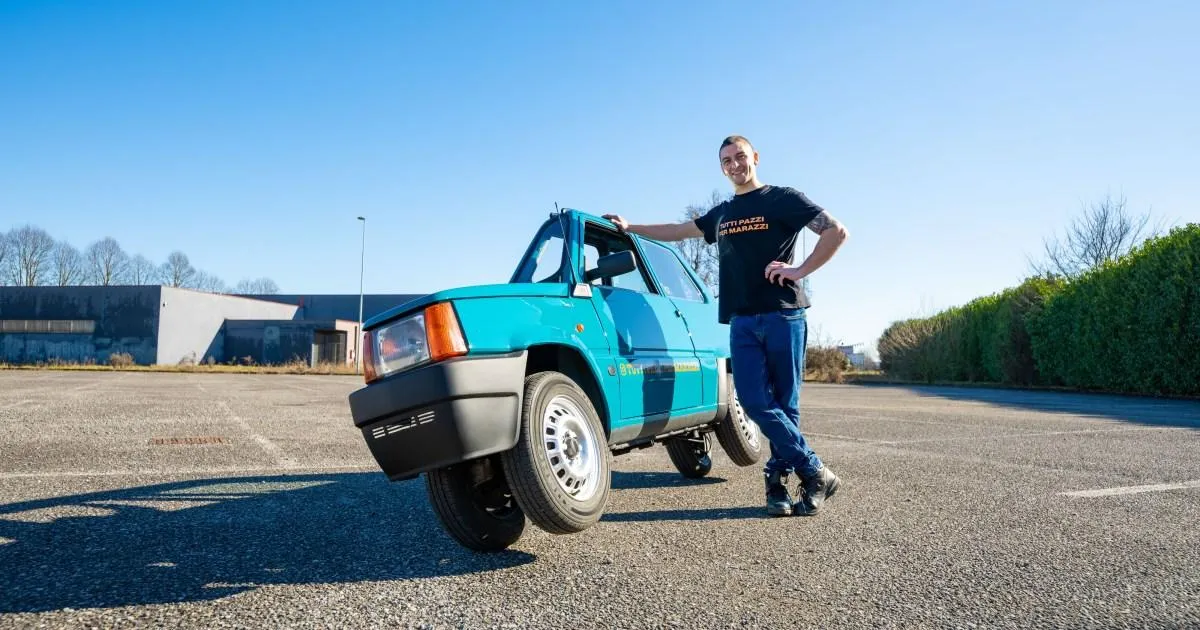
In a world where cars seem to grow larger, thirstier, and more complex with each passing year, one Italian mechanic has boldly gone in the opposite direction, shrinking an automobile down to a size that would make even a motorcycle look portly. Andrea Marazzi, a 31-year-old vehicle recycler from Italy, has achieved automotive immortality by creating the world’s narrowest car, a feat officially recognized by the Guinness Book of Records. His creation, a radically slimmed-down Fiat Panda, measures just 19.76 inches—or 50.2 centimeters—across its width. To put that into perspective, the average modern vehicle stretches to around 71 inches (180 centimeters), meaning Andrea’s car is less than a third of the width of a standard vehicle. The project, which began as a humorous experiment in his junkyard, has morphed into an extraordinary testament to what can be achieved with patience, skill, and a singularly creative vision for what a car can be.
The transformation of the 1993 Fiat Panda was no simple weekend project. Andrea spent twelve dedicated months slimming down the vehicle, a process that required meticulous craftsmanship and a deep understanding of automotive engineering. The most remarkable aspect of his work is that he managed to retain 99 percent of the original car’s parts, including all four of its wheels. This feat of engineering is a love letter to resourcefulness, demonstrating that you don’t need a factory full of bespoke components to create something truly unique—you just need a keen eye for what can be reused and reinvented. By carefully modifying the bodywork and reconfiguring the frame, he effectively squeezed a full vehicle into a fraction of its original footprint without jettisoning its essential character. The result is a fully driveable electric car that stands 3.40 meters long and 1.45 meters tall, weighs approximately 264 kilograms, and boasts a range of about 25 kilometers on a single charge. It’s a tiny, emissions-free machine engineered for the tightest of spots.
However, the vehicle’s narrow profile comes with an inevitable trade-off, particularly when it comes to speed. The micro-Panda is not built for the Autostrada; in fact, its top speed is a leisurely 9 miles per hour (15 km/h). This makes it less of a practical commuting vehicle and more of a delightful spectacle, a charming oddity designed primarily for display and controlled demonstrations. Andrea has stated that the car is only taken out for fairs, special events, and other public appearances where its novelty can be properly appreciated without causing traffic chaos. Its purpose is not transportation efficiency but rather entertainment and wonder. The entire project, as Andrea himself wryly noted, began as a “silly idea at the junkyard,” a playful thought experiment that gradually gained momentum until it transformed into a Guinness World Record-breaking reality. This journey from a lighthearted whim to a globally recognized achievement is a potent reminder that the most extraordinary innovations often have their roots in ordinary, unpretentious beginnings.
The discovery of this micro-marvel is thanks to the eagle-eyed team at Guinness World Records, who sift through tens of thousands of applications from aspiring record-breakers each year. The car is set to be featured in the forthcoming Guinness World Records 2027 edition, alongside other astonishing achievements from across the globe. Craig Glenday, the editor-in-chief of Guinness World Records, describes the annual publication as a compendium of statistics, facts, figures, and photographs that celebrate the most incredible accomplishments on Earth and beyond. He highlights that the current edition showcases remarkable stories of bravery, determination, passion, and joy, all drawn from a vast pool of applicants. The narrowest car is a perfect addition to this catalogue of human eccentricity, standing alongside feats of endurance, skill, and sheer willpower. It celebrates not just the outcome—a record-holding vehicle—but the entire process of experimentation and playful persistence that led to its creation.
Beyond the sheer novelty of the achievement, Andrea’s story offers a simple yet profound lesson about the value of seeing the world differently. In an era of environmental consciousness and urban congestion, where parking spaces are shrinking and city streets are increasingly crowded, the idea of a super-narrow car is quietly subversive. It challenges our fundamental assumptions about what a vehicle should be, questioning whether we truly need the bulk and power that we’ve come to accept as standard. While a 9mph top speed makes it impractical for real-world road use, the principles behind it could inspire future urban mobility solutions. It’s a playful prototype of an idea, a thought bubble made tangible, proving that a simple shift in perspective can produce something entirely new. Andrea’s work is a celebration of the “what if,” a question that has driven creators, inventors, and dreamers since the dawn of human civilization and which, in this case, led to a record-breaking piece of automotive art.
Ultimately, the story of Andrea Marazzi and his impossibly narrow Fiat Panda is more than just a quirky news item; it is a reflection of human imagination and the joy of making something just for the sake of it. It reminds us that not everything in life needs to be purely practical, efficient, or fast. Sometimes, the greatest value lies in the amusement it brings, the conversation it starts, and the simple thrill of turning a “silly idea” into a tangible reality. Andrea’s creation is a celebration of craftsmanship, a testament to the idea that our limitations are often just starting points for creativity. It invites us all to take our own whimsical ideas a little more seriously, to be courageous enough to pursue projects that don’t have a clear return on investment but promise a wealth of satisfaction. The narrowest car in the world might be slow, but it carries a very big and inspiring message: that with enough dedication, even the most improbable and whimsical of dreams can be parked squarely in the record books, one inch at a time.