
In the heart of the sweltering Mexican state of Oaxaca, where the sun beats down on the modest village of San Francisco La Paz, life moves to the rhythm of the river and the resilience of its people. For Erasto Crisanto Valdez, a 31-year-old fisherman with a weathered face and a quiet devotion to his family, the morning of July 23rd began like any other. He rose before dawn, kissed his children goodbye, and joined his father for what should have been a routine fishing expedition. The air smelled of damp earth and freshwater, a scent he knew as intimately as his own skin. The cenote, a vast and ancient sinkhole hidden among the dense foliage, had always been a part of the local landscape—a mystical, deep blue eye of water that the Mayans once revered as a gateway to the underworld. For Erasto, it was simply a place where the fish were plentiful and the shadows ran deep. He never imagined that this familiar, almost sacred body of water would become his tomb. As he cast his net from his small boat, a moment of distraction—perhaps a glance at the distant mangroves, perhaps a misstep on the slick wooden hull—changed everything. He slipped, and the water swallowed him whole, pulling him down not into a simple pond, but into a labyrinthine network of submerged caves and tunnels that extended hundreds of feet beneath the earth, plunging him into an absolute, suffocating darkness.
The initial fall was a chaos of cold water, scraping rock, and desperate, flailing limbs. Erasto was a strong swimmer, but this was not the open river; this was a geological nightmare of narrow passages and collapsing visibility. His lungs burned as he was dragged deeper by the current, his eyes wide open but seeing nothing but a black void. He fought against the panic, the primordial fear that threatened to steal the very air he needed to survive. Pushed and pulled by the undertow, he tumbled through what felt like an eternity of stone until, mercifully, his hand scraped against a rough, dry surface. Gasping, choking, vomiting water, he hauled his body out of the frigid water onto a small, jagged ledge. He was alive. But as he lay there, shivering and bleeding from countless cuts, he looked around and realized the true horror of his predicament. He was trapped inside a colossal air pocket, a dry cavern deep within the sinkhole. The only exit was the water he had just surfaced from, a black, inky abyss that disappeared into unknowable depths. The silence was deafening, broken only by the slow, steady drip of water somewhere in the distance. He was 300 feet below the surface of the earth, separated from his family, his father, and the life he knew by a vertical maze of rock and water that no one even knew existed beneath the placid surface of the cenote. His screams for help echoed off the unseen walls, swallowed by the oppressive weight of the cave, returning only as ghostly, mocking whispers.
Alone in the impenetrable blackness, the distinction between day and night dissolved almost immediately. Without a single photon of light, Erasto’s circadian rhythm shattered, leaving him adrift in a temporal void where hours felt like minutes and minutes stretched into agonizing eternities. He had no food, only the brackish, mineral-heavy water that he cupped desperately from the underground river that flowed through his stone prison. Hunger gnawed at his stomach, a constant, aching companion, while the cold seeped into his bones, turning his limbs into heavy, numb weights. To survive, he had to occupy his mind, to fight the crushing despair that crept in like a rising tide. He began to pray. He prayed to God, to the Virgin Mary, to the spirits of the Mayan ancestors that he had heard about as a child—anything that could anchor him to hope. He spoke aloud to his children, describing the green hills of Oaxaca, the taste of his wife’s cooking, the sound of his mother’s laughter. He slept in fits, his dreams a violent collision of warm sunlight and horrifying floods. He lost all sense of time, completely detached from the frantic search unfolding on the surface. He didn’t know if his father had made it out safely. He didn’t know if days or weeks had passed. He only knew that the darkness was his new reality, and that if he closed his eyes and allowed the silence to consume him, he would never see his family again. So, he talked. He sang. He cried. And he waited, every minute a test of his will to live, clinging to the fragile thread of faith that held him to the world of the living.
Meanwhile, on the surface, a desperate rescue operation was spiraling into a full-scale international crisis. Erasto’s father had raised the alarm immediately, but the vast, complex nature of the cenote system left local authorities baffled. This was not a simple drowning recovery; divers knew that the underwater networks in this region twisted through treacherous, silty passages that could swallow an entire team. Word spread, and the call went out to the global community of cave divers—a specialized, fearless breed of explorers who navigated the most dangerous environments on Earth. Soon, a coalition of experts arrived from Mexico, Germany, the United States, and the Dominican Republic. Among them was Harry Gust, an American cave-diving instructor based in Tulum, whose reputation for navigating the most complex underground rivers in the Yucatán Peninsula was legendary. Harry had seen tragedy before; he knew that after fifteen days, a missing person in a coldwater cave was usually a recovery mission, not a rescue. He descended into the cenote with a heavy heart, moving through the murky water with the practiced, economical strokes of a professional. The visibility was nearly zero, a thick soup of silt that erased the beam of his flashlight. He pushed deeper, past the initial rock falls, following the geological maps that suggested larger caverns might exist below. After 75 grueling minutes of navigating the underwater labyrinth, a massive air bell opened up before him—a vast, dry cave that had never been explored. He surfaced, treading water in the pitch black, and unclipped his flashlight. And then, cutting through the silence like a knife, he heard a faint, rasping voice. It was the voice of a man who had been waiting in the dark for what felt like a lifetime.
The moment Harry Gust laid eyes on the emaciated, skeletal figure huddled on the rock, he knew this was a miracle in the making. Erasto, who had been slipping in and out of consciousness, lifted his head when he heard the splash of Harry’s equipment. Their eyes met in the beam of the flashlight—a connection between two strangers forged in the depths of the earth. “I could not see him clearly due to the darkness, but I assured him that I was coming back for him with more help,” Harry later recounted, his voice thick with emotion. Erasto’s voice was weak, barely a whisper, but his words carried a profound, unshakeable gratitude. He had completely lost track of the days, but he knew his ordeal was finally over. Harry, recognizing the critical condition of the man, had to make a gut-wrenching decision. He could not bring Erasto up alone; the journey was too long, too dangerous, and required specialized gear and medical support. He had to leave him, just for a moment, to get more equipment and a properly sized buoyancy system. He reassured Erasto, telling him to stay strong, that he was safe now, and that he would return. The dive back to the surface was a blur of adrenaline and urgency. When Harry emerged, his brief message shocked the world: “He’s alive.” The rescue team immediately mobilized, orchestrating a complex extraction that involved installing temporary air bottles along the escape route, carefully securing the fragile man, and guiding him inch by inch through the underwater tunnels, shielding him from the biting cold and the disorienting darkness.
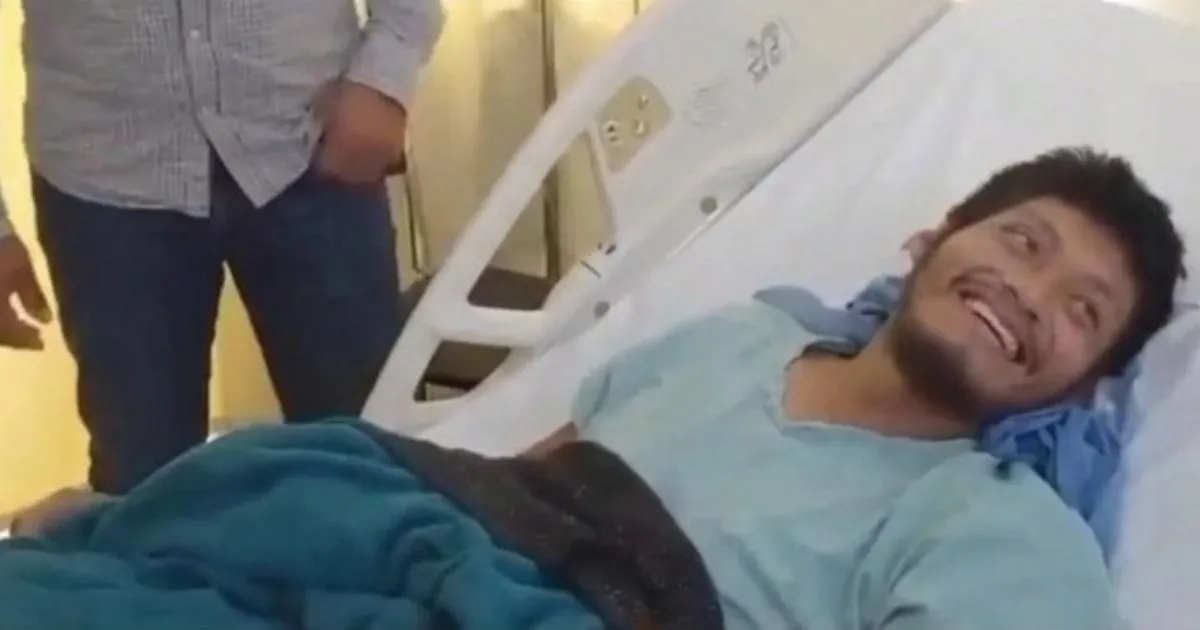
Finally, after hours of painstaking work, sunlight broke over the edge of the cenote, and Erasto Crisanto Valdez emerged from the water, gasping as the warm, brilliant Mexican sun hit his skin for the first time in fifteen days. His body was ravaged—severely dehydrated, suffering from malnutrition, his skin pale and wrinkled, his muscles wasted—but he was alive. He was wrapped in blankets and rushed to a hospital, where he was treated for his condition. As he recovered, the story of his survival spread like wildfire, a testament to the sheer resilience of the human spirit. “Thank you God for giving me another opportunity in life and allowing me to see my children and my family,” he told reporters, tears streaming down his face as he was reunited with his loved ones. His