
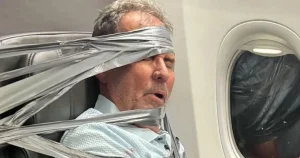

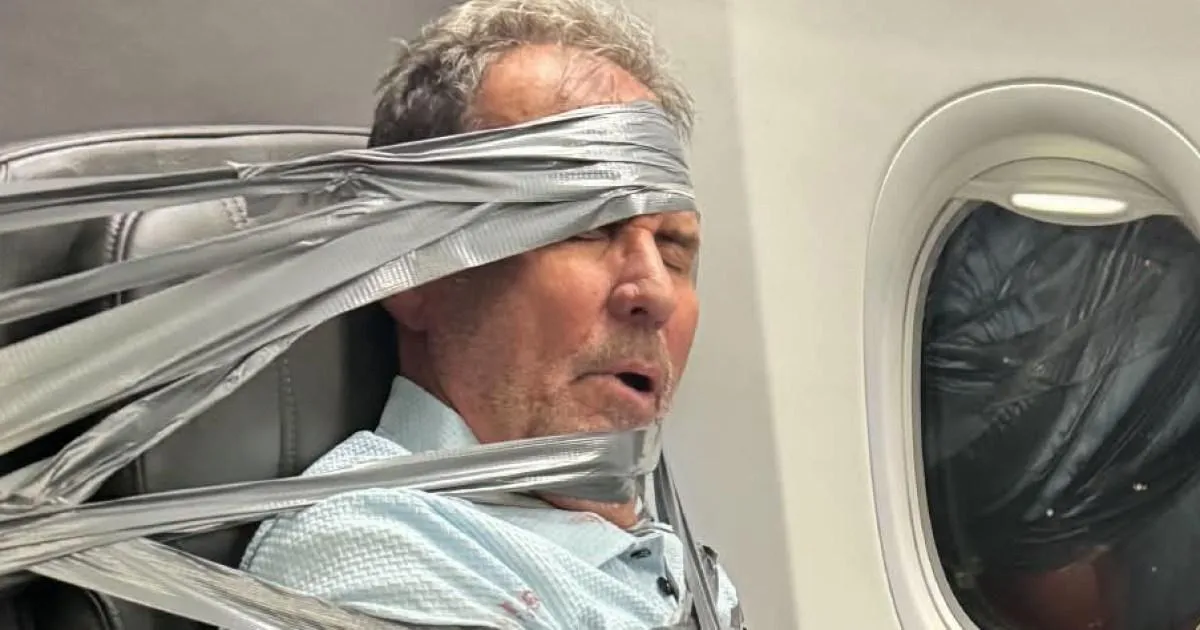
It was supposed to be a routine flight, the kind millions of people take every year without a second thought. A short hop from Dallas to Newark on American Airlines, with passengers settling into their seats, flight attendants preparing for service, and the familiar hum of engines filling the cabin. But somewhere above the American landscape, that ordinary journey unraveled into chaos. On September 3, flight 618 became the scene of a disturbing outburst that would force the pilot to divert the plane to Baltimore/Washington International Thurgood Marshall Airport, where police were waiting on the tarmac. At the center of it all sat Layne Arthur Lundeen, a 67-year-old real estate agent, now accused of turning a cramped airplane cabin into a space of fear and hostility. According to authorities, Lundeen unleashed a tirade of racist and homophobic language, shouted profanities at passengers and crew, and eventually struck a female passenger in the arm. When officers boarded the aircraft, they found him restrained with duct tape across his upper and lower body, his hands secured with zip ties—a vivid, almost surreal image that underscored how desperate the situation had become. By the time the dust settled, Lundeen had been arrested, charged with second-degree assault and disorderly conduct, and removed from the flight in front of fellow passengers who would likely never forget what they had witnessed.
For Lundeen, the consequences of that afternoon were swift and severe. He is an estate agent, a profession built on trust, personal rapport, and the ability to navigate delicate negotiations with grace and patience. Yet within days, his employer had decided that his behavior was indefensible and terminated him. The professional fall was immediate; the personal damage was only beginning to surface. According to the police report, the scene inside the plane had been tense and volatile long before law enforcement arrived. Lundeen had allegedly used the N-word against a member of the cabin crew, a slur so charged and hateful that it stunned those who heard it. The flight staff and passengers were forced to improvise, using duct tape to subdue a man whose behavior had become increasingly unpredictable and aggressive. It is not every day that airline personnel resort to physically restraining a passenger, and the use of zip ties and tape suggests a level of fear and urgency that cannot be overstated. Police later alleged that even after being freed from those restraints, Lundeen struck an officer in the chest—an action that, if true, would escalate an already serious situation into a direct confrontation with the very people who had been called to help. For a man in his late sixties, someone who had likely spent decades building a reputation and a livelihood, the speed with which his life unraveled is almost dizzying.
The court hearing the following day in Annapolis offered a strange, almost surreal window into Lundeen’s state of mind. Seemingly bewildered and disoriented, he told the district court commissioner that he had no memory of the events that had led to his arrest. “I don’t remember any of what happened,” he said, according to audio of the proceeding obtained by the Baltimore Banner. The words hang in the air with an unsettling ambiguity. Was this a genuine blackout, a dissociative episode, or a strategic claim designed to blunt the force of criminal charges? No one can say for certain, and the law will have to wrestle with that uncertainty. At one point, as the charges were read aloud, Lundeen seemed unable to fully grasp what was happening. “I assaulted a police officer? Is that what it says? I don’t have glasses,” he asked, his confusion painfully apparent. He did acknowledge drinking, admitting that he had consumed “two screwdrivers” before the flight—a detail that, while not an excuse, offered some possible explanation for the memory gaps and erratic behavior. Then came the moment of raw, human realization: “Oh my God. What a mess… I don’t remember any of it.” In that brief fragment, we catch a glimpse of a man confronting the ruin of his own life, even if the haze of alcohol or shock prevented him from fully comprehending the details.
But the allegations, if proven, paint a darker picture than a confused elderly man caught in an unfortunate lapse of judgment. Police contend that Lundeen’s behavior on the plane was not a quiet slip but a sustained, aggressive outburst that terrorized those around him. The moments leading up to the restraint were reportedly filled with profanities and racial slurs, language that has no place in any public setting, let alone in the confined, pressurized environment of an airborne aircraft. A female passenger was allegedly struck on the arm, a violent act that transformed a verbal disturbance into a physical one. Flight attendants, already stretched thin by the demands of modern air travel, had to make split-second decisions to protect their other passengers. The sight of duct tape stretched across a man’s body is not a normal part of aviation safety procedures; it is a last resort, a desperate measure taken when every other option has failed. Those who watched from their seats likely endured a rollercoaster of fear, anger, and disbelief. The passengers on flight 618 will carry this experience with them, their memories of a routine journey replaced by an unplanned landing, a police presence, and the sight of a screaming man being physically subdued. For the crew member targeted with the slur, and for the passenger struck on the arm, the trauma may be even more lasting.
This incident is not isolated, and that is perhaps the most troubling part. In recent years, airlines and federal authorities have seen a troubling surge in unruly passenger behavior, much of it documented in videos that spread across social media within hours. Arguments over masks, alcohol-fueled outbursts, and political confrontations have turned the skies into a pressure cooker. The Federal Aviation Administration has pursued stricter penalties, and airlines have banned unruly travelers with increasing frequency. Yet the problem persists, reminding us that air travel is not just a logistical operation but a deeply human one, where cramped spaces, limited service, and the stress of travel can spark explosive reactions in people who, on the ground, would never dream of behaving so badly. Lundeen’s case fits into this larger pattern, but it also carries a unique weight because of the hateful nature of the language involved. The use of racial slurs elevates the incident from simple disorderly conduct to something far more corrosive. It speaks to a deeper failure of empathy and restraint, a moment in which whatever boundaries a person once had simply dissolved. For his attorney, Anatoly Smolkin, there has been no public comment. Lundeen himself has not offered a fuller explanation, only those halting words of memory loss. The court proceedings will unfold in the coming months, producing a legal verdict. But the social judgment has already been rendered, in the court of public opinion, where videos and news reports have turned Lundeen into another cautionary tale of how quickly a lifetime of reputation can be undone.
What remains is a story about a fall from grace, but also a story about accountability, memory, and the possibility of redemption. Lundeen’s claim that he remembers nothing is both a legal defense and a human tragedy. If he truly does not remember, he is left in the strange position of being told that he committed acts he cannot visualize, condemned by a version of himself that exists only in the testimonies of others. That must be a deeply disorienting experience, even for someone whose anger or intoxication may have helped create the situation. But a lack of remembrance does not erase the harm done to others. The passengers and crew are left with memories that will not fade. The woman allegedly struck in the arm did not ask to be part of this story. The flight attendant subjected to a slur did not sign up for that kind of abuse. They are the ones whose lives were disrupted, whose sense of safety was violated. Whether Lundeen’s punishment is a fine, probation, or something more severe, the true measure of this incident will not be found in the courtroom alone. It will be found in the quiet moments afterward, in the regret that may settle over a man whose career is gone and whose name is now attached to a national news story. It will be found in the conversations among family members trying to understand what happened. It will be found in whatever steps Lundeen takes, if any, to confront the reasons behind his outburst and make amends. In the end, this is not just a story about an unruly passenger. It is a story about how ordinary people can, in a single moment, become strangers to themselves—and how the rest of us, whether we are on the same plane or simply reading the news, must decide what we do with that knowledge.