



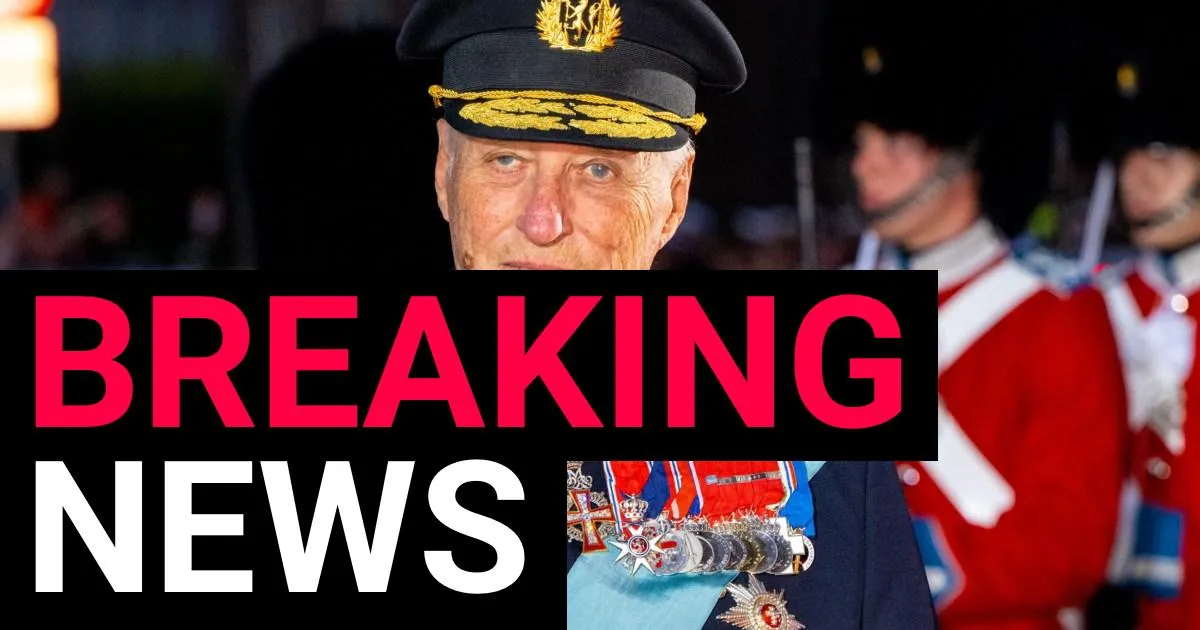
On a late August morning, with the low sun creeping over Oslo Fjord, the news that thousands had quietly dreaded finally arrived. King Harald V of Norway had died at the age of 89. The palace’s announcement was careful and tender: he had passed away peacefully at 6.35am local time at the national hospital in Oslo, after a period of deteriorating health. For years he had been treated for a rare blood condition, and although the public had grown used to seeing him recover with the same stubborn grace he brought to everything, this time the end came softly. The silence that followed was not just institutional; it was shared by people who had known him as more than a monarch. Norwegians had watched him age in public for decades—walking through the snow with a stick, smiling through official ceremonies, waving from the palace balcony in a way that seemed less like duty than genuine affection—and they loved him all the more for it. When the British royal family learned of his death, King Charles issued a personal and heartfelt statement. He called Harald his “dear cousin,” saying he and his wife were learning of the loss with “the most profound sadness.” He remembered Harald’s “unwavering dedication,” his “warmth and humility,” and his service to Norway over thirty-five years. Those were more than formal words. They were the observations of a man who had grown up in the same royal world, attended the same ceremonies, understood the weight of a crown, and could see the humanity beneath it. Harald’s son, Haakon, now stepped into his first moments as King Haakon VIII. But before the nation looked forward, it needed to look back—at a life that had been both extraordinary and remarkably ordinary, a life that belonged to a family yet somehow also belonged to everyone.
Harald’s story begins in a moment of hope that almost defies imagination. Born in 1937, he was the first prince born in Norway since the fourteenth century, a child who appeared as if sent to renew a monarchy still finding its place in a young, independent nation. The joy, however, was short-lived. When Harald was barely two years old, war crashed over Europe and German forces invaded Norway. The royal family was forced to flee, and the little prince experienced something that most people would never associate with royalty: displacement, fear, and exile. He spent part of his childhood in the United States and Britain, far from the fjords and the palaces that were meant to be his inheritance. His grandfather, King Haakon VII, had refused to surrender to the occupying forces, becoming a symbol of Norwegian resistance from abroad. That memory never left Harald. He knew that monarchy was not something you were born into; it was something you had to deserve, and sometimes it was something you had to sacrifice everything to protect. When the war ended and the family returned to Norway, Harald carried with him a deep sense of what his country had endured. He studied at Oxford, wore the ordinary clothes of a student, and learned to live among strangers without relying on his title. Perhaps most importantly, he fell in love with the sea. He was a competitive sailor, representing Norway at the Olympic Games, and in those moments out on the water he was not “Your Majesty” or even “Crown Prince Harald”—he was just a man with a sail, a wind, and a stubborn hope. That early life shaped him in ways that would become visible to everyone later: a reserved but warm demeanor, an ability to listen, a refusal to take his good fortune for granted.
When Harald inherited the throne in 1991, after the death of his beloved father, King Olav V, he stepped into a country that was changing faster than ever. The Cold War was over, Norway was discovering new wealth, and the old certainties of nations and monarchies were being questioned. Harald could have chosen to hide behind protocol, to become a distant and decorative figurehead. Instead, he chose to be a king for all Norwegians. Over his thirty-five-year reign, he guided the monarchy through shifting attitudes and extraordinary events, always with a quiet steadiness that felt more like a hand on the tiller than a hand on the helm. He was known for his humility. He took public transport, refused to be treated as superior to ordinary citizens, and spoke openly about the fact that he was, in the end, just a human being. That humility endeared him to a nation that values equality above almost everything else. He did not try to be big; he simply tried to be present. When tragedy struck—whether natural disasters or national shocks—he was there, sometimes without words, just his presence, a kind of quiet comfort that made people feel less alone. He also faced his own health struggles with the same honesty. Over the years, he endured surgeries and hospital stays, and each time he returned to public life with a grateful smile. His body was fragile at times, but his commitment was never fragile. He once admitted, in his characteristic way, that he was just trying to do his best. That simple honesty may have been his greatest political skill. He did not promise miracles; he promised loyalty, and he kept that promise with every step he took.
Perhaps nothing humanized Harald more than his long and patient romance with Sonja Haraldsen. When they met, Sonja was a young woman from an ordinary background, and the royal court was not ready to accept her. For nine long years, Harald refused to give her up. He was told that marrying her could be a problem for the monarchy, but he answered, in words that have since become legendary in Norway, that if he could not marry her, he would never marry at all. Eventually, love won. In 1968, Sonja became his wife, and she later became a queen who is as beloved as the king himself. That love story transformed the Norwegian monarchy, because it proved that the crown was not only a symbol of tradition but also of the human heart. Together they raised two children, and although the family faced its share of public scrutiny and private sadness, they remained close. Harald’s passion for sailing stayed with him through his whole life. He competed in the Olympics in three different years, long after he had become a crown prince, and he sailed with a joyful determination that reminded everyone that kings are not robots. He loved art, music, skiing, dogs, and long walks by the water. These small details matter, because they made him accessible. He was not a man who lived above the clouds; he was someone who stepped onto the same pavements as everyone else, who tasted the same sea air, who laughed at the same jokes and felt the same grief. That is why his death feels so intimate to so many people. It is the loss of a person, not just the loss of an institution.
King Charles’s message of condolence did more than fulfill diplomatic duty; it acknowledged a deep and living connection between two kingdoms. He spoke of the particularly close historical and family ties between Britain and Norway, noting that the United Kingdom was one of the first countries to recognize Norwegian independence and establish diplomatic relations in 1905. Those are the kinds of facts that live in history books, but they became real during the Second World War, when Norway’s exiled government found sympathy and support in Britain, and the resistance spirit of both nations were bound together in the fight against tyranny. Charles described the bonds that were strengthened in those dreadful trials and said they helped to tie the two countries together. When he offered his condolences to Queen Sonja and all Harald’s family, he spoke not just as one monarch to another, but as a cousin mourning a cousin. The emotional weight in his words was unmistakable: “As Norway mourns the loss of so towering a figure, my whole family join in remembering a much-loved kinsman and friend whose kindness, compassion and deep sense of duty echoed from across the sea and across the decades.” That phrase—“across the sea and across the decades”—is the perfect way to describe Harald’s life. He belonged to Norway, but he also belonged to a wider world of shared history, shared blood and shared values. His death is not a distant event watched from abroad. It is a moment of grief that touches people in Britain just as it touches people in Norway, because the royal families are woven together, and their stories are part of the same fabric.
Now the crown passes to Harald’s son, Haakon, who becomes King Haakon VIII, and later today a council of state will gather to formalize the change. The ceremony is necessary, but it cannot fill the empty space left by the old king. For Norway, this is a moment of both mourning and renewal. Harald’s reign lasted thirty-five years, and in that time he became something more than a constitutional figure. He became the improbable guardian of a small nation’s soul, a man who could greet a prime minister with the same easy warmth he offered a fisherman or a schoolchild. As the tributes pour in from around the world, the most meaningful tribute may be the quiet grief of ordinary people who never knew him personally but still feel they have lost someone they loved. They are not mourning a distant ruler; they are mourning a familiar face, an enduring presence, a man who waved at them through crowds, who sent a letter when they were ill, who stood in the rain at memorial services, who offered his country the best of himself. King Charles’s final words—“Britain shares in Norway’s grief at this time of such heartbreaking loss”—remind us that death is one of the few things that makes all people equal, even kings. Harald once said that he was not sure he had been a good king, but the nation knew better. He was a good man, and that made him a great king. As the fjords return to their stillness and the palace flags drop to half-mast, the memory of Harald V sails on, not as a monument of stone, but as a living reminder of kindness, humility, and the quiet courage of a man who loved his people with all his heart.