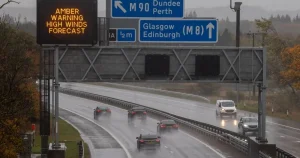



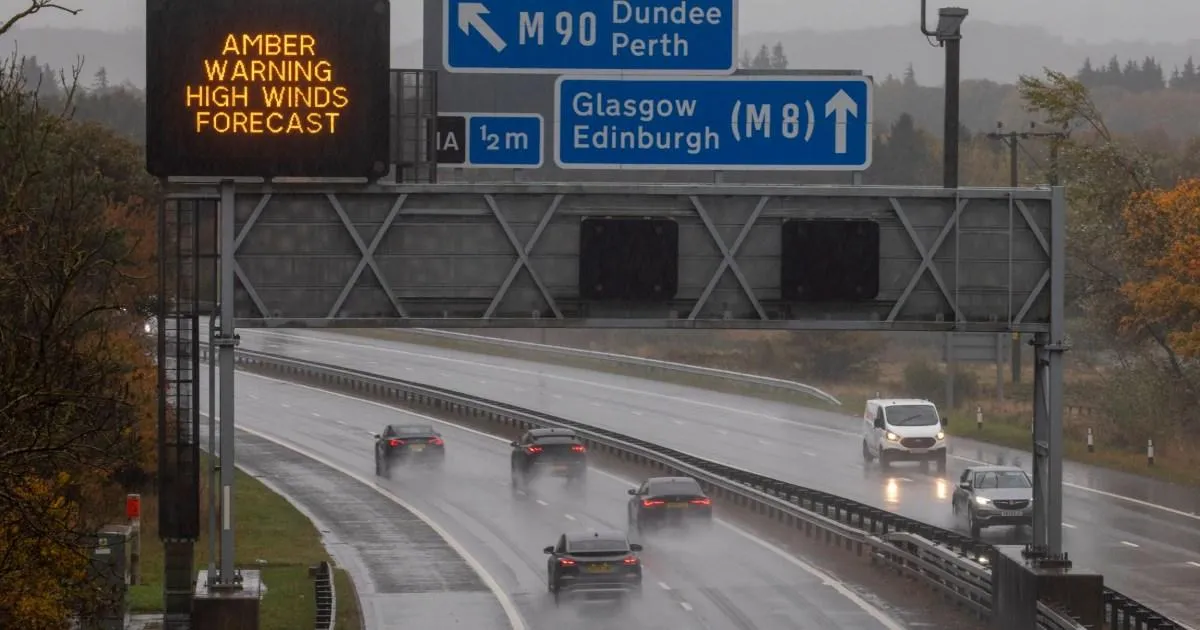
Just as the UK was beginning to catch its breath after the chaos of Storm Austen, the message from forecasters and officials is now clear: there is no time to rest. The second named storm of the season, Storm Boelo, is already bearing down on British shores, and while Austen’s worst impacts were felt in the far south, across northern France and the Channel Islands, Boelo is set to take a very different path. This time, it is Scotland and the northern parts of the UK that are in the firing line, with the Met Office issuing an amber wind warning that stretches from later today all the way through tonight and into the end of Sunday. For anyone who lived through the power cuts and travel chaos of the past few days, the timing feels almost cruel. Thousands of homes were left without electricity after Austen tore through, and Friday night saw engineers from the National Grid working at full stretch, battling the elements to restore power to more than 60,000 homes. You can almost picture those households: flickering candlelight in kitchens, families wrapping duvets around themselves on sofas, parents trying to reassure children as the wind howled outside. And now, just as the kettle was finally starting to boil again, another storm is lining up to make its own mischief.
The Met Office’s Tom Morgan has been at pains to explain the shift in weather patterns, and his words paint a vivid picture of what lies ahead. Whereas Storm Austen’s fury was concentrated on the south of the UK and the near continent, Storm Boelo will be a northern affair, bringing with it strong winds that could locally gust in excess of 80 miles per hour. That is not just a mildly inconvenient breezy day; that is the kind of wind that rips tiles off roofs, sends wheelie bins cartwheeling down streets, and turns a simple commute into an obstacle course of fallen branches and overturned lorries. Mr Morgan warned of “widespread travel disruption” across Scotland, with possible knock-on effects in the northern parts of Northern Ireland and the far north of England over the next 24 to 36 hours. For people planning to travel, this is the kind of forecast that makes you rethink everything. Should you drive? Is the train going to be cancelled? Will the ferry sail? These are the questions rattling around millions of minds. The amber warning itself is significant, suggesting that the conditions are not just a matter of needing a good coat, but a genuine hazard. Road closures, delayed or cancelled flights, and power outages are all realistic possibilities. There is a strange, familiar rhythm to these moments in British life: the national obsession with the weather suddenly becomes deadly serious, and the usual small talk about rain turns into a practical survival checklist.
The wider picture on Saturday is one of very wet and windy conditions across much of the UK, and yet there is a sliver of hope for England and Wales as Sunday approaches. Forecasters suggest that a brighter, sunnier picture will emerge for many southern areas, a welcome break after days of grey skies and stormy seas. But the rain itself is not unwelcome. In a comment that might surprise those who only see rain as an inconvenience, Tom Morgan noted that “we do need the rain desperately,” particularly in the south of the UK, which spent the summer gripped by severe drought. There is something bittersweet about that. A summer of record heatwaves and parched lawns has given way to autumn storms, and the rain that was once so badly missing is now arriving with a vengeance. This is exactly the kind of irony that climate scientists have been warning about for years: human-driven climate change disrupts rainfall patterns and drives more extreme weather events, meaning the UK lurches from drought to deluge with barely a pause in between. We saw it this summer, when successive heatwaves broke records and left reservoirs dangerously low. Now we are seeing the other side of the coin. The landscape cannot win. One minute it is cracking from the dryness; the next it is being battered by violent winds. It is a stark reminder that the natural world is not a gentle backdrop to our lives, but a powerful force that we ignore at our peril.
The political dimension has not gone unnoticed either. On Friday, the Prime Minister warned that the UK could face “a winter of greater flooding,” and spoke of living in a world where “unexpected events” are more common. It is a sobering statement, not least because it comes from a leader not usually prone to dramatic pronouncements. But the truth is that his words will resonate with anyone who has watched the news over the past few days. Flooded roads, collapsed sea walls, and homes left without power are no longer rare events to be gasped at and quickly forgotten. They are becoming part of the fabric of British life. The Prime Minister’s warning is not just about the practicalities of flood defences and emergency response; it is also about a psychological shift. We are being asked to accept that the world our grandparents knew, a world with stable seasons and predictable weather, is not the world we live in now. Every storm becomes a test. Every forecast becomes a source of anxiety. And yet, in true British style, there is also a sense of grim determination. Communities rally, neighbours check on elderly residents, and volunteers pile sandbags into place. The prime minister may be talking about strategic preparedness, but the real resilience is happening at street level, in the small acts of kindness that get people through the worst of it.
When you look closely at the damage left behind by Storm Austen, the human cost becomes clear. At one stage on Friday, in the South West alone, 31,000 homes were without power. That is not just a statistic; it is 31,000 families trying to cook dinner, 31,000 people unable to charge their phones, 31,000 households worrying about freezers defrosting and medical equipment losing charge. Planes had been cancelled, leaving passengers stranded and holiday plans in ruins. And in a moment that seemed to capture the fragility of our built heritage, part of the historic West Pier in Brighton collapsed into the sea. That pier, which has stood for over a century as a symbol of seaside joy and Victorian engineering, was slowly eaten by the waves. For many, it will feel like losing an old friend. The image of it crumpling into the water is heartbreaking, a reminder that the storms we face are not just inconveniences to be moaned about and then forgotten. They are events that reshape our coastline, test our infrastructure, and leave lasting scars on the places we love. It is easy to talk about storms in terms of pressure systems and wind speeds, but the reality is far more personal. It is about the elderly woman in a ground-floor flat watching water seep under the door. It is about the young family whose car is crushed by a falling tree. It is about the seaside town watching its history tumble into the sea.
In the midst of all this, there is a quiet heroism in the work of the engineers and emergency crews. Amy Webb, chief operating officer at National Grid Electricity Distribution, spoke for many when she acknowledged how difficult it is to be without power, particularly during severe weather. Her words were measured but empathetic: engineers are out across the affected areas, working to repair the damage and get customers back on supply as quickly and safely as possible. She also offered a simple but crucial piece of safety advice: if you see a fallen power line, a damaged pole, or anything else that looks wrong, stay well clear and call 105 straight away. It is the kind of advice that can save lives, and it bears repeating. Far too often, people think they can help by moving a branch off a cable, not realising that the line is still live. The message is clear: there is a difference between being helpful and being reckless. As the country faces another 24 to 36 hours of violent weather, the best thing most of us can do is stay home, keep safe, and let the professionals do their jobs. There is an odd intimacy to these moments. The storm strips away our usual routines and forces us to slow down, to listen to the wind, to check on the people we love. We may not be able to stop Storm Boelo, and we certainly cannot control the climate that is making these events more frequent. But we can weather them together, with patience, kindness, and a stubborn refusal to let the wind win. The storm will pass, the lights will come back on, and eventually the sun will shine again. Until then, hold on to something solid, keep your phone charged, and remember that whatever the weather throws at us, we are all in it together.