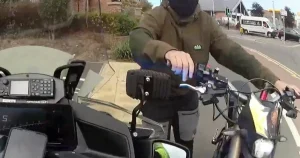


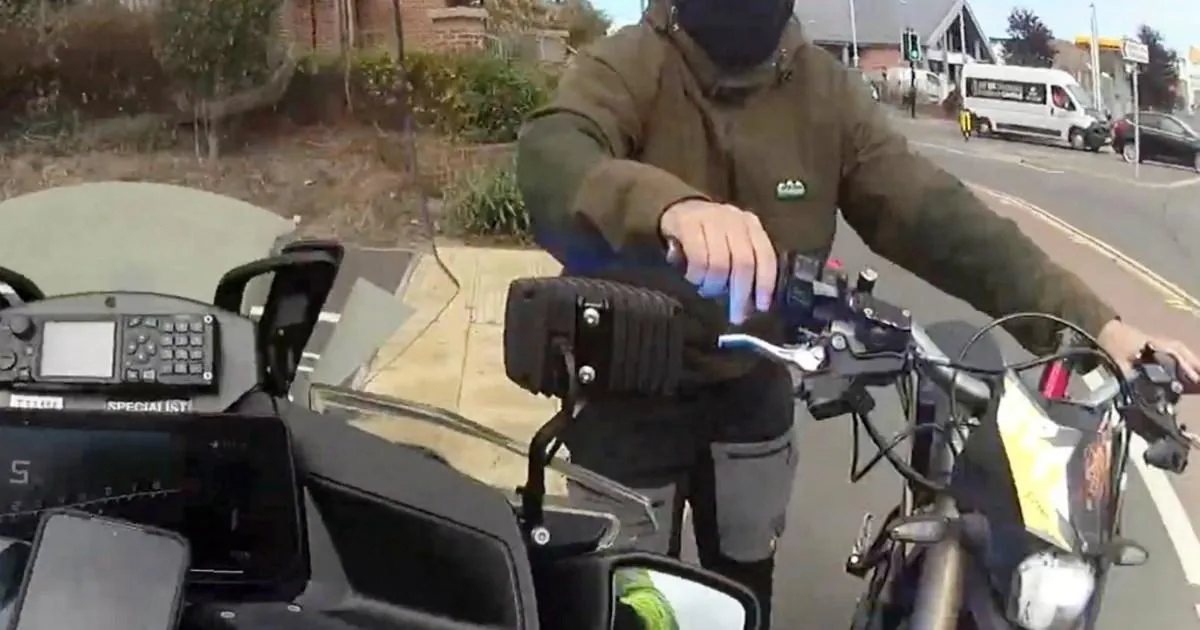
Bobby Duxfield, a 21-year-old man from Darlington, must have believed he could slip through every net the authorities cast. For forty minutes, he turned a busy town into his personal racetrack, weaving through parks, residential streets, and main roads on a powerful Surron e-bike while police officers scrambled to keep up. What began as an attempt to stop him over a report that a dog walker had been threatened with a machete on Hutton Avenue quickly escalated into a dangerous pursuit that could have ended in tragedy. Officers in cars and on foot tried to box him in, but Duxfield kept going, dodging traffic and pedestrians, even losing his shoes at one point before accelerating along the A66. At last, after what must have felt like an eternity of adrenaline and fear, police deployed a stinger device that shredded the e-bike’s tyres and forced him to stop. The chase was over, but for Duxfield, something far more serious was just beginning. As he stood on the side of the road, breathless and shoeless, surrounded by armed officers, the reality of his situation slowly started to sink in. Bodycam footage captured the moment his smirk began to fade as officers listed the charges against him: drug dealing, carrying a weapon, driving offences. It was the kind of moment that separates the person you pretend to be from the person the world now sees—and for Duxfield, that divide was suddenly very, very narrow.
What makes this story so striking is the strange mix of arrogance and denial that poured out of Duxfield in the moments after his arrest. Even with his hands in cuffs and his bike disabled, he seemed to think that maybe, just maybe, he could talk his way out of it. He joked with the officers who had chased him, comparing the pursuit to a hunt and himself to a little hare. “You were coursing us like a little hare man!” he said, almost impressed. “You got us like, I’ll give you that. Fair play to you. I wish you’d leave us to it.” The officer’s reply was cold and dry: “I love leaving people to their criminal activity.” It was a line that punctured the lightness of the moment. Duxfield was not a friend sharing a laugh; he was a suspect being arrested, and the officers were not playing games. Then the search began, and a thick wad of £20 notes was pulled from his pocket. The tone shifted even further. Duxfield looked at an armed officer and asked the question he had probably been avoiding: “Am I going to jail?” The answer was immediate and absolute. “Oh, 100%, you’re going to prison,” the officer told him. “Even with the prison crisis, I’d put my mortgage on you going to prison.” For the first time, the mask cracked. Duxfield’s response was a quiet, defeated “F*** my life,” followed by a nervous joke about not having to arrange his own transport to the cell. It was a small, human moment inside a story full of danger and poor decisions—a glimpse of a young man who had spent so long acting invincible that he had forgotten what it felt like to be vulnerable.
The chase itself was reckless beyond words, and it is only by sheer luck that no one was killed. Duxfield tore through Darlington on an electric bike that was never designed for such chaos, ignoring red lights, swerving around pedestrians, and forcing drivers to slam on their brakes. A police helicopter was scrambled to track him from above, its camera providing a chilling bird’s-eye view of the pursuit. At one point, a police car came within inches of cutting him off, and in the scramble Duxfield lost his shoes, yet he still managed to speed away, his bare feet somehow finding the pedals as he fled along the A66. He passed through parks where families were walking, past homes where children were playing, and along busy roads where a single mistake could have caused a multi-car pileup. The danger was not hypothetical. A man walking his dog had already been threatened with a machete that day—that was the reason police were after him in the first place. And when the chase finally ended, officers recovered exactly the kind of evidence that turned a traffic stop into a major criminal case: a large machete, a stash of cocaine, and £1,320 in cash. This was not a joyride gone wrong. This was the everyday reality of drug dealing in a British town, with all its violence, fear, and twisted logic laid bare on camera.
When Duxfield appeared at Teesside Crown Court, he had no choice but to face the consequences of his actions. He admitted a string of offences, including drug dealing, carrying an offensive weapon, and driving without insurance. The judge did not show leniency. Duxfield was sentenced to three years in prison and banned from driving for three years. For a 21-year-old, that sentence marks a massive crossroads. He will miss birthdays, relationships, perhaps the birth of a child, and countless ordinary moments that most people take for granted. He will have time to sit with the choices he made, from the machete to the cocaine to the decision to run instead of stop. There is something almost tragic about the way he laughed and joked during the arrest, as if the whole situation were a video game or a scene from a film. But in the courtroom, there was no script, no edit, no chance to restart. The judge’s decision reflects how seriously the courts treat this kind of behaviour, especially when it involves weapons, drugs, and a pursuit that endangered the public. The prison system may be overwhelmed, but for Duxfield, there was no alternative. The officer’s “100%” prediction had become fact.
Police, unsurprisingly, welcomed the sentence. Chief Inspector Sarah Hindmarsh, from Durham Roads and Armed Policing Unit, made it clear that this was exactly the outcome officers had been working toward. “This is a great result in getting a dangerous drug dealer off our streets,” she said, “and highlights our commitment to tackling the illegal and antisocial use of these bikes.” Her words carry weight because they speak to a wider problem. Electric bikes like the Surron have become increasingly popular in recent years, but they have also become tools for criminals who use their speed and agility to escape police, weave through traffic, and make urban areas feel unsafe. Duxfield’s case is a textbook example of how these machines can be weaponised, not with metal or explosives, but with pure recklessness. “Duxfield’s riding was absolutely appalling,” Hindmarsh continued. “He put other road users and pedestrians at serious risk – it is only by chance that nobody was seriously injured, or worse, killed, as a result of his actions.” That last part is worth pausing on. Every time a police officer chases someone like Duxfield, they are making a calculation: how do we stop this person before someone dies? And every time a suspect chooses to flee, they are making a different calculation, one that values escape over life. The fact that no one was killed on that September day is not a sign of skill or luck on Duxfield’s part. It is simply chance, a random twist of fate that spared him from standing trial on far more serious charges.
The story does not end with Duxfield alone. A 17-year-old boy was also arrested and charged with being concerned in the supply of Class A drugs, possession of an offensive weapon in a public place, and possession of criminal property. Unlike Duxfield, he pleaded not guilty, and he is now due to stand trial in November. His case is a reminder that drug dealing rarely happens in isolation. There are networks, suppliers, couriers, and lookouts; there are young people pulled in by promises of money and status, only to find themselves trapped in a world where violence is the currency and prison is the destination. The teenagers and young adults caught up in these cases are not faceless criminals; they are sons, brothers, sometimes fathers, often from backgrounds where opportunities are scarce and the lure of quick cash is overwhelming. That does not excuse their choices or reduce the harm they cause to their communities. But it does make the story more human, more complicated, and more tragic. For Duxfield, the next three years will be spent behind bars, stripped of the bravado that kept him smirking through his arrest. For the 17-year-old, the uncertainty of a trial hangs over his immediate future. And for the community of Darlington, there is at least some relief that a machete-wielding, cocaine-dealing threat is off the streets for now. The officers who chased Duxfield, the dog walker who was threatened, and the pedestrians who narrowly avoided being hit can all breathe a little easier. But the deeper lesson remains: the choices we make in moments of fear and arrogance can ripple outward, affecting not just our own lives but the safety and peace of everyone around us. In the end, no amount of laughter, dark humour, or wild riding can change what Duxfield was doing. He was dealing drugs and carrying a weapon, and when the chase ended, all that was left was a shoeless young man whispering “f*** my life” as the cell door began to close.