
The evening rush at a busy Lidl supermarket in Wolverhampton turned suddenly and devastatingly tragic when a car crashed through the front entrance, leaving a man dead and several other people injured. The incident unfolded on Finchfield Hill, close to a mini-roundabout, at around 5.51pm, a time when many shoppers would have been finishing their weekly groceries or stopping by on their way home from work. West Midlands Police confirmed that the driver of the car, a man in his 30s, was pronounced dead at the scene despite the best efforts of emergency responders. What should have been an ordinary shopping trip became a scene of chaos, fear and profound loss, and the shockwaves of that moment are still being felt across the local community. For the family and friends of the man who died, the news represents an unimaginable and sudden heartbreak, made all the more painful by the fact that his death occurred in such a familiar, everyday setting. The authorities have said that his death is not being treated as suspicious, which offers some clarity but does little to soften the raw grief of a life cut short. As dusk settled over the city, the supermarket, usually a place of bright lights and routine errands, was transformed into a cautionary, sorrowful scene, and the normality of the day was abruptly stripped away.
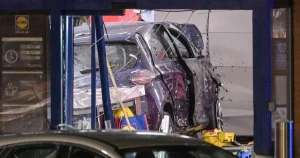
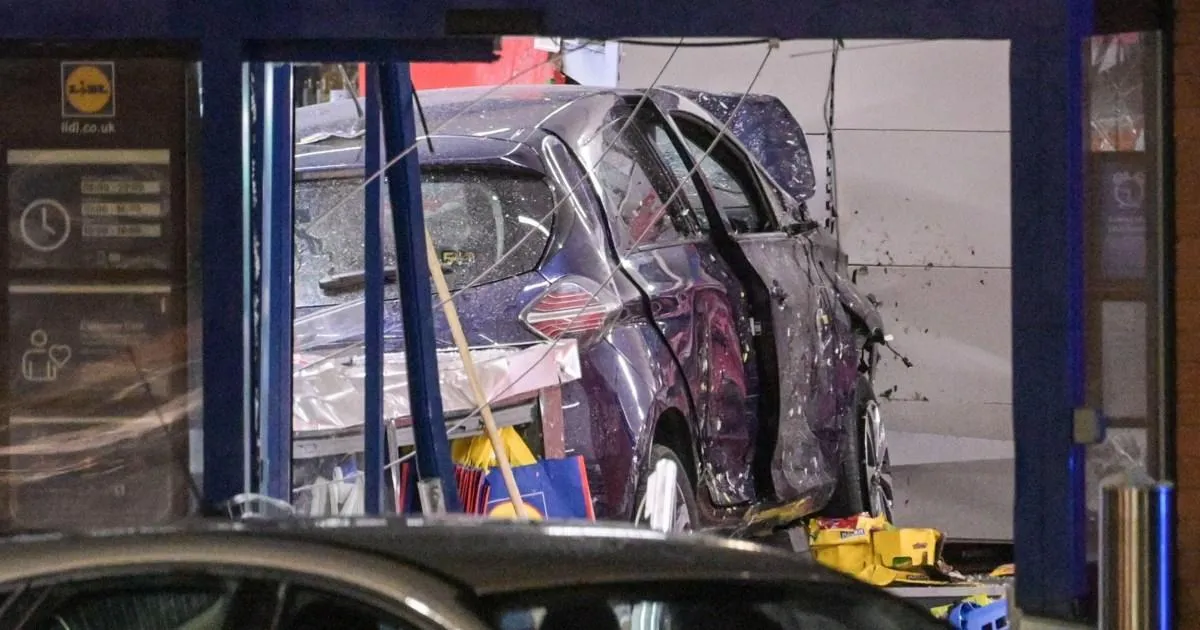
The aftermath was captured in photographs and video footage that circulated quickly across social media, painting a stark picture of destruction. The blue Renault that ploughed into the store came to a sudden and violent stop on the shop floor, its front embedded in the doorway. The building itself suffered visible damage, with the entrance torn and crumpled under the force of the impact. Around the vehicle, the debris told the story of a frightening moment: a metal bollard bent over at a severe angle, a crushed shopping trolley lying helplessly nearby, and glass fragments scattered across the floor. The presence of a large police cordon made it clear that this was no minor accident. Officers sealed off the scene and nearby roads, while blue lights from emergency vehicles added an eerie glow to the evening. The supermarket’s entrance, so often filled with the hum of trolleys and conversation, was now a forensic site where investigators would work carefully to piece together exactly what had happened. The physical evidence alone was enough to convey the immense force involved, and for anyone arriving later, the sight was both sobering and deeply unsettling. In moments like this, the everyday architecture of our lives—the bollards, the trolleys, the automatic doors—becomes part of a tragedy, a reminder that violence and loss can intrude into the most ordinary spaces without warning.
For the customers who were inside the store at the time, the experience must have been terrifying and disorienting. Video footage shared online captured the sound of alarms ringing harshly through the aisles as shoppers made their way toward the exits, stepping carefully over shattered glass and debris. There is a particular kind of fear that comes when a safe, mundane environment suddenly becomes dangerous, and the images of people moving through the wreckage suggest a stunned, hurried exit. Some may have been injured, treated at the scene for cuts, bruises or the shock of the ordeal. Others, unharmed physically, will likely carry the memory of the noise, the chaos, and the uncertainty with them for a long time. It is not difficult to imagine the confusion in those first seconds—the crash, the screech of metal, the breaking glass, the alarms, and then the urgent need to get out, to check that loved ones were safe, to make sense of what had just happened. In the days that follow, many of those present will replay the moment in their minds, wondering what they could have done differently, even if there was nothing they could have done. The psychological impact of such an event can linger long after the physical wounds have healed, and the community will need time and support to process what they witnessed.
West Midlands Police issued a statement that sought to provide information while acknowledging the depth of the loss. A spokesperson said: “A man in his 30s was sadly pronounced deceased while a number of other people were treated for injuries at the scene. The man’s death is not being treated as suspicious, and our thoughts are with his family at this sad time.” Those few words carry enormous weight, especially for the family who must now face a future without their loved one. The confirmation that the death is not suspicious will no doubt raise its own difficult questions, but it also means that the focus will be on understanding the circumstances rather than criminal intent. The police, along with colleagues from West Midlands Fire Service and the ambulance service, remained at the scene to carry out detailed enquiries, ensuring that every available piece of evidence was gathered. The phrase “thoughts are with his family” is often repeated in official statements, but here it feels genuinely heartfelt, a recognition that beneath the formalities lies a human tragedy with real, grieving people at its centre. For the other individuals treated for injuries, the hope is that their wounds are minor and that they are now recovering, but the emotional aftereffects may require care and patience in the weeks ahead.
The impact of the crash extended far beyond the immediate scene, reaching into the daily lives of everyone in the surrounding area. Roads were closed for hours, including Finchfield Hill near The Spinney, as well as Road West and Oak Hill, causing significant disruption to local traffic. Drivers were advised to find alternate routes, and those who lived nearby found their neighbourhood suddenly transformed into a place of sirens and police tape. For a community, such events are deeply unsettling, not only because of the tragedy itself but because they disrupt the sense of safety that people rely on. The sight of a familiar supermarket sealed off by cordons, with emergency services working under bright lights, serves as a stark reminder that accidents can happen anywhere. Local residents may gather in small groups, talking in hushed tones, trying to understand how something like this could occur on an ordinary weekday evening. In the midst of the disruption, there is also likely to be a quiet outpouring of sympathy for the man who died and for his family, as well as for the shoppers and staff who were caught up in the ordeal. Police have appealed for anyone with more information to come forward, asking witnesses to call 101 and quote log 4069 of 23 October, in the hope that a clearer picture of the incident can be established.
As the investigation continues, the broader meaning of this tragedy begins to settle over the community. There is a helplessness that accompanies such sudden, random losses, a feeling that lingers even after the cordons are removed and the roads reopen. The supermarket will eventually repair its doors, the shattered glass will be cleared, and the mangled trolley will be replaced, but the memory of what happened there will not fade so easily. For the family of the man in his 30s, life will be forever divided into before and after this day, and no amount of public sympathy can fill the void left in their lives. In times like this, people often search for meaning, for someone or something to blame, but sometimes the truth is simply that terrible things happen without explanation. The fact that his death is not being treated as suspicious means that this was likely a tragic accident, perhaps a moment of confusion, a medical emergency, or a simple loss of control—details that may become clearer as the investigation progresses. What remains, for now, is a profound sense of sorrow, and a shared hope that the injured will recover fully, that the family will find strength, and that the community will slowly heal. The ordinary act of going to the supermarket will never feel quite the same for those who witnessed this event, and that is perhaps the most human response of all: to carry the weight of what we have seen, to honour those who were lost, and to hold our loved ones a little closer in the quiet, fragile moments of everyday life.