
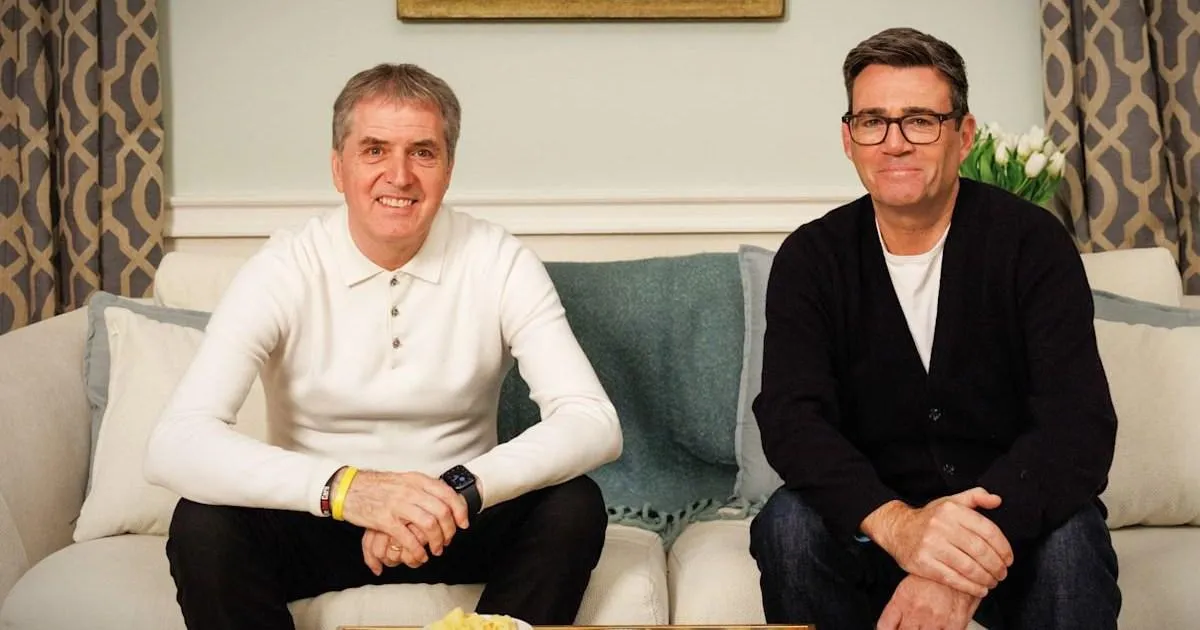
There is a particular kind of magic that happens when public figures step down from their podiums and into the everyday domestic settings that most of us recognize: the sofa, the remote control, the shared bowl of snacks, the running commentary on whatever happens to be on television. That was the scene Andy Burnham chose to embrace in the latest Stand Up To Cancer special of Celebrity Gogglebox, sitting shoulder to shoulder with his close friend and longtime political ally, Liverpool City Region Mayor Steve Rotheram. The two men have become something of a beloved double act over the years, their friendship obvious in every exchanged glance and gentle ribbing. But what might have been a straightforward, feel-good charity appearance soon found itself dragged into the rough-and-tumble of Westminster politics. Conservative leader Kemi Badenoch publicly questioned why the Prime Minister had time to film hours of television while the country faced serious challenges. In response, Burnham offered a characteristically unapologetic defence. He told reporters that he would make no apology for trying to lead with a bit of lightness, and he insisted that his decision to appear on the show was driven not by vanity but by a sincere desire to support cancer research. He framed the whole thing in simple, human terms: if a few more people watched the episode and, as a result, supported Stand Up To Cancer, then his job was done. It was a reminder that politics, at its best, is not just about policy papers and press conferences, but about reaching people where they are—and sometimes that means appearing on a Channel 4 sofa with a friend, watching television for a good cause.
Badenoch, however, was clearly not persuaded. Speaking to the Press Association earlier in the day, she said the appearance was “not my thing” and admitted she was amazed that Burnham had found the time, given that a show like Gogglebox can take hours to shoot. Her criticism was not just about the television appearance itself; she wove it into a broader attack on the government’s priorities. She pointed to the recent official advice telling Britons to stockpile food, water, and other essentials in preparation for potential emergencies, and suggested that the Prime Minister seemed more interested in appearing on television and posting on social media than in doing the difficult, unglamorous work of protecting the country. “I don’t mind them giving advice,” she said. “I worry that between the prime minister being on Gogglebox and then talking about stockpiling canned goods, they’re not actually doing the really difficult stuff that will protect the country.” She went further, portraying Burnham as someone who is “on social media all day” and claiming that if she spent her time doing the same, she would not be able to do her own job as leader of the opposition. “My job is to hold him to account,” she said, “and I’ve seen a lot of prime ministers up close, and I’ve never seen a prime minister have the time to do this much Goggleboxing, social media, and Lad Bible.” The tone was pointed, almost incredulous, as if she genuinely could not understand how a person in such a position could choose to sit on a television sofa with a friend for a charity special.
Burnham’s response, delivered with the calmness of someone who has long learned not to let criticism rattle him, was rooted in a simple philosophy. He did not try to hide from the comments or apologise for his choices; instead, he doubled down on the importance of maintaining a human connection with the public. Speaking further to BBC Radio 5 Live, he explained that the Stand Up To Cancer edition of Gogglebox had become something of a fixture in his annual calendar. “Steve and I are proud to do it,” he said, adding that he was always someone who put his shoulder behind the fight against cancer. But he also spoke more broadly about the kind of leader he wants to be. He said he is trying to give the country a lift, to offer some hope, and to approach his role in a way that does not always have to be heavy and grim. “That’s always my approach, and it’s what I’m trying to do,” he said. “It may not appeal to everybody when it comes to Gogglebox. It’s Stand Up To Cancer night, and I’ve always been somebody who puts my shoulder behind the fight against cancer.” There was no defensiveness in his voice, only a quiet, steady conviction. He seemed genuinely untroubled by the idea that people might think less of him for taking part, and in many ways, that is exactly the point. In an age when political leaders are often criticised for being robotic and remote, Burnham’s willingness to show a lighter side can be read not as a dereliction of duty but as a deliberate, strategic choice about how to communicate with the public. He is not trying to be everyone’s favourite television personality; he is trying to be a Prime Minister who feels approachable, human, and relatable without sacrificing the seriousness of the office.
Beneath all the political back-and-forth, however, there is a deeper and far more emotional layer to this story, and it is the one that matters most. In a clip released ahead of the show, Burnham can be seen tearfully reacting to the stories of people who have been diagnosed with cancer. He describes the disease as “utter devastation,” and his voice cracks as he tries to articulate the weight of what those families must be going through. “I just couldn’t imagine,” he says, sitting on the sofa next to Rotheram, the two of them for once quiet, without their usual banter. “The only thing that does give some hope is there is so much incredible research going on, and some of the main cancers of years ago, there’s been such big progress on them.” He pauses, looks down, and adds: “But it’s utter devastation, isn’t it? If you’re that couple, I don’t know how you cope with that.” For a moment, the political duel with Badenoch fades into the background. This is not about party advantage or media strategy. It is about a man who, like so many others, has been touched by the reality of cancer and who understands that the disease does not care about political affiliations or social media followings. It is a reminder that celebrities and politicians alike are not immune to the shared human experiences of fear, loss, and hope. And it is in those vulnerable, unguarded moments that Burnham’s appearance on Gogglebox stops being a PR stunt and becomes something far more genuine: an opportunity to show empathy, to stand in solidarity with those suffering, and to use whatever platform he has to shine a light on the researchers working tirelessly to find better treatments and, ultimately, cures.
The friendship between Burnham and Rotheram is a large part of why the special works as well as it does. The pair are not just colleagues; they are visibly at ease with each other, comfortable enough to be quiet together, to laugh together, and to share the occasional emotional moment without embarrassment. That ease translates beautifully on screen, and it gives the episode a warmth that is often missing from more polished, produced celebrity appearances. Rotheram, for his part, is a steady presence next to Burnham, offering supportive nods and quiet acknowledgements, never overshadowing but always present. Their relationship exemplifies the kind of camaraderie that can exist across political roles and regional boundaries, and it serves as a subtle counter-narrative to the often combative and transactional nature of national politics. In a world where every gesture is scrutinised and every word is parsed for hidden meaning, the sight of two grown men simply watching television together, being moved by the stories unfolding on screen, is refreshingly simple. It also gives the episode a credibility that a more performative celebrity appearance might lack. These are not actors pretending to have feelings for the camera; they are public figures allowing themselves to have real reactions, to be affected, and to let the audience see that they care. That authenticity is precisely what the Stand Up To Cancer campaign relies upon, because it invites viewers to connect emotionally with the cause and, in doing so, to open their hearts and their wallets.
Ultimately, the episode airs tonight on Channel 4 at 9.05pm, joining a star-studded lineup that includes actor Stanley Tucci, comedian Joe Lycett, and the Sugababes. It is, by design, a night of entertainment wrapped around a serious mission, using laughter and tears to raise money and awareness for cancer research. And while Badenoch’s comments have guaranteed the episode an extra layer of publicity, the truth is that Burnham’s appearance was never really about her. It was about showing up, in every sense of the phrase. It was about being present in the lives of people who watch television, who laugh at the same jokes, who cry at the same sad stories, and who may be fighting their own private battles with illness. Burnham’s defence of his decision—his insistence that he will not apologise for trying to lead with lightness, for connecting with people, for supporting a cause he believes in—is ultimately a statement about what kind of leader he wants to be. He wants to be someone who can sit in the rooms where big decisions are made, but who can also sit on a sofa with a friend and let the nation see him as he is. Whether that is a strength or a weakness depends entirely on one’s point of view. But for many people watching tonight, the image of a Prime Minister wiping away a tear while thinking of those touched by cancer will not feel like an abdication of responsibility. It will feel like a welcome reminder that behind the titles, the briefings, and the political battles, there is still a human being—someone who, like the rest of us, knows that the real work of any society is not just protecting the country, but caring for one another.