

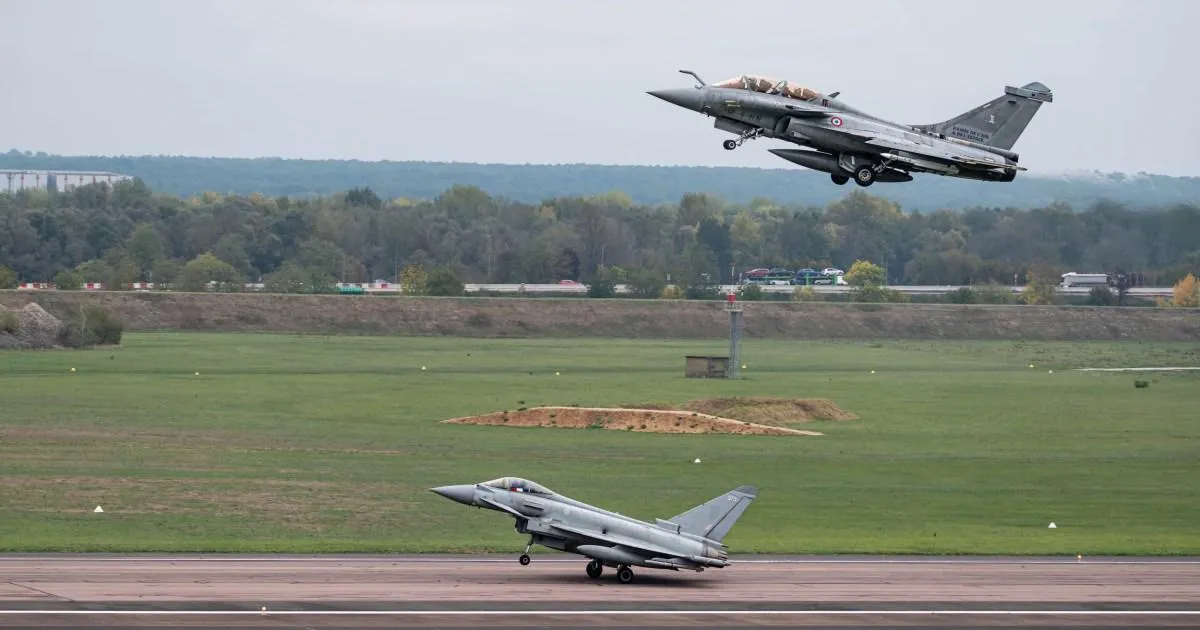
There is a strange kind of poetry in the image: two fighter jets, one French and one British, rising side by side into the dark sky above northeastern France and heading out over the Mediterranean Sea. The aircraft were not scrambling to respond to an emergency, nor were they racing to intercept an unknown intruder. They were taking part in something more patient and more deliberate: a rehearsal of the unthinkable. On Tuesday evening, for the first time in history, Royal Air Force Typhoon jets joined French Rafale fighters in a joint nuclear exercise. The operation, named Rummy, was a simulated nuclear strike mission, launched from the Saint-Dizier airbase in France. No actual nuclear weapons were carried or dropped, but the symbolism and the strategic weight of the mission were enormous. Britain and France, two nations that have spent centuries sparring with each other, were together practicing the ultimate act of national survival. In the world of nuclear deterrence, this kind of cooperation has long been considered almost untouchable — a domain so sensitive and secretive that even close allies rarely share it. That barrier was quietly broken this week, and the event may mark a turning point in how Europe thinks about its own security.
What makes this exercise so significant is not just the hardware, impressive though it is. The Typhoon and the Rafale are two of Europe’s most advanced combat aircraft, and watching them fly in formation is a reminder of the industrial and technological strength of the continent. But the real story is the choreography behind the mission. A nuclear strike mission, even a simulated one, is not simply a matter of pointing a plane at a target and pressing a button. It involves planning, communication, timing, navigation, electronic warfare, aerial refueling, command-and-control integration, and a thousand smaller decisions that have to happen in perfect sequence. For the pilots and ground crews involved, the exercise was a chance to practice all of that together, to learn how the other air force thinks, and to build a level of trust that no speech or treaty can create on its own. The fact that neither side carried live weapons does not make the exercise less meaningful. In some ways, it makes it more meaningful, because it shows that the two countries are serious about developing a shared understanding of deterrence in advance, not reacting to a crisis at the last moment. Nuclear deterrence has always been a lonely business. This week, two of Europe’s nuclear powers made it a little less lonely.
The official reactions to the exercise reflect just how important it was. Catherine Vautrin, the French armed forces and veterans minister, described the drill as a “decisive milestone” in the defence partnership between the two countries. Her words were striking in their clarity. “Having nuclear forces does not exclude collaboration,” she said. “Our nuclear co-operation with the United Kingdom does not cease to deepen: on Tuesday evening, Typhoon fighters participated for the first time in a nuclear exercise alongside Rafale fighters.” She went on to link the exercise to the broader security of the Euro-Atlantic zone, saying that by coordinating, the two countries’ nuclear forces can make an increasingly significant contribution to global security and to peace and stability in the region. British defence secretary Wes Streeting echoed that sentiment, calling the exercise a “landmark step in UK-France defence co-operation” and a clear signal that the two countries stand shoulder to shoulder with their allies on European security and credible deterrence. There is a warmth in those words that feels different from the usual diplomatic language. This was not a routine statement of alliance solidarity; it was a recognition that something genuinely new had happened. The two countries were not just agreeing on policy. They were putting their most sensitive military capabilities in the same operational space, trusting each other with the very machinery that represents their ultimate guarantee of sovereignty.
To understand why this matters, it is helpful to look at the wider European nuclear landscape. France and Britain are Europe’s two major nuclear powers. No other country on the continent has an independently developed arsenal of its own. There are American nuclear weapons stationed in Belgium, Germany, Italy, and the Netherlands as part of NATO’s shared arrangements, but the only indigenous European nuclear capabilities belong to Paris and London. This has created a unique relationship between the two countries, one that has survived Brexit, past disagreements, and centuries of rivalry. There have been moments in recent history when Franco-British relations felt strained, from debates over fishing rights to arguments about trade and migration. But defence cooperation has often remained a quiet exception to the noise of politics. The Lancaster House treaties, signed in 2010, laid the foundation for closer military coordination, including on nuclear matters, and this week’s exercise can be seen as the maturation of that relationship. It is also a reminder that, despite all the talk of European solidarity, the reality is that only two nations are able to provide a genuinely independent nuclear deterrent on the continent. Their willingness to train together sends a powerful message: that Europe’s security is not simply guaranteed from across the Atlantic, but also shaped by the decisions and capabilities of European nations themselves.
The broader strategic context makes this exercise even more meaningful. In the years since Russia’s full-scale invasion of Ukraine, European governments have been forced to rethink assumptions about security and defence. The idea that peace on the continent could be taken for granted has been shattered. NATO has responded with a renewed focus on deterrence, but Europe has also had to ask itself a difficult question: what would it do if it had to defend itself? Part of the answer lies in conventional military strength, but part of it lies in the nuclear realm. Nuclear deterrence is not about preparing to fight a nuclear war; it is about preventing one by making the cost of aggression unacceptable. Exercises like Rummy are part of that logic. They are designed to show potential adversaries that the weapons are ready, that the procedures are in place, and that the people responsible for them are capable of working together under enormous pressure. They are also designed to reassure allies and citizens that the systems meant to protect them are not just theoretical. There is a psychological dimension to deterrence that cannot be measured by warhead counts or delivery systems. It is about credibility, about perception, about the signal sent by a pair of Typhoons flying alongside Rafales over the Mediterranean. In that sense, the exercise was as much about communication as it was about military capability.
For all the high politics, it is worth pausing to remember the human dimension of what happened. Behind every jet, every flight plan, and every official statement, there are real people: pilots who climbed into their cockpits with the weight of expectation on their shoulders, engineers who spent hours checking systems and making sure everything was ready, mission planners who worked in secure rooms to coordinate every detail, and the families back home who love and worry about them. There is something almost strange about the idea of a nuclear exercise being a moment of cooperation and trust, but that is exactly what it was. The operation was named Rummy, a word that evokes card games and clever strategy, and perhaps there is something fitting in that. Nuclear diplomacy, like a good card game, is about knowing when to hold back and when to show your hand, reading the intentions of others, and building alliances that improve your chances of winning. But unlike a card game, the stakes are incalculable. What this week’s exercise shows is that even in the darkest corners of national security, cooperation is possible. It shows that two nations with a long history of rivalry can choose trust over suspicion, transparency over secrecy, and partnership over isolation. That choice does not make the world safe, and it does not eliminate the terrible reality of nuclear weapons. But it does offer a small measure of reassurance in a dangerous world. The sky above the Mediterranean may have looked ordinary this week, but the message underneath it was extraordinary: old allies, old friends, and even old rivals can find ways to stand together when it matters most.