


In the early hours of a mid-July morning, while most of south London was still wrapped in sleep, a carefully planned crime was unfolding in the unassuming streets of Tooting. Just after 3am, a group of men were busy breaking into a massage parlour on Mitcham Road, not with the intention of stealing from that business, but with a far more ambitious and audacious goal in mind. They were going to tunnel through the wall into the jewellery shop next door. The operation was methodical, silent, and intended to go unnoticed. But it did not. Police were already closing in, and what they discovered would reveal a sophisticated organised crime group responsible for burglaries totalling more than £700,000 across London. The gang members had chosen a target that required patience, tools, and precision, but they had also chosen a night that would end with one of them hiding on a rooftop, another scrambling through a nearby alleyway, and a third desperately trying to board a flight out of the country from Stansted Airport. What might have seemed like a scene from a heist film was, in reality, a bold but ultimately failed attempt to break into a jeweller’s, captured on the body-worn cameras of the officers who arrested them.
The first suspect to be apprehended was Laurentiu-Daniel Nitisoara, who was found by police in a nearby alleyway shortly after the break-in was discovered. Officers moved swiftly, and the immediate area was searched with intense focus. A second man, Ioan Asafeti, was discovered hiding on a rooftop, having apparently tried to evade capture by climbing up and away from the street-level chaos below. It was a desperate attempt, but it was not enough. The police had already secured the perimeter, and Asafeti was handcuffed and taken into custody. Later that same day, the third gang member, Sergiu Plastin, was tracked by the Flying Squad using mobile phone data. He was heading to Stansted Airport with the clear intention of fleeing the country, and had apparently booked a flight to Ireland. But his escape was cut short. Officers intercepted him at the Essex airport before he could board, and he too was arrested. It was a day of gathering up loose ends, and by the time it was over, all three men were in police custody, their carefully plotted heist reduced to nothing more than evidence, arrests, and a tunnel that would never be finished.
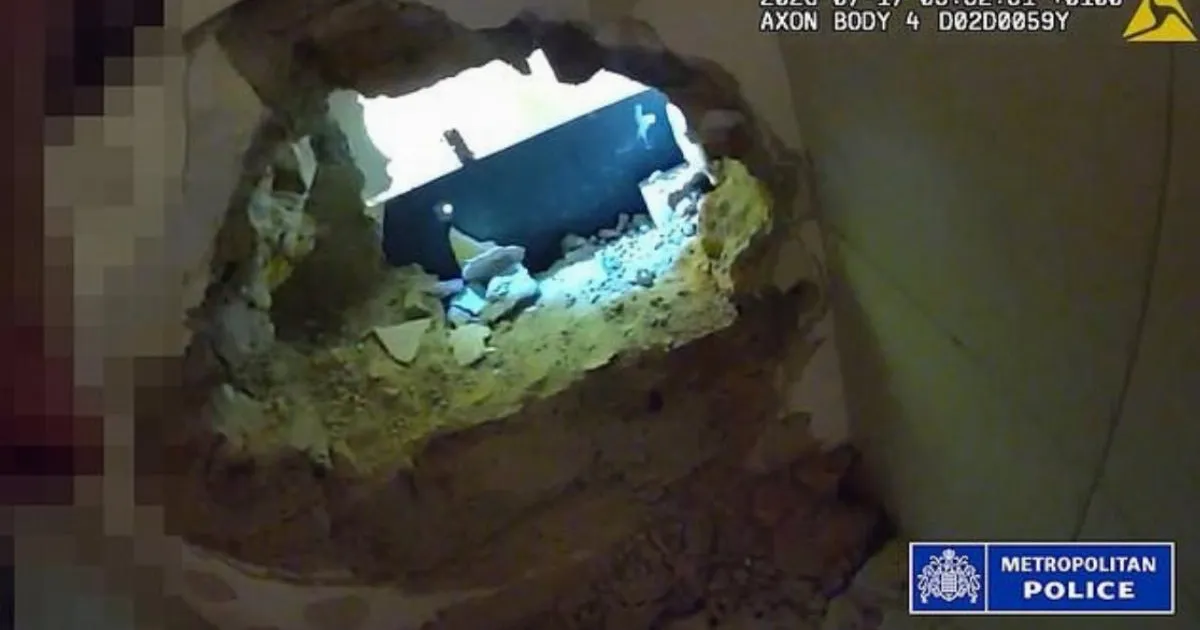
When officers examined the scene, they found clear evidence of the gang’s intentions. A tunnel had been dug between the massage parlour and the jewellery shop, a physical passageway carved out of the walls and floors that connected the two properties. The tools used for this work had been discarded nearby, leaving behind a story of hours of effort, preparation, and criminal labour. The tunnel itself stood as a silent testament to the lengths that organised criminals are willing to go to in order to reach their prize. But it also stood as evidence of their failure. The Metropolitan Police later released footage from body-worn cameras showing the inside of the massage parlour and the damage caused by the gang, offering the public a rare glimpse into the world of commercial burglary and the sheer scale of the operation. The images were stark, revealing a hole large enough for a person to crawl through, a crude but effective construction that had clearly taken time, skill, and determination to create. Yet despite all that work, the gang was caught before they could actually break through into the jeweller’s and get their hands on the valuable stock inside.
As the investigation widened, the scale of the gang’s criminal enterprise became clear. They were not simply a group of opportunistic thieves operating on a one-off basis. Instead, detectives linked them to more than £700,000 worth of burglaries from shops across the capital. This was a major organised crime group, one that had been operating with a degree of sophistication and coordination, moving from target to target and leaving behind a trail of expensive losses for business owners. The Tooting tunnel was one operation among many, and the justice system was eager to shut the group down for good. The case took an even more serious turn when inquiries were made through Interpol. It emerged that the group may have had possible links to similar offences in Europe, raising the possibility that their criminal activity stretched far beyond London’s borders. This international dimension added weight to the investigation and highlighted the challenge faced by law enforcement agencies when dealing with organised crime networks that operate across national boundaries. For the detective leading the case, the sentencing of the three men was a crucial moment, not just for the victims in London, but for the wider message it sent to criminals both at home and abroad.
The three men appeared at Kingston Crown Court, where they pleaded guilty to charges of conspiracy to commit burglary with intent to steal and cause criminal damage. They had originally entered their pleas in August, and the court proceedings that followed were the culmination of a long and detailed police investigation. Ioan Asafeti, aged 39, was jailed for four years and ten months. Sergiu Plastin, aged 42, received a sentence of three years and four months. Laurentiu-Daniel Nitisoara, aged 38, was handed a two-year jail sentence. The sentences reflect not just the seriousness of the particular offence in Tooting, but the broader pattern of criminality that saw the group linked to hundreds of thousands of pounds’ worth of burglaries. For the judge, the leniency that might usually be reserved for a first-time offender was not appropriate here. These were men who had planned a sophisticated burglary, who had gone to great lengths to evade detection, and who were part of a wider operation that had caused significant financial harm to businesses across the city. The court’s decision was met with approval from the Metropolitan Police, who were quick to highlight the significance of the result. As they prepared to move the men to prison, the officers who had worked on the case could reflect on a successful investigation that had taken one organised crime group off the streets of London.
Detective Chief Inspector Craig Magee spoke publicly after the sentencing, and his words were direct and confident. “Today’s sentencing sends a clear message: if you target London businesses, we’ll catch you, and you will face justice,” he said. It was a statement designed to reassure the public and to warn any other criminals who might be considering similar operations. The investigation was, in many ways, a textbook example of modern policing, bringing together rapid response, forensic examination, mobile phone tracking, and international cooperation through Interpol. But it was also an example of the broader effort by the Met to reduce commercial burglary across the capital. According to figures released by the Metropolitan Police, commercial burglaries fell by 10.7 per cent in the year to September, compared with the previous twelve months. This reduction was something that DCI Magee was keen to highlight. “Our crackdown on thieves is delivering results,” he said. “We’re driving down commercial burglary across the capital, with offences falling by 11 per cent in the past 12 months.” The figures were a rare piece of good news in the ongoing battle against crime, and they suggested that the strategy being used by the police was having a tangible effect on the ground. For business owners, the statistics offered some comfort, though the emotional and financial impact of a burglary is never fully measured by numbers alone.
Behind the police statements, the court appearances, and the official statistics, there is a human story that is worth pausing to consider. For the small business owners in Tooting and across London, the threat of burglary is more than just an inconvenience. It is a source of fear, anxiety, and financial strain. A break-in can wipe out years of hard work in a single night, leaving behind damaged premises, stolen goods, and a lingering sense of violation. The jeweller in Tooting, whose shop was the target of this tunnel plan, may never know exactly how close the gang came to breaking through, but the discovery of the half-finished tunnel must have been a shocking reminder of how vulnerable even the most secure-looking businesses can be. The massage parlour next door was also caught up in the ordeal, its premises damaged by criminals who had no regard for the people who worked there. In the end, the case was resolved with convictions, sentences, and a clear message from the police. But for the wider community, the resolution is about more than just punishment. It is about safety, security, and the feeling that justice has been done. The fact that the gang was caught before they could steal from the jeweller is a small victory, but an important one, and it is a reminder that behind every crime, there are real lives, real livelihoods, and real people who deserve protection. In the quiet aftermath of the trial, with the three men now behind bars, the streets of Tooting can feel a little safer, and the business owners can sleep a little more easily, knowing that a gang of determined criminals has been stopped in its tracks.