


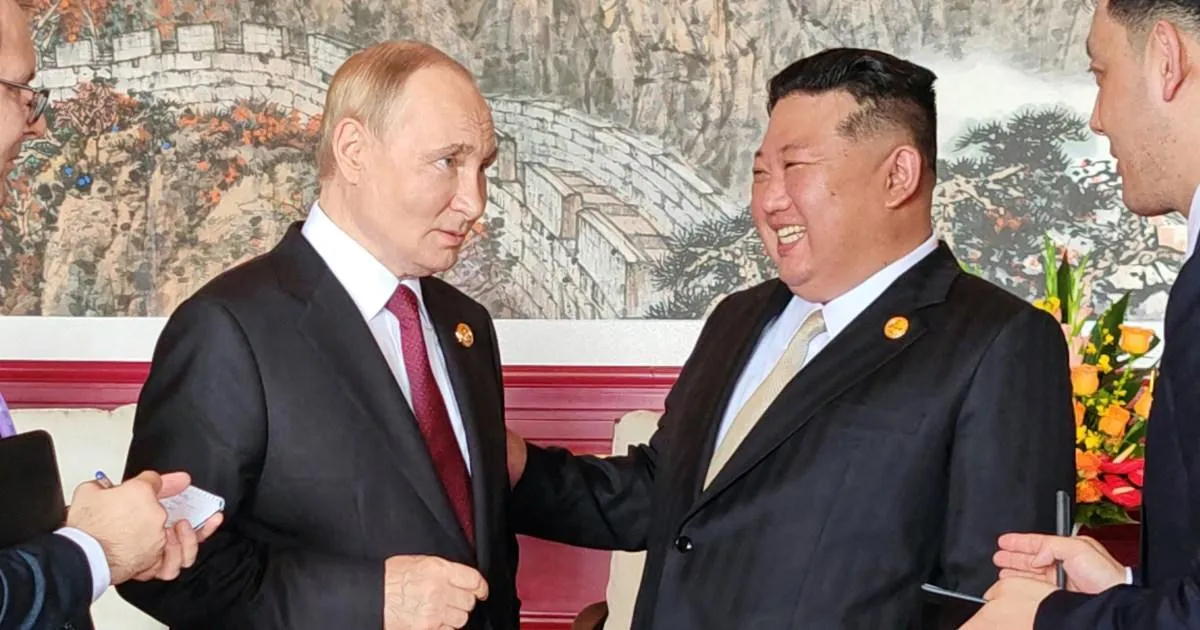
The escalating partnership between Russia and North Korea has moved into a dangerous new phase, as intelligence reports confirm the deployment of specialized North Korean missile units to the Russian frontlines. According to Andrii Cherniak, the head of Ukraine’s Intelligence Agency, this mobilization includes six sophisticated launchers and a staggering arsenal of 120 ballistic missiles. Stationed in the Voronezh region of Russia, these units are manned by approximately 90 North Korean personnel tasked with integrating this hardware into Russia’s ongoing offensive against Ukraine. This development signals a shift from mere logistical support to direct, tactical involvement in the conflict, fundamentally altering the military landscape for a country already stretched to its breaking point.
For Ukraine, the arrival of these missiles is not merely a strategic setback; it is an existential threat to its overburdened defensive networks. The Ukrainian military has been consistently warning about its dwindling supply of air defense systems, which are essential for protecting civilians and critical infrastructure. Ballistic missiles, by their very nature, are notoriously difficult to intercept compared to drones or cruise missiles because of their high-speed, parabolic flight paths. As Russia increases its reliance on these weapons—reportedly with the assistance of Pyongyang—Ukraine’s ability to “shield” its skies is rapidly diminishing, leaving cities and civilian populations increasingly vulnerable to strikes that are almost impossible to parry in time.
The reality of this alliance is already being felt on the ground, with tragic consequences for the Ukrainian people. President Volodymyr Zelensky recently highlighted that intelligence suggests a North Korean-manufactured missile was used in a lethal strike that claimed the lives of six villagers. This incident serves as a chilling preview of what a deeper tactical integration of North Korean hardware could mean for the war. Beyond the missiles, the broader logistical support provided by North Korea—including massive quantities of artillery shells and other military equipment—is actively fueling the Russian war machine, effectively outsourcing the production of violence to a regime desperate to align its interests with the Kremlin.
The scale of this cooperation is staggering, with South Korean intelligence estimates suggesting that as many as 15,000 North Korean soldiers have been deployed to Russia since last year. These forces are not just sitting in the background; Vladimir Putin has openly lauded their “bravery and heroism,” specifically in the context of pushing back Ukrainian incursions into the Kursk border region. This marks a rare and provocative instance of a modern European war being fought with the direct, boots-on-the-ground support of an East Asian totalitarian regime. The result is a more resilient and better-supplied Russian front, one that is increasingly insulated from the traditional limitations of its own domestic manufacturing capabilities.
Military analysts, such as Rob Lee of the Foreign Policy Research Institute, are deeply concerned about the long-term strategic implications of this axis. Lee emphasizes that ballistic missile defense remains one of Ukraine’s most glaring vulnerabilities. By saturating the theater with more of these high-velocity threats, Russia is essentially forcing Ukraine to exhaust its remaining interceptors at an unsustainable rate. As winter approaches, the fear is that this influx of weaponry will be used to systematically target Ukraine’s power grid once again, potentially plunging millions of civilians into cold and darkness by destroying the infrastructure that provides heat and electricity during the brutal winter months.
While the Russian Ministry of Defence and North Korean officials have remained silent regarding these specific reports, the intelligence gathered by Ukrainian officials paints a clear, if ominous, picture. The conflict in Ukraine has transitioned into a globalized struggle, where the borders of the battlefield now extend far beyond Eastern Europe, pulling in resources and personnel from the Korean Peninsula. For the people of Ukraine, the war has become a race against time and dwindling resources. As the international community watches these developments unfold, the central question remains whether Ukraine can withstand this intensified onslaught or if the marriage of Russian military ambition and North Korean firepower will prove too great an obstacle for them to overcome.